International Center for Equity in Health, Federal University of Pelotas, Pelotas, Brazil.
Postgraduate Program in Physical Education, Federal University of Pelotas, Pelotas, Brazil.
Int J Obes (Lond). 2021 Nov;45(11):2419-2424. doi: 10.1038/s41366-021-00911-5. Epub 2021 Jul 22.
To describe how overweight and wasting prevalence varies with age among children under 5 years in low- and middle-income countries (LMICs).
We used data from nationally representative Demographic and Health Surveys and Multiple Indicator Cluster Surveys. Overweight and wasting prevalence were defined as the proportions of children presenting mean weight for length/height (WHZ) more than 2 standard deviations above or below 2 standard deviations from the median value of the 2006 WHO standards, respectively. Descriptive analyses include national estimates of child overweight and wasting prevalence, mean, and standard deviations of WHZ stratified by age in years. National results were pooled using the population of children aged under 5 years in each country as weight. Fractional polynomials were used to compare mean WHZ with both overweight and wasting prevalence.
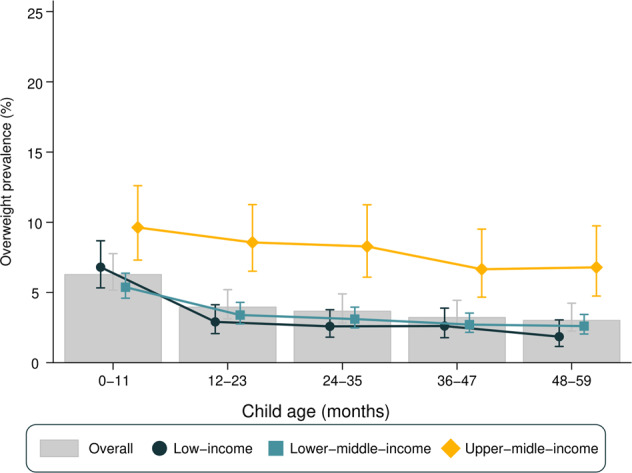
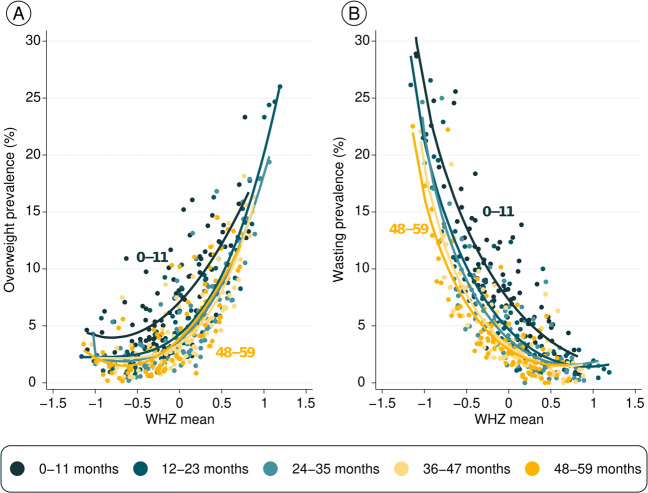
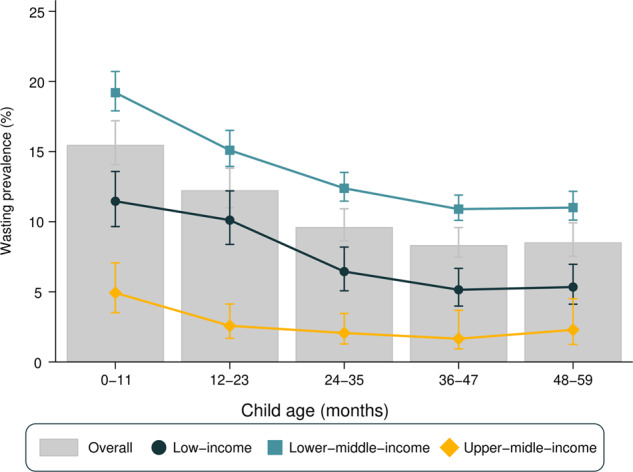
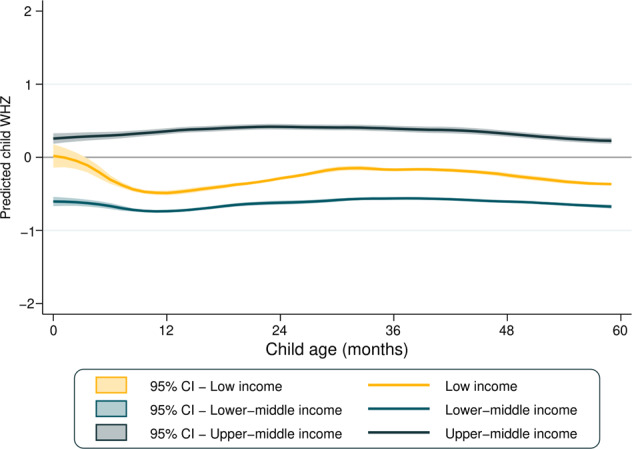
Ninety national surveys from LMICs carried out between 2010 and 2019 were included. The overall prevalence of overweight declined with age from 6.3% for infants (aged 0-11 months) to 3.0% in 4 years olds (p = 0.03). In all age groups, lower prevalence was observed in low-income compared to upper-middle-income countries. Wasting was also more frequent among infants, with a slight decrease between the first and second year of life, and little variation thereafter. Lower-middle-income countries showed the highest wasting prevalence in all age groups. On the other hand, mean WHZ was stable over the first 5 years of life, but the median standard deviation for WHZ decreased from 1.39 in infants to 1.09 in 4-year-old children (p < 0.001). For any given value of WHZ, both overweight and wasting prevalence were higher in infants than in older children.
The higher values of WHZ standard deviations in infants suggest that declining prevalence in overweight and wasting by age may be possibly due to measurement error or rapid crossing of growth channels by infants.
描述在低收入和中等收入国家(LMICs),5 岁以下儿童的超重和消瘦患病率随年龄的变化情况。
我们使用了来自具有代表性的国家人口与健康调查和多指标类集调查的数据。超重和消瘦患病率定义为分别呈现出长度/身高的均值体重(WHZ)超过或低于 2006 年世卫组织标准中位数 2 个标准差以上的儿童比例。描述性分析包括国家层面的儿童超重和消瘦患病率、WHZ 均值和标准差的估计值,以及按年龄分层的结果。使用各国 5 岁以下儿童的人口作为权重,对各国结果进行汇总。使用分数多项式来比较超重和消瘦患病率与 WHZ 均值的关系。
共纳入了 2010 年至 2019 年期间在 90 个低收入国家进行的 90 项调查。超重的总体患病率随年龄增长而下降,从 0-11 个月的婴儿的 6.3%降至 4 岁儿童的 3.0%(p=0.03)。在所有年龄组中,低收入国家的患病率均低于中上收入国家。消瘦在婴儿中更为常见,在生命的头两年略有下降,之后变化不大。中下收入国家在所有年龄组中均表现出最高的消瘦患病率。另一方面,WHZ 的均值在生命的前 5 年保持稳定,但 WHZ 的中位数标准差从婴儿的 1.39 降至 4 岁儿童的 1.09(p<0.001)。对于任何给定的 WHZ 值,超重和消瘦的患病率在婴儿中均高于年龄较大的儿童。
婴儿 WHZ 标准差的较高值表明,随着年龄的增长,超重和消瘦的患病率呈下降趋势,这可能归因于测量误差或婴儿快速跨越生长通道。