Lancet. 2025 Dec 21;404(10471):2543-2583. doi: 10.1016/S0140-6736(24)01821-X. Epub 2024 Dec 9.
The six global nutrition targets (GNTs) related to low birthweight, exclusive breastfeeding, child growth (ie, wasting, stunting, and overweight), and anaemia among females of reproductive age were chosen by the World Health Assembly in 2012 as key indicators of maternal and child health, but there has yet to be a comprehensive report on progress for the period 2012 to 2021. We aimed to evaluate levels, trends, and observed-to-expected progress in prevalence and attributable burden from 2012 to 2021, with prevalence projections to 2050, in 204 countries and territories.
The prevalence and attributable burden of each target indicator were estimated by age group, sex, and year in 204 countries and territories from 2012 to 2021 in the Global Burden of Diseases, Injuries, and Risk Factors Study (GBD) 2021, the most comprehensive assessment of causes of death, disability, and risk factors to date. Country-specific relative performance to date was evaluated with a Bayesian meta-regression model that compares prevalence to expected values based on Socio-demographic Index (SDI), a composite indicator of societal development status. Target progress was forecasted from 2021 up to 2050 by modelling past trends with meta-regression using a combination of key quantities and then extrapolating future projections of those quantities.
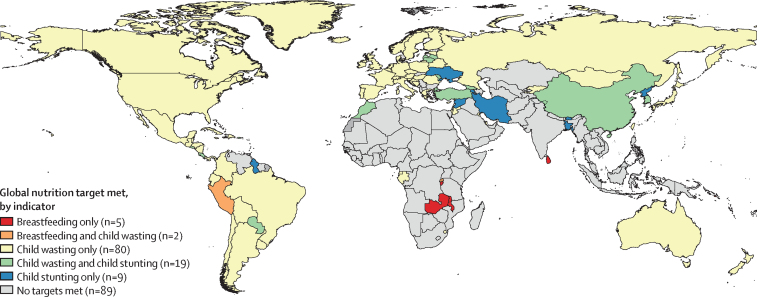
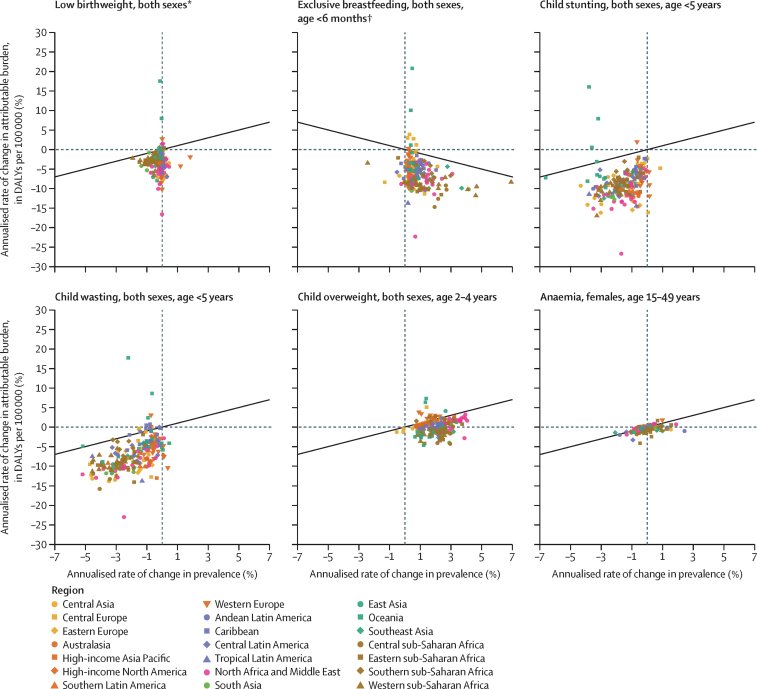
In 2021, a few countries had already met some of the GNTs: five for exclusive breastfeeding, four for stunting, 96 for child wasting, and three for child overweight, and none met the target for low birthweight or anaemia in females of reproductive age. Since 2012, the annualised rates of change (ARC) in the prevalence of child overweight increased in 201 countries and territories and ARC in the prevalence of anaemia in females of reproductive age decreased considerably in 26 countries. Between 2012 and 2021, SDI was strongly associated with indicator prevalence, apart from exclusive breastfeeding (|r-|=0·46-0·86). Many countries in sub-Saharan Africa had a decrease in the prevalence of multiple indicators that was more rapid than expected on the basis of SDI (the differences between observed and expected ARCs for child stunting and wasting were -0·5% and -1·3%, respectively). The ARC in the attributable burden of low birthweight, child stunting, and child wasting decreased faster than the ARC of the prevalence for each in most low-income and middle-income countries. In 2030, we project that 94 countries will meet one of the six targets, 21 countries will meet two targets, and 89 countries will not meet any targets. We project that seven countries will meet the target for exclusive breastfeeding, 28 for child stunting, and 101 for child wasting, and no countries will meet the targets for low birthweight, child overweight, and anaemia. In 2050, we project that seven additional countries will meet the target for exclusive breastfeeding, five for low birthweight, 96 for child stunting, nine for child wasting, and one for child overweight, and no countries are projected to meet the anaemia target.
Based on current levels and past trends, few GNTs will be met by 2030. Major reductions in attributable burden for exclusive breastfeeding and anthropometric indicators should be recognised as huge scientific and policy successes, but the comparative lack of progress in reducing the prevalence of each, along with stagnant anaemia in women of reproductive age and widespread increases in child overweight, suggests a tenuous status quo. Continued investment in preventive and treatment efforts for acute childhood illness is crucial to prevent backsliding. Parallel development of effective treatments, along with commitment to multisectoral, long-term policies to address the determinants and causes of suboptimal nutrition, are sorely needed to gain ground.
Bill & Melinda Gates Foundation.

2012年世界卫生大会选定了六项全球营养目标(GNTs),涉及低出生体重、纯母乳喂养、儿童生长(即消瘦、发育迟缓及超重)以及育龄女性贫血,将其作为母婴健康的关键指标,但尚未有关于2012年至2021年期间进展情况的全面报告。我们旨在评估204个国家和地区在2012年至2021年期间各目标的水平、趋势以及观察到的与预期的进展情况,包括患病率和归因负担,并预测到2050年的患病率。
在《2021年全球疾病、伤害及风险因素负担研究》(GBD 2021)中,按年龄组、性别和年份估算了204个国家和地区2012年至2021年期间各目标指标的患病率和归因负担,这是迄今为止对死亡原因、残疾及风险因素最全面的评估。采用贝叶斯元回归模型评估各国迄今的相对表现,该模型将患病率与基于社会人口指数(SDI)的预期值进行比较,SDI是社会发展状况的综合指标。通过使用关键数量组合进行元回归模拟过去趋势,然后外推这些数量的未来预测值,对2021年至2050年的目标进展进行预测。
2021年,一些国家已实现部分全球营养目标:五项实现纯母乳喂养目标,四项实现发育迟缓目标,96项实现儿童消瘦目标,三项实现儿童超重目标,没有国家实现低出生体重或育龄女性贫血目标。自2012年以来,201个国家和地区儿童超重患病率的年化变化率(ARC)上升,26个国家育龄女性贫血患病率的ARC大幅下降。2012年至2021年期间,除纯母乳喂养外,社会人口指数与指标患病率密切相关(|r-|=0.46 - 0.86)。撒哈拉以南非洲的许多国家多个指标患病率的下降速度比基于社会人口指数预期的更快(儿童发育迟缓和消瘦观察到的与预期的ARC差异分别为-0.5%和-1.3%)。在大多数低收入和中等收入国家,低出生体重、儿童发育迟缓和儿童消瘦归因负担的ARC下降速度快于各自患病率的ARC。预计到2030年,94个国家将实现六项指标中的一项,21个国家将实现两项指标,89个国家将无法实现任何指标。预计七个国家将实现纯母乳喂养目标,28个国家将实现儿童发育迟缓目标,101个国家将实现儿童消瘦目标,没有国家将实现低出生体重、儿童超重和贫血目标。预计到2050年,将有另外七个国家实现纯母乳喂养目标,五个国家实现低出生体重目标,96个国家实现儿童发育迟缓目标,九个国家实现儿童消瘦目标,一个国家实现儿童超重目标,预计没有国家将实现贫血目标。
基于当前水平和过去趋势,到2030年几乎无法实现全球营养目标。纯母乳喂养和人体测量指标归因负担的大幅降低应被视为巨大的科学和政策成就,但各指标患病率降低方面相对缺乏进展,以及育龄女性贫血情况停滞不前和儿童超重普遍增加,表明现状脆弱。持续投资于儿童急性疾病的预防和治疗工作对于防止倒退至关重要。迫切需要同步开发有效的治疗方法,并致力于制定多部门长期政策以解决营养状况不佳的决定因素和原因,以取得进展。
比尔及梅琳达·盖茨基金会