Yang Yanjie, Xia Ruixue, Zhang Xiaomei, Wang Xu, Zhou Yuchen, Wang Honggang, Feng Yu, Lv Shuangyu, Ji Shaoping
Institute of Molecular Medicine, Henan Provincial Engineering Center for Tumor Molecular Medicine, School of Basic Medical Sciences, Henan University, Kaifeng, China.
Front Physiol. 2021 Jul 6;12:657266. doi: 10.3389/fphys.2021.657266. eCollection 2021.
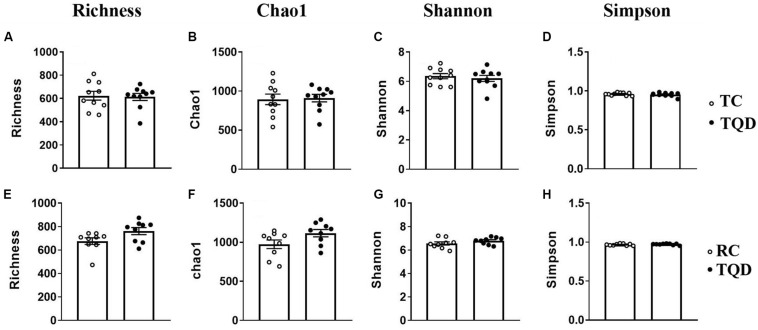
Mn-doped ZnS quantum dots (QDs) with excellent optical properties have been explored in a wide range of fields. Their potential adverse effects on biological systems and human health should be evaluated before biological application. In the present study, we investigated the effect of Mn-doped ZnS QDs on the intestinal tract and gut microbiota structures at 2 h and 14 days (d) after 14 d repeated oral exposure in mice. Flame atomic absorption spectrophotometry (FAAS), histopathological examination, and transmission electron microscopy (TEM) were used to assess the absorption and toxicity of Mn-doped ZnS QDs on the intestinal tract. The 16S rRNA gene sequencing was used to evaluate the gut microbial communities. Mn-doped ZnS QDs did not accumulate in the duodenum, jejunum, ileum, or colon. The Zn content of feces was not significantly higher than in the control group. No major histological changes were found in these tissues. The intestinal microvilli remained regular, but swelling of mitochondria and endoplasmic reticulum was detected by TEM at 14 d after the last gavage. A total of 2,712 operational taxonomic units (OTUs) were generated. Mn-doped ZnS QDs treatment did not significantly change the α-diversity of Richness, Chao1, Shannon, and Simpson indexes. According to principal component analysis (PCA), Mn-doped ZnS QDs had no effect on the overall structure of the gut microbiota. No significant change occurred at the phylum level, while three genera were downregulated at 2 h and seven changed at 14 d after the last gavage. Our findings revealed that Mn-doped ZnS QDs had a little stimulation of the intestinal tract and gut microbiota, and oral administration may be a safe route for biological application (such as bioimaging and drug delivery).
具有优异光学性能的锰掺杂硫化锌量子点(QDs)已在广泛领域得到探索。在生物应用之前,应评估它们对生物系统和人类健康的潜在不利影响。在本研究中,我们调查了在小鼠经14天重复口服暴露后2小时和14天,锰掺杂硫化锌量子点对肠道和肠道微生物群结构的影响。采用火焰原子吸收分光光度法(FAAS)、组织病理学检查和透射电子显微镜(TEM)来评估锰掺杂硫化锌量子点对肠道的吸收和毒性。使用16S rRNA基因测序来评估肠道微生物群落。锰掺杂硫化锌量子点未在十二指肠、空肠、回肠或结肠中蓄积。粪便中的锌含量并不显著高于对照组。在这些组织中未发现主要的组织学变化。肠道微绒毛保持规则,但在最后一次灌胃后14天通过TEM检测到线粒体和内质网肿胀。总共产生了2712个可操作分类单元(OTUs)。锰掺杂硫化锌量子点处理并未显著改变丰富度、Chao1、香农和辛普森指数的α多样性。根据主成分分析(PCA),锰掺杂硫化锌量子点对肠道微生物群的整体结构没有影响。在门水平上没有显著变化,而在最后一次灌胃后2小时有三个属下调,14天时有七个属发生变化。我们的研究结果表明,锰掺杂硫化锌量子点对肠道和肠道微生物群有轻微刺激,口服给药可能是生物应用(如生物成像和药物递送)的安全途径。