Department of Emergency and Organ Transplantation, Nephrology, Dialysis and Transplantation Unit, University of Bari Aldo Moro, Bari, Italy.
Department of Nephrology and Dialysis, University Clinic for Internal Medicine III, Medical University Vienna, Vienna, Austria.
Front Immunol. 2021 Jul 6;12:673562. doi: 10.3389/fimmu.2021.673562. eCollection 2021.
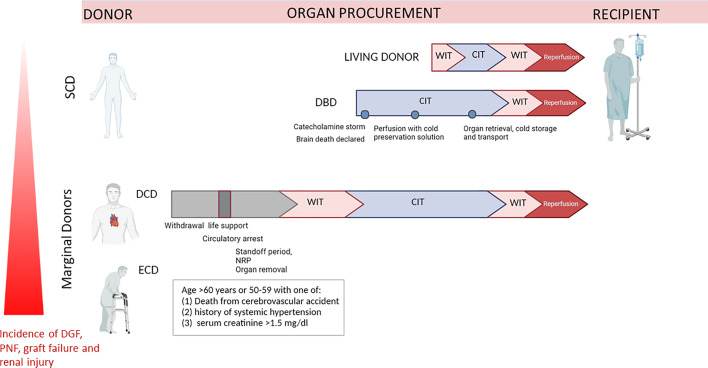
Donor organ shortage still remains a serious obstacle for the access of wait-list patients to kidney transplantation, the best treatment for End-Stage Kidney Disease (ESKD). To expand the number of transplants, the use of lower quality organs from older ECD or DCD donors has become an established routine but at the price of increased incidence of Primary Non-Function, Delay Graft Function and lower-long term graft survival. In the last years, several improvements have been made in the field of renal transplantation from surgical procedure to preservation strategies. To improve renal outcomes, research has focused on development of innovative and dynamic preservation techniques, in order to assess graft function and promote regeneration by pharmacological intervention before transplantation. This review provides an overview of the current knowledge of these new preservation strategies by machine perfusions and pharmacological interventions at different timing possibilities: in the organ donor, during perfusion machine reconditioning or after implementation in the recipient. We will report therapies as anti-oxidant and anti-inflammatory agents, senolytics agents, complement inhibitors, HDL, siRNA and H2S supplementation. Renal delivery of pharmacologic agents during preservation state provides a window of opportunity to treat the organ in an isolated manner and a crucial route of administration. Even if few studies have been reported of transplantation after drugs administration, targeting the biological pathway associated to kidney failure (i.e. oxidative stress, complement system, fibrosis) might be a promising therapeutic strategy to improve the quality of various donor organs and expand organ availability.
供体器官短缺仍然是等待接受肾移植的患者获得最佳治疗终末期肾病(ESKD)的严重障碍。为了扩大移植数量,使用来自老年 ECD 或 DCD 供体的较低质量器官已成为既定常规,但代价是原发性无功能、延迟移植物功能和较低的长期移植物存活率增加。在过去的几年中,肾移植领域从手术程序到保存策略都取得了一些进展。为了改善肾移植效果,研究人员专注于开发创新和动态保存技术,以便在移植前通过药物干预评估移植物功能并促进再生。
在器官捐献者中、在机器再灌注期间或在受者中实施后。我们将报告抗氧化和抗炎剂、衰老细胞清除剂、补体抑制剂、HDL、siRNA 和 H2S 补充剂等疗法。在保存状态下向肾脏输送药物为以隔离方式治疗器官提供了机会,并提供了关键的给药途径。尽管只有少数研究报告了药物给药后的移植情况,但针对与肾衰竭相关的生物途径(即氧化应激、补体系统、纤维化)可能是改善各种供体器官质量和扩大器官可用性的有前途的治疗策略。