Tarekegn Getinet M, Khayatzadeh Negar, Liu Bin, Osama Sarah, Haile Aynalem, Rischkowsky Barbara, Zhang Wenguang, Tesfaye Kassahun, Dessie Tadelle, Mwai Okeyo A, Djikeng Appolinaire, Mwacharo Joram M
Department of Animal Production and Technology School of Animal Sciences and Veterinary Medicine Bahir Dar University Bahir Dar Ethiopia.
Department of Animal Breeding and Genetics Swedish University of Agricultural Sciences (SLU) Uppsala Sweden.
Evol Appl. 2021 Jun 15;14(7):1716-1731. doi: 10.1111/eva.13118. eCollection 2021 Jul.
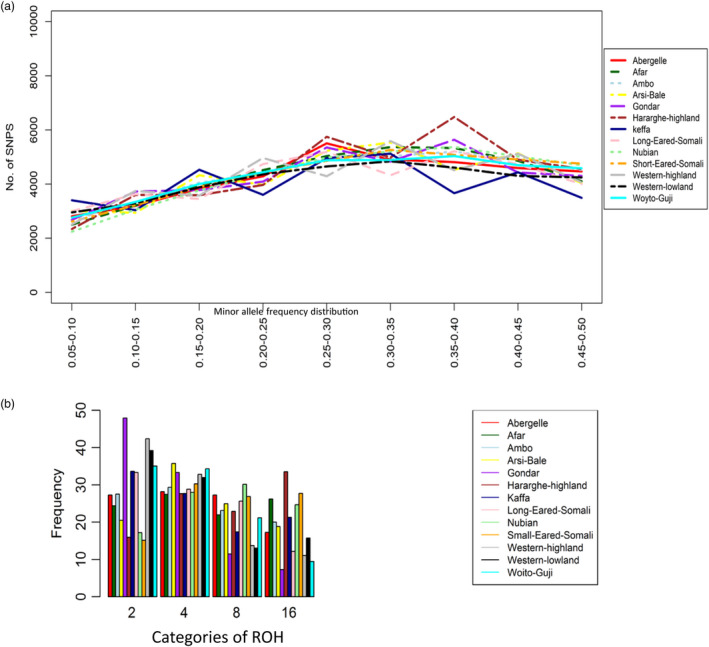
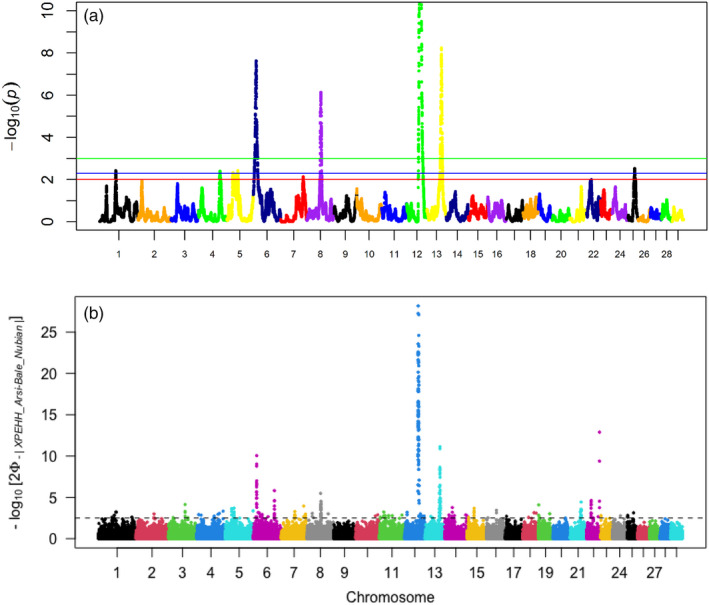
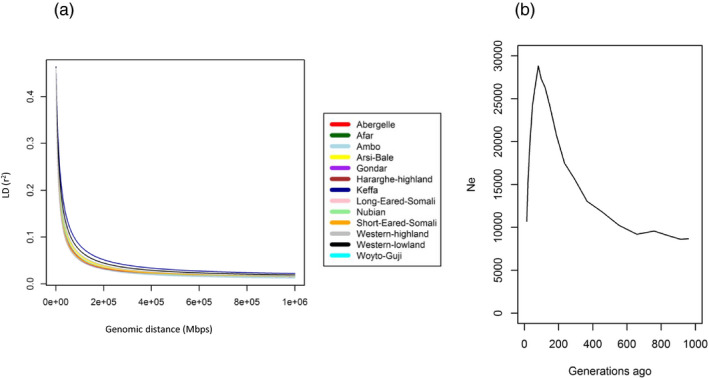
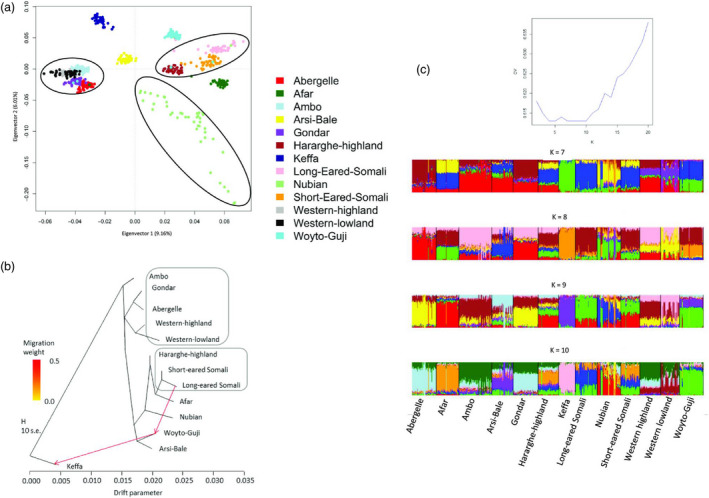
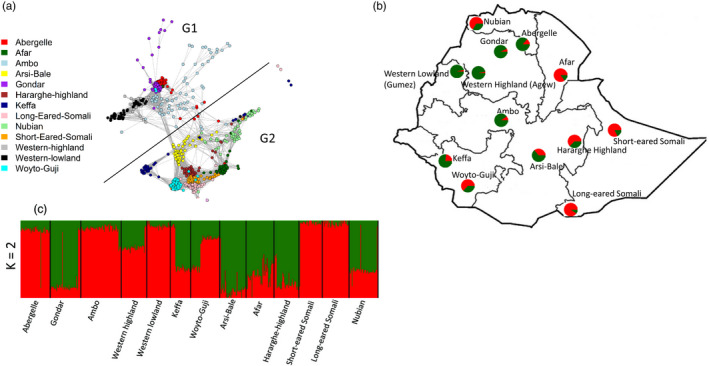
Knowledge on how adaptive evolution and human socio-cultural and economic interests shaped livestock genomes particularly in sub-Saharan Africa remains limited. Ethiopia is in a geographic region that has been critical in the history of African agriculture with ancient and diverse human ethnicity and bio-climatic conditions. Using 52K genome-wide data analysed in 646 individuals from 13 Ethiopian indigenous goat populations, we observed high levels of genetic variation. Although runs of homozygosity (ROH) were ubiquitous genome-wide, there were clear differences in patterns of ROH length and abundance and in effective population sizes illustrating differences in genome homozygosity, evolutionary history, and management. Phylogenetic analysis incorporating patterns of genetic differentiation and gene flow with ancestry modelling highlighted past and recent intermixing and possible two deep ancient genetic ancestries that could have been brought by humans with the first introduction of goats in Africa. We observed four strong selection signatures that were specific to Arsi-Bale and Nubian goats. These signatures overlapped genomic regions with genes associated with morphological, adaptation, reproduction and production traits due possibly to selection under environmental constraints and/or human preferences. The regions also overlapped uncharacterized genes, calling for a comprehensive annotation of the goat genome. Our results provide insights into mechanisms leading to genome variation and differentiation in sub-Saharan Africa indigenous goats.
关于适应性进化以及人类社会文化和经济利益如何塑造家畜基因组,尤其是撒哈拉以南非洲地区家畜基因组的知识仍然有限。埃塞俄比亚位于一个在非洲农业历史上至关重要的地理区域,拥有古老且多样的人类种族和生物气候条件。利用对来自13个埃塞俄比亚本土山羊群体的646个个体进行分析的52K全基因组数据,我们观察到了高水平的遗传变异。尽管纯合子片段(ROH)在全基因组中普遍存在,但ROH长度和丰度模式以及有效种群大小存在明显差异,这说明了基因组纯合性、进化历史和管理方面的差异。结合遗传分化模式和基因流以及祖先建模的系统发育分析突出了过去和近期的混合情况,以及可能在人类首次将山羊引入非洲时带来的两个古老的遗传祖先。我们观察到四个特定于阿尔西 - 巴勒山羊和努比亚山羊的强烈选择信号。这些信号与与形态、适应、繁殖和生产性状相关的基因所在的基因组区域重叠,这可能是由于环境限制和/或人类偏好下的选择所致。这些区域还与未表征的基因重叠,这就需要对山羊基因组进行全面注释。我们的结果为撒哈拉以南非洲本土山羊基因组变异和分化的机制提供了见解。