Albuquerque Catarina, Manguinhas Rita, Costa João G, Gil Nuno, Codony-Servat Jordi, Castro Matilde, Miranda Joana P, Fernandes Ana S, Rosell Rafael, Oliveira Nuno G
Research Institute for Medicines (iMed.ULisboa), Faculty of Pharmacy, Universidade de Lisboa, Lisboa, Portugal.
CBIOS, Universidade Lusófona's Research Center for Biosciences & Health Technologies, Lisboa, Portugal.
Transl Lung Cancer Res. 2021 Jun;10(6):2698-2714. doi: 10.21037/tlcr-21-121.
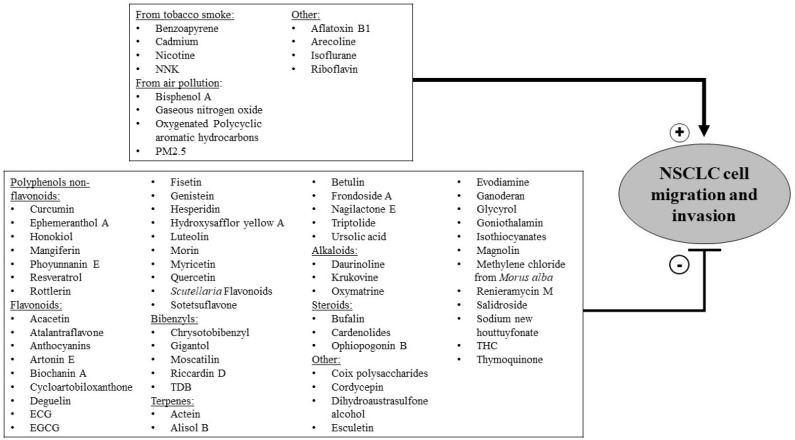
Lung cancer (LC) is the leading cause of cancer deaths worldwide, being non-small lung cancer (NSCLC) sub-types the most prevalent. Since most LC cases are only detected during the last stage of the disease the high mortality rate is strongly associated with metastases. For this reason, the migratory and invasive capacity of these cancer cells as well as the mechanisms involved have long been studied to uncover novel strategies to prevent metastases and improve the patients' prognosis. This narrative review provides an overview of the main migration and invasion assays employed in NSCLC research. While several methods have been developed, experiments using conventional cell culture models prevailed, specifically the wound-healing and the transwell migration and invasion assays. Moreover, it is provided herewith a summary of the available information concerning chemical contaminants that may promote the migratory/invasive properties of NSCLC cells , shedding some light on possible LC risk factors. Most of the reported agents with pro-migration/invasion effects derive from cigarette smoking [e.g., Benzo(a)pyrene and cadmium] and air pollution. This review further presents several studies in which different dietary/plant-derived compounds demonstrated to impair migration/invasion processes in NSCLC cells . These chemicals that have been proposed as anti-migratory consisted mainly of natural bioactive substances, including polyphenols non-flavonoids, flavonoids, bibenzyls, terpenes, alkaloids, and steroids. Some of these compounds may eventually represent novel therapeutic strategies to be considered in the future to prevent metastasis formation in LC, which highlights the need for additional methodologies that more closely resemble the tumor microenvironment and cancer cell interactions. These studies along with adequate models should be further explored as proof of concept for the most promising compounds.
肺癌(LC)是全球癌症死亡的主要原因,其中非小细胞肺癌(NSCLC)亚型最为常见。由于大多数肺癌病例仅在疾病的最后阶段才被检测到,因此高死亡率与转移密切相关。出于这个原因,长期以来一直在研究这些癌细胞的迁移和侵袭能力以及所涉及的机制,以发现预防转移和改善患者预后的新策略。这篇叙述性综述概述了NSCLC研究中使用的主要迁移和侵袭试验。虽然已经开发了几种方法,但使用传统细胞培养模型的实验占主导地位,特别是伤口愈合以及Transwell迁移和侵袭试验。此外,本文还总结了有关可能促进NSCLC细胞迁移/侵袭特性的化学污染物的现有信息,揭示了可能的肺癌风险因素。大多数报道的具有促迁移/侵袭作用的物质来自吸烟[例如,苯并(a)芘和镉]和空气污染。这篇综述还介绍了几项研究,其中不同的饮食/植物来源的化合物被证明会损害NSCLC细胞的迁移/侵袭过程。这些被提议为抗迁移的化学物质主要由天然生物活性物质组成,包括多酚类非黄酮类、黄酮类、联苄类、萜类、生物碱类和甾体类。其中一些化合物最终可能代表未来预防肺癌转移形成时可考虑的新治疗策略,这突出了需要更接近肿瘤微环境和癌细胞相互作用的额外方法。这些研究以及适当的模型应作为最有前景化合物的概念验证进行进一步探索。