Guerrero-Díaz Delia Vanessa, Hernández-Vásquez Akram, Montoya-Rivera Wency Cecilia, Rojas-Roque Carlos, Chacón Díaz Manuel Alberto, Bendezu-Quispe Guido
Universidad Científica del Sur, Lima, Peru.
Centro de Excelencia en Investigaciones Económicas y Sociales en Salud, Vicerrectorado de Investigación, Universidad San Ignacio de Loyola, Lima, Peru.
Heliyon. 2021 Jul 9;7(7):e07516. doi: 10.1016/j.heliyon.2021.e07516. eCollection 2021 Jul.
To determine the factors associated and measure the socioeconomic inequalities in people with undiagnosed hypertension in Peru.
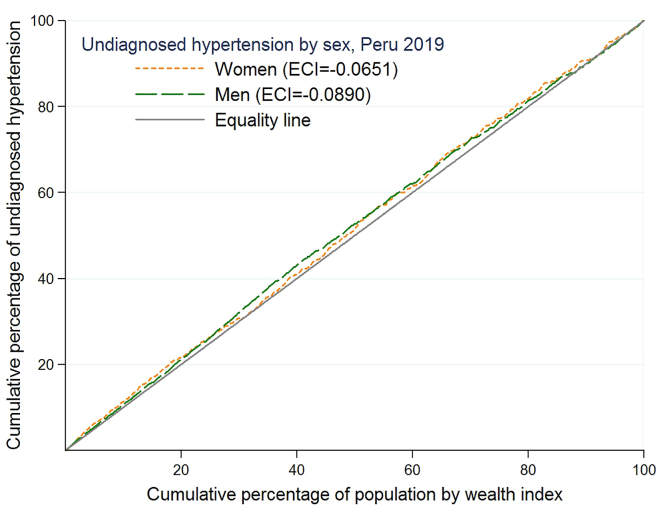
An observational, cross-sectional, analytical study was performed using data from the 2019 Demographic and Family Health Survey (ENDES, acronym in Spanish) database. The dependent variable was the presence of undiagnosed hypertension (mean systolic blood pressure ≥140 mmHg and/or mean diastolic blood pressure ≥90 mmHg in the two blood pressure measurements and with no prior diagnosis of hypertension by a health care professional). Adjusted prevalence ratios were estimated to determine the factors associated with undiagnosed hypertension. The socioeconomic inequality in undiagnosed hypertension was estimated using concentration curves and the Erreygers concentration index.
67.2% of 3697 persons with hypertension had not been diagnosed. Non-diagnosis of hypertension was more prevalent in men who were residents of the Coast and in inhabitants residing at more than 3000 m above sea level. Being 50 years of age or older, having health insurance, being obese and having diabetes mellitus were associated with a lower prevalence of undiagnosed hypertension. Inequality of the non-diagnosis of hypertension was found to be concentrated in the poorest population.
At least one out of every two adult Peruvians with hypertension have not been diagnosed with this condition. Socioeconomic inequality was found, as well as socio-demographic and health-related factors associated with undiagnosed hypertension. Our findings identify some population subgroups in which interventions for screening and treatment of hypertension should be prioritized in order to reduce both inequalities and complications of hypertension among the most vulnerable.
确定秘鲁未确诊高血压患者的相关因素并衡量其社会经济不平等状况。
使用2019年人口与家庭健康调查(ENDES,西班牙语首字母缩写)数据库中的数据进行了一项观察性、横断面分析研究。因变量为未确诊高血压的存在情况(两次血压测量中平均收缩压≥140 mmHg和/或平均舒张压≥90 mmHg,且之前未被医疗保健专业人员诊断为高血压)。估计调整后的患病率比以确定与未确诊高血压相关的因素。使用浓度曲线和埃雷格斯浓度指数估计未确诊高血压的社会经济不平等状况。
3697名高血压患者中有67.2%未被诊断。高血压未诊断在沿海地区居民男性以及海拔3000米以上居民中更为普遍。年龄在50岁及以上、拥有健康保险、肥胖和患有糖尿病与未确诊高血压的较低患病率相关。发现高血压未诊断的不平等现象集中在最贫困人群中。
每两名患有高血压的成年秘鲁人中至少有一人未被诊断出患有这种疾病。发现了社会经济不平等以及与未确诊高血压相关的社会人口学和健康相关因素。我们的研究结果确定了一些人群亚组,在这些亚组中应优先开展高血压筛查和治疗干预措施,以减少最弱势群体中的高血压不平等现象和并发症。