Acevedo Parker K, Lord Katherine E, Williams Kendra N, Underhill Lindsay J, Cordova-Ascona Lucy, Campos Karina, Cuentas Gonzalo, Gittelsohn Joel, Mendoza Juan C, de Las Fuentes Lisa, Hartinger Stella M, Dávila-Román Victor G, Checkley William
Division of Pulmonary and Critical Care, School of Medicine, Johns Hopkins University, Baltimore, MD, USA.
Center for Global Non-Communicable Disease Research and Training, School of Medicine, Johns Hopkins University, Baltimore, MD, USA.
J Multimorb Comorb. 2024 Dec 10;14:26335565241292325. doi: 10.1177/26335565241292325. eCollection 2024 Jan-Dec.
Hypertension is the leading modifiable risk factor for premature death globally despite the existence of evidence-based and cost-effective treatments. Medication nonadherence is cited as the main cause of treatment failure for hypertension. In Peru, adherence to anti-hypertensive medications of individuals with both hypertension and type 2 diabetes (T2D) is not well studied. The few studies that have investigated differences in anti-hypertensive medication adherence among patients with and without T2D have demonstrated both positive and negative effects.
In a cross-sectional study in Puno, Peru, we compared anti-hypertensive medication adherence in individuals with hypertension between those with and without comorbid T2D. The primary outcome was adherence to anti-hypertensive medications as assessed by the Hill-Bone Compliance scale. The primary exposure variable was comorbidity status (i.e., having hypertension and diabetes vs. hypertension alone).
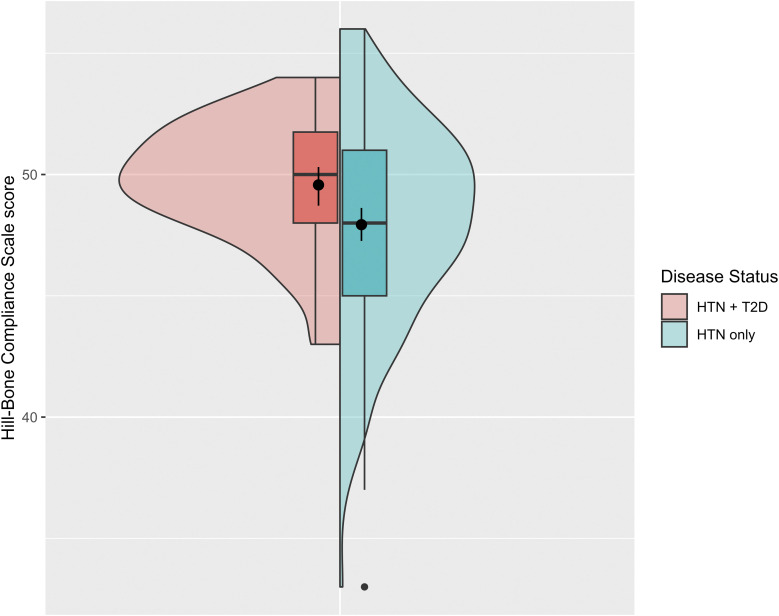
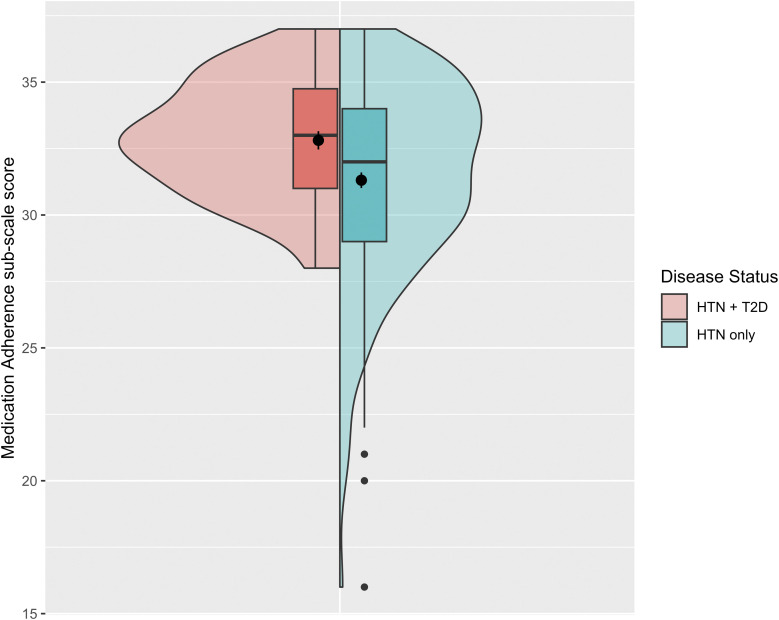
Of the 204 participants with hypertension (mean age 67 ± 11 years, 60% female), 42 (21%) had comorbid diabetes. Participants with comorbid disease had higher overall anti-hypertensive adherence scores (49.5 ± 2.8 vs. 48.0 ± 4.1 points; p<0.001) and higher medication adherence scores (32.8 ± 2.2 vs. 31.3 ± 3.7 points; p<0.01) when compared to those with hypertension alone. In multivariable regression, comorbid diabetes and monthly income above 250 soles (68 USD) were associated with higher Hill-Bone Compliance scale scores by 1.5 ± 0.7 points (p=0.025) and 2.0 ± 0.7 points (p<0.01), respectively.
Participants with comorbid hypertension and diabetes exhibited higher adherence to anti-hypertensive medications when compared to those with hypertension alone, suggesting that individuals with comorbid disease are more likely to adhere to anti-hypertensive medications.
尽管存在循证且具成本效益的治疗方法,但高血压仍是全球过早死亡的首要可改变风险因素。药物治疗依从性差被认为是高血压治疗失败的主要原因。在秘鲁,高血压合并2型糖尿病(T2D)患者的抗高血压药物依从性尚未得到充分研究。少数研究调查了合并T2D和未合并T2D患者在抗高血压药物依从性方面的差异,结果显示了正反两方面的影响。
在秘鲁普诺进行的一项横断面研究中,我们比较了合并T2D和未合并T2D的高血压患者的抗高血压药物依从性。主要结局是通过希尔 - 博恩依从性量表评估的抗高血压药物依从性。主要暴露变量是合并症状态(即患有高血压和糖尿病与仅患有高血压)。
在204名高血压参与者中(平均年龄67±11岁,60%为女性),42人(21%)患有合并糖尿病。与仅患有高血压的参与者相比,合并症患者的总体抗高血压依从性得分更高(49.5±2.8对48.0±4.1分;p<0.001),药物依从性得分也更高(32.8±2.2对31.3±3.7分;p<0.01)。在多变量回归中,合并糖尿病和月收入高于250索尔(68美元)分别与希尔 - 博恩依从性量表得分高出1.5±0.7分(p = 0.025)和2.0±0.7分(p<0.01)相关。
与仅患有高血压的患者相比,合并高血压和糖尿病的参与者对抗高血压药物的依从性更高,这表明合并症患者更有可能坚持服用抗高血压药物。