Frezel N, Platonova E, Voigt F F, Mateos J M, Kastli R, Ziegler U, Karayannis T, Helmchen F, Wildner H, Zeilhofer H U
Institute of Pharmacology and Toxicology, University of Zurich, CH-8057 Zürich, Switzerland.
Center for Microscopy and Image Analysis, University of Zurich, CH-8057 Zürich CH-8057, Switzerland.
Cereb Cortex Commun. 2020 Aug 20;1(1):tgaa052. doi: 10.1093/texcom/tgaa052. eCollection 2020.
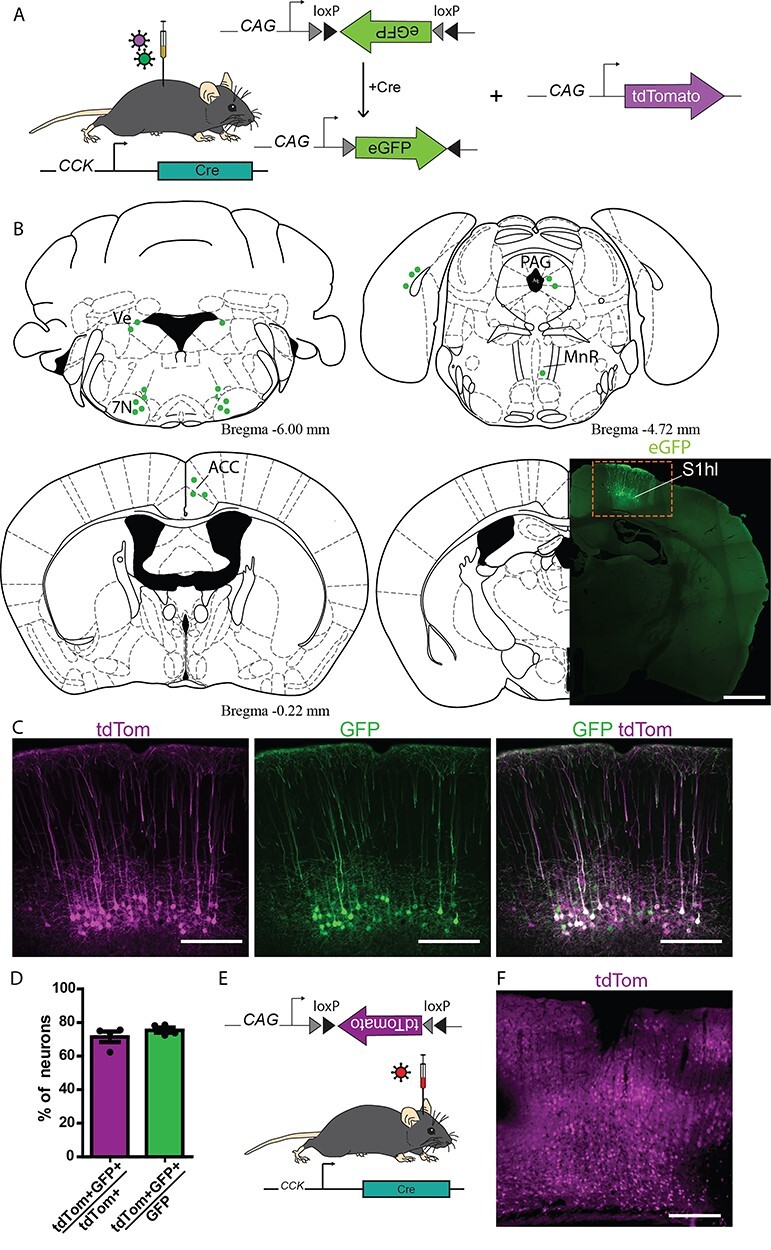
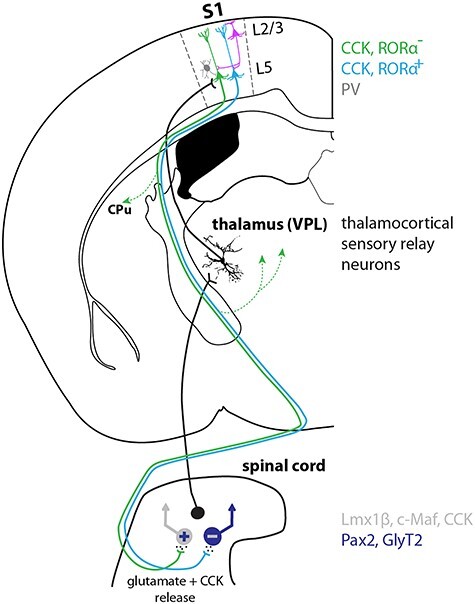
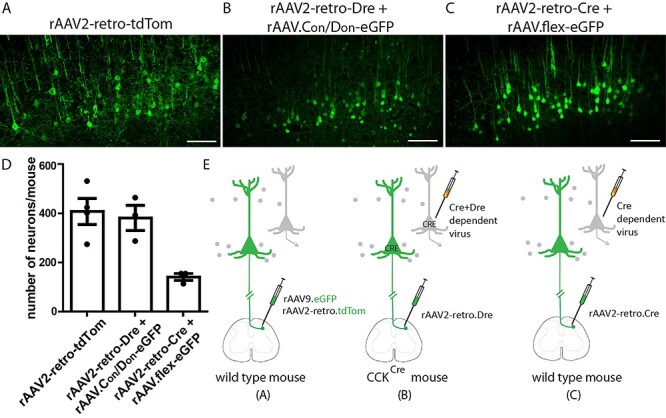
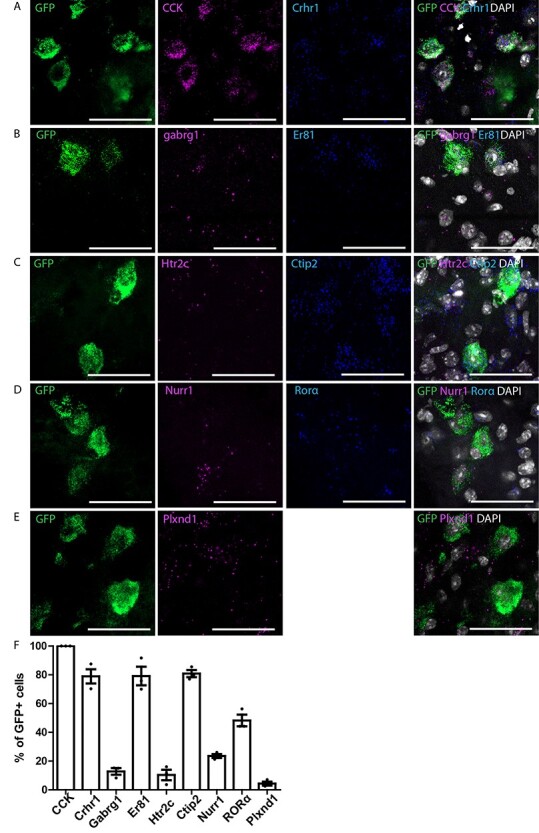
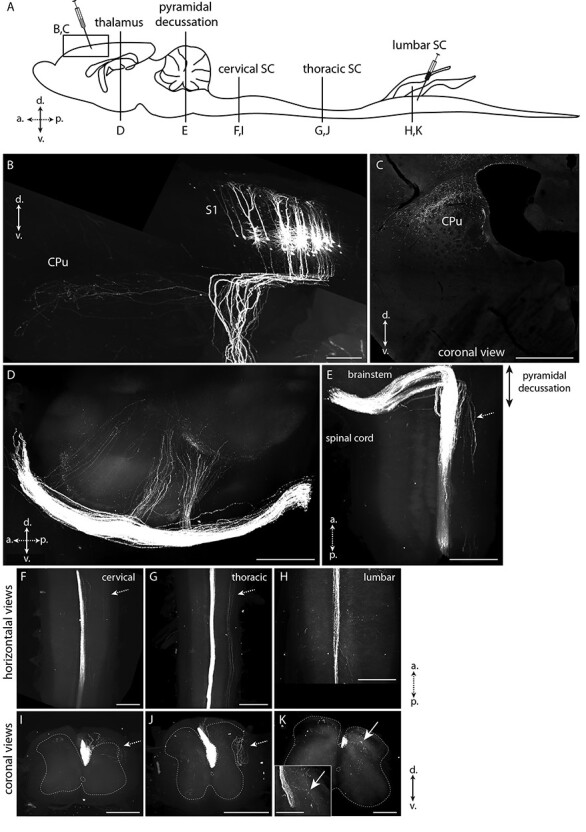
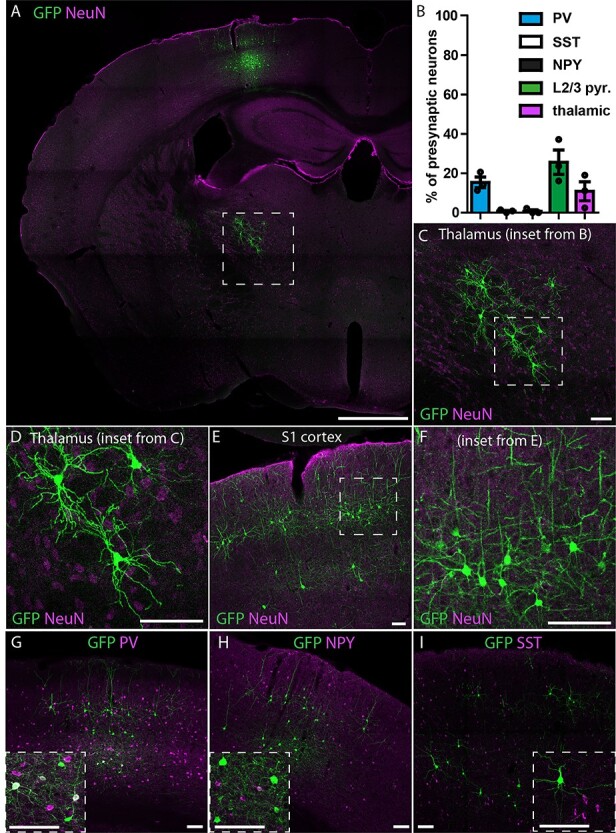
Neuronal circuits of the spinal dorsal horn integrate sensory information from the periphery with inhibitory and facilitating input from higher central nervous system areas. Most previous work focused on projections descending from the hindbrain. Less is known about inputs descending from the cerebral cortex. Here, we identified cholecystokinin (CCK) positive layer 5 pyramidal neurons of the primary somatosensory cortex (CCK S1-corticospinal tract [CST] neurons) as a major source of input to the spinal dorsal horn. We combined intersectional genetics and virus-mediated gene transfer to characterize CCK S1-CST neurons and to define their presynaptic input and postsynaptic target neurons. We found that S1-CST neurons constitute a heterogeneous population that can be subdivided into distinct molecular subgroups. Rabies-based retrograde tracing revealed monosynaptic input from layer 2/3 pyramidal neurons, from parvalbumin positive cortical interneurons, and from thalamic relay neurons in the ventral posterolateral nucleus. Wheat germ agglutinin-based anterograde tracing identified postsynaptic target neurons in dorsal horn laminae III and IV. About 60% of these neurons were inhibitory and about 60% of all spinal target neurons expressed the transcription factor c-Maf. The heterogeneous nature of both S1-CST neurons and their spinal targets suggest complex roles in the fine-tuning of sensory processing.
脊髓背角的神经回路将来自外周的感觉信息与来自中枢神经系统更高区域的抑制性和易化性输入整合在一起。以往的大多数研究集中于后脑发出的投射。对于来自大脑皮层的下行输入了解较少。在这里,我们确定了初级体感皮层中胆囊收缩素(CCK)阳性的第5层锥体神经元(CCK S1-皮质脊髓束[CST]神经元)是脊髓背角的主要输入源。我们结合了交叉遗传学和病毒介导的基因转移来表征CCK S1-CST神经元,并确定它们的突触前输入和突触后靶神经元。我们发现S1-CST神经元构成了一个异质性群体,可细分为不同的分子亚群。基于狂犬病的逆行追踪揭示了来自第2/3层锥体神经元、小白蛋白阳性的皮质中间神经元以及腹后外侧核中的丘脑中继神经元的单突触输入。基于小麦胚芽凝集素的顺行追踪确定了背角III层和IV层中的突触后靶神经元。这些神经元中约60%是抑制性的,并且所有脊髓靶神经元中约60%表达转录因子c-Maf。S1-CST神经元及其脊髓靶标的异质性表明它们在感觉处理的精细调节中发挥着复杂的作用。