The Shraga Segal Department of Microbiology Immunology and Genetics, Faculty of Health Sciences, Ben-Gurion University of the Negev, 84105, Israel; National Institute for Biotechnology in the Negev, 84105, Israel.
The Shraga Segal Department of Microbiology Immunology and Genetics, Faculty of Health Sciences, Ben-Gurion University of the Negev, 84105, Israel; National Institute for Biotechnology in the Negev, 84105, Israel; Center for Regenerative Medicine and Stem Cells, Ben-Gurion University of the Negev, 84105, Israel.
Stem Cell Reports. 2021 Aug 10;16(8):1884-1893. doi: 10.1016/j.stemcr.2021.06.013. Epub 2021 Jul 22.
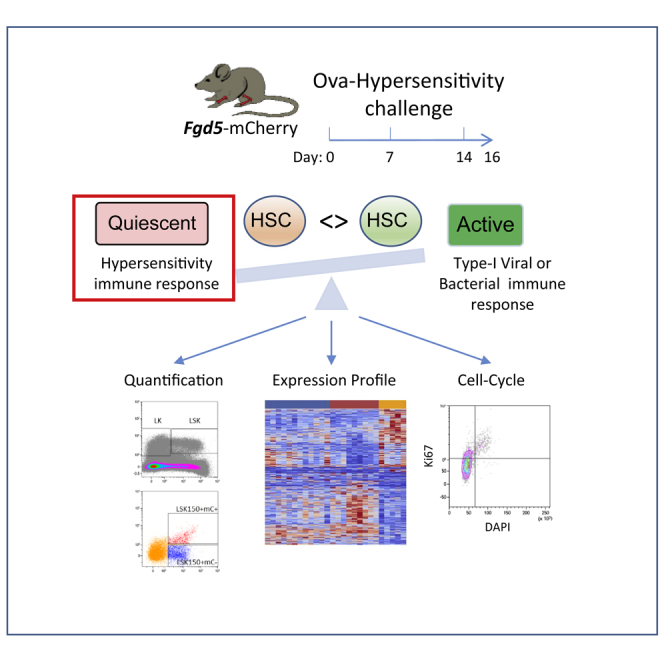
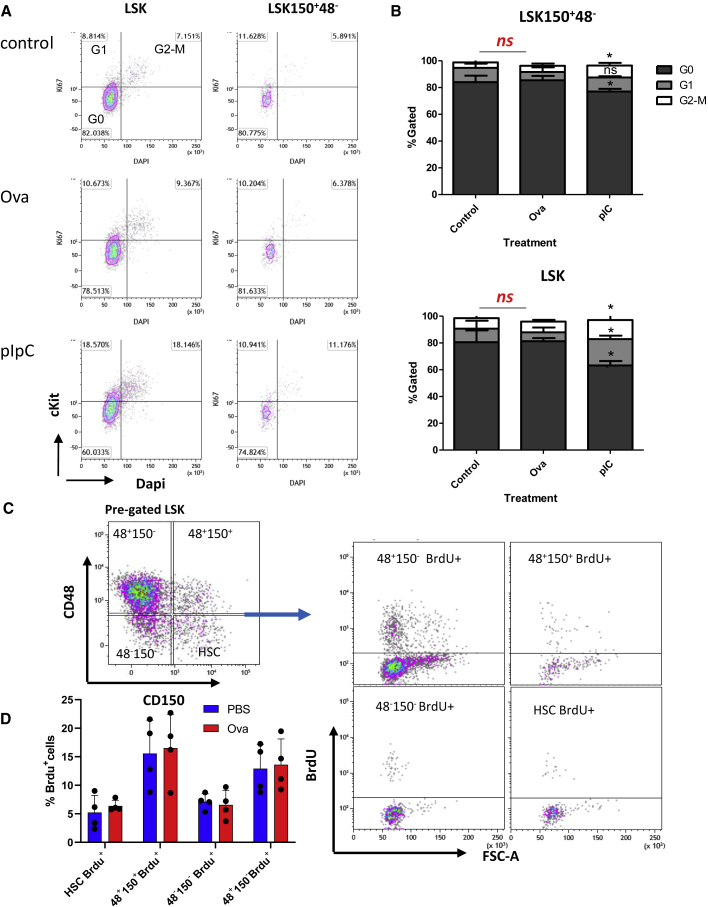
Immune cells are generated from hematopoietic stem cells (HSCs) in the bone marrow (BM). Immune stimulation can rapidly activate HSCs out of their quiescent state to accelerate the generation of immune cells. HSCs' activation follows various viral or bacterial stimuli, and we sought to investigate the hypersensitivity immune response. Surprisingly, the Ova-induced hypersensitivity peritonitis model finds no significant changes in BM HSCs. HSC markers cKIT, SCA1, CD48, CD150, and the Fgd5-mCherry reporter showed no significant difference from control. Functionally, hypersensitivity did not alter HSCs' potency, as assayed by transplantation. We further characterized the possible impact of hypersensitivity using RNA-sequencing of HSCs, finding minor changes at the transcriptome level. Moreover, hypersensitivity induced no significant change in the proliferative state of HSCs. Therefore, this study suggests that, in contrast to other immune stimuli, hypersensitivity has no impact on HSCs.
免疫细胞由骨髓(BM)中的造血干细胞(HSCs)产生。免疫刺激可以迅速激活 HSCs,使其从静止状态中活跃起来,从而加速免疫细胞的生成。HSCs 的激活遵循各种病毒或细菌刺激,我们试图研究过敏免疫反应。令人惊讶的是,卵清蛋白诱导的过敏腹膜炎模型在 BM HSCs 中未发现明显变化。HSC 标志物 cKIT、SCA1、CD48、CD150 和 Fgd5-mCherry 报告基因与对照相比没有显著差异。功能上,过敏反应并没有改变 HSCs 的效力,如通过移植测定。我们进一步利用 HSCs 的 RNA 测序来描述过敏反应的可能影响,发现转录组水平上有微小变化。此外,过敏反应没有引起 HSCs 增殖状态的显著变化。因此,本研究表明,与其他免疫刺激不同,过敏反应对 HSCs 没有影响。