Luddy School of Informatics, Computing, and Engineering, Indiana University, Bloomington, IN 47408;
Luddy School of Informatics, Computing, and Engineering, Indiana University, Bloomington, IN 47408.
Proc Natl Acad Sci U S A. 2021 Jul 27;118(30). doi: 10.1073/pnas.2102061118.
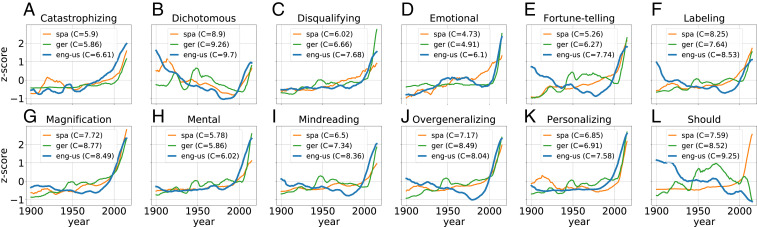
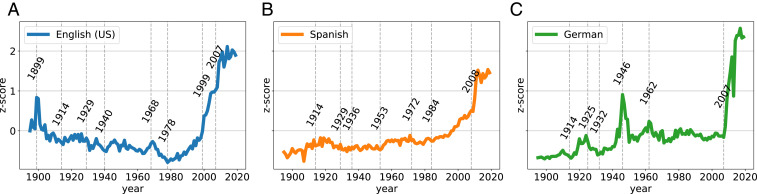
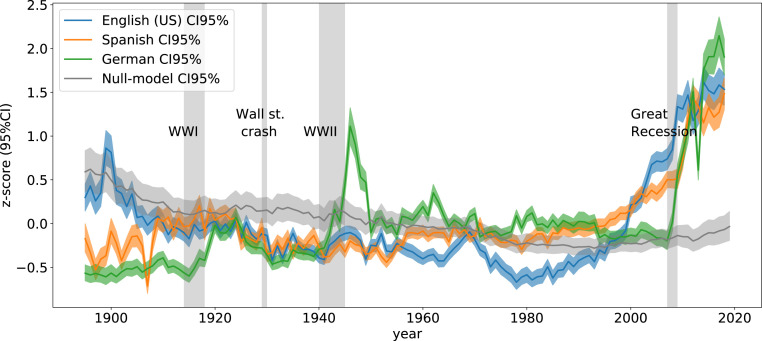
Individuals with depression are prone to maladaptive patterns of thinking, known as cognitive distortions, whereby they think about themselves, the world, and the future in overly negative and inaccurate ways. These distortions are associated with marked changes in an individual's mood, behavior, and language. We hypothesize that societies can undergo similar changes in their collective psychology that are reflected in historical records of language use. Here, we investigate the prevalence of textual markers of cognitive distortions in over 14 million books for the past 125 y and observe a surge of their prevalence since the 1980s, to levels exceeding those of the Great Depression and both World Wars. This pattern does not seem to be driven by changes in word meaning, publishing and writing standards, or the Google Books sample. Our results suggest a recent societal shift toward language associated with cognitive distortions and internalizing disorders.
患有抑郁症的个体容易出现适应不良的思维模式,即认知扭曲,他们以过于消极和不准确的方式看待自己、世界和未来。这些扭曲与个体的情绪、行为和语言的显著变化有关。我们假设,社会可能会在其集体心理上经历类似的变化,这些变化反映在语言使用的历史记录中。在这里,我们调查了过去 125 年来超过 1400 万本书中认知扭曲的文本标记的流行程度,并观察到自 20 世纪 80 年代以来,它们的流行程度急剧上升,达到了超过大萧条和两次世界大战的水平。这种模式似乎不是由词义变化、出版和写作标准或 Google 书籍样本驱动的。我们的研究结果表明,最近社会语言出现了与认知扭曲和内化障碍相关的转变。