Mayo Clinic College of Medicine, Rochester, MN, USA.
St. Mary's Hospital for Children, Bayside, NY, USA.
J Hosp Infect. 2021 Oct;116:69-77. doi: 10.1016/j.jhin.2021.07.006. Epub 2021 Jul 22.
The real-world impact of breathing zone air purification and coronavirus disease 2019 (COVID-19) mitigation measures on healthcare-associated infections is not well documented. Engineering solutions to treat airborne transmission of disease may yield results in controlled test chambers or single rooms, but have not been reported on hospital-wide applications, and the impact of COVID-19 mitigation measures on healthcare-associated infection rates is unknown.
To determine the impact of hospital-wide bioaerosol treatment and COVID-19 mitigation measures on clinical outcomes.
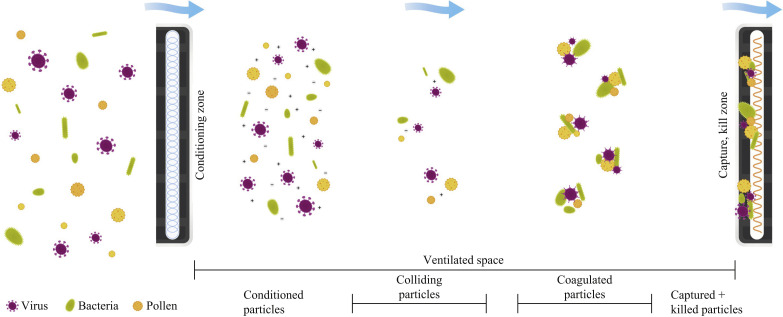
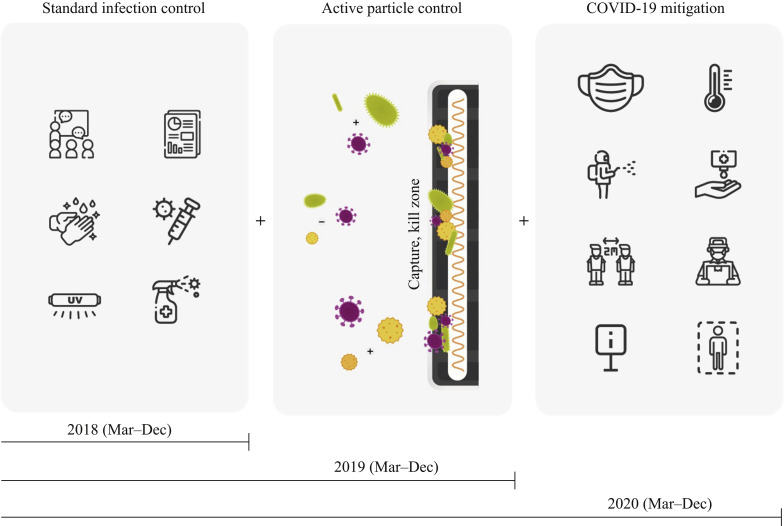
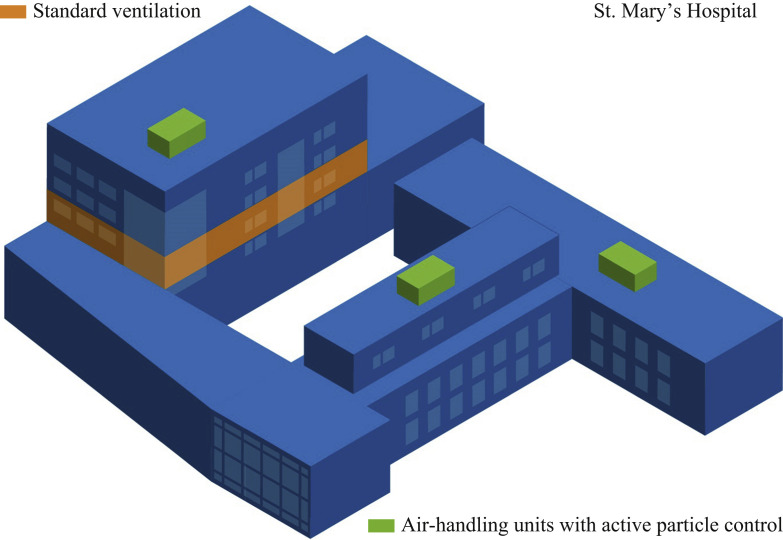
The impact of the step-wise addition of air disinfection technology and COVID-19 mitigation measures to standard multi-modal infection control on particle counts, viral and bacterial bioburden, and healthcare-associated infection rates was investigated in a 124-bed hospital (>100,000 patient-days over 30 months).
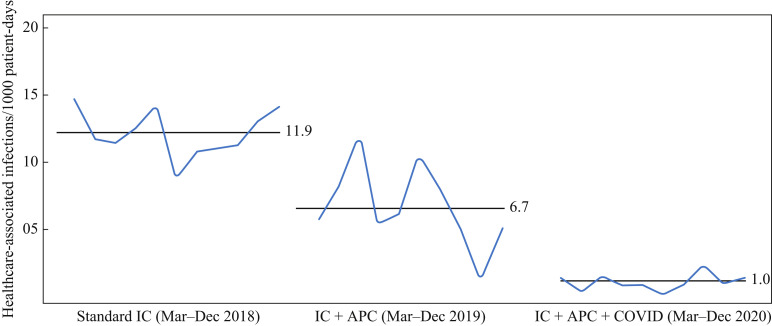
The addition of air disinfection technology and COVID-19 mitigation measures reduced airborne ultrafine particles, altered hospital bioburden, and reduced healthcare-associated infections from 11.9 to 6.6 (per 1000 patient-days) and from 6.6 to 1.0 (per 1000 patient-days), respectively (P<0.0001, R=0.86). No single technology, tool or procedure will eliminate healthcare-associated infections, but the addition of a ubiquitous facility-wide engineering solution at limited expense and with no alteration to patient, visitor or staff traffic or workflow patterns reduced infections by 45%. A similar impact was documented with the addition of comprehensive, restrictive, and labour- and material-intensive COVID-19 mitigation measures. To the authors' knowledge, this is the first direct comparison between traditional infection control, an engineering solution and COVID-19 mitigation measures.
关于呼吸区域空气净化和 2019 年冠状病毒病(COVID-19)缓解措施对医源性感染的实际影响,相关记录并不完善。用于治疗空气传播疾病的工程解决方案可能在受控测试室或单人房内产生效果,但尚未在全医院范围内的应用中得到报告,并且 COVID-19 缓解措施对医源性感染率的影响也未知。
确定全医院范围内生物气溶胶处理和 COVID-19 缓解措施对临床结果的影响。
通过逐步添加空气消毒技术和 COVID-19 缓解措施来研究对标准多模式感染控制的影响,以调查 124 张病床的医院(超过 30 个月的 100,000 多患者日)中粒子计数、病毒和细菌生物负荷以及医源性感染率的变化。
空气消毒技术和 COVID-19 缓解措施的添加减少了空气传播的超细颗粒,改变了医院的生物负荷,并使医源性感染从 11.9 例/1000 患者日减少到 6.6 例/1000 患者日(P<0.0001,R=0.86),从 6.6 例/1000 患者日减少到 1.0 例/1000 患者日(P<0.0001,R=0.86)。没有单一的技术、工具或程序可以消除医源性感染,但以有限的费用添加无处不在的全医院范围的工程解决方案,而不会改变患者、访客或员工的流量或工作流程模式,可将感染率降低 45%。在添加全面、严格且劳动和材料密集型 COVID-19 缓解措施时,也记录到了类似的影响。据作者所知,这是传统感染控制、工程解决方案和 COVID-19 缓解措施之间的首次直接比较。