
可移动遗传元件中的多种ATP酶蛋白构成了原核宿主ATP的一个巨大潜在消耗库。
Diverse ATPase Proteins in Mobilomes Constitute a Large Potential Sink for Prokaryotic Host ATP.
作者信息
Shim Hyunjin, Shivram Haridha, Lei Shufei, Doudna Jennifer A, Banfield Jillian F
机构信息
Department of Earth and Planetary Science, University of California, Berkeley, Berkeley, CA, United States.
Innovative Genomics Institute, University of California, Berkeley, Berkeley, CA, United States.
出版信息
Front Microbiol. 2021 Jul 8;12:691847. doi: 10.3389/fmicb.2021.691847. eCollection 2021.
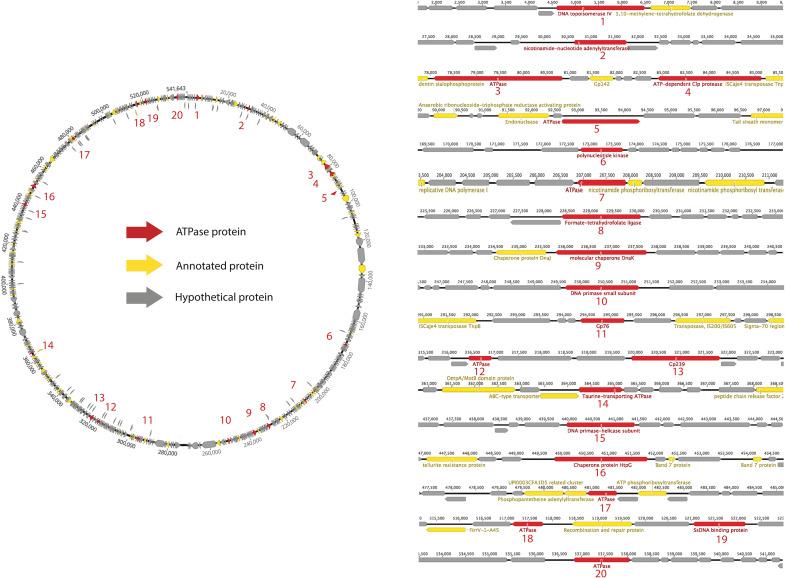
Prokaryote mobilome genomes rely on host machineries for survival and replication. Given that mobile genetic elements (MGEs) derive their energy from host cells, we investigated the diversity of ATP-utilizing proteins in MGE genomes to determine whether they might be associated with proteins that could suppress related host proteins that consume energy. A comprehensive search of 353 huge phage genomes revealed that up to 9% of the proteins have ATPase domains. For example, ATPase proteins constitute ∼3% of the genomes of Lak phages with ∼550 kbp genomes that occur in the microbiomes of humans and other animals. Statistical analysis shows the number of ATPase proteins increases linearly with genome length, consistent with a large sink for host ATP during replication of megaphages. Using metagenomic data from diverse environments, we found 505 mobilome proteins with ATPase domains fused to diverse functional domains. Among these composite ATPase proteins, 61.6% have known functional domains that could contribute to host energy diversion during the mobilome infection cycle. As many have domains that are known to interact with nucleic acids and proteins, we infer that numerous ATPase proteins are used during replication and for protection from host immune systems. We found a set of uncharacterized ATPase proteins with nuclease and protease activities, displaying unique domain architectures that are energy intensive based on the presence of multiple ATPase domains. In many cases, these composite ATPase proteins genomically co-localize with small proteins in genomic contexts that are reminiscent of toxin-antitoxin systems and phage helicase-antibacterial helicase systems. Small proteins that function as inhibitors may be a common strategy for control of cellular processes, thus could inspire future biochemical experiments for the development of new nucleic acid and protein manipulation tools, with diverse biotechnological applications.
原核生物可移动基因组依赖宿主机制来生存和复制。鉴于移动遗传元件(MGEs)从宿主细胞获取能量,我们研究了MGE基因组中利用ATP的蛋白质的多样性,以确定它们是否可能与能够抑制相关宿主耗能蛋白质的蛋白质相关。对353个巨大噬菌体基因组的全面搜索显示,高达9%的蛋白质具有ATP酶结构域。例如,ATP酶蛋白约占Lak噬菌体基因组的3%,Lak噬菌体基因组大小约为550 kbp,存在于人类和其他动物的微生物群中。统计分析表明,ATP酶蛋白的数量随基因组长度呈线性增加,这与巨型噬菌体复制过程中宿主ATP的大量消耗一致。利用来自不同环境的宏基因组数据,我们发现了505种具有ATP酶结构域并与不同功能结构域融合的可移动基因组蛋白质。在这些复合ATP酶蛋白中,61.6%具有已知的功能结构域,这些结构域可能在可移动基因组感染周期中导致宿主能量转移。由于许多蛋白具有已知的与核酸和蛋白质相互作用的结构域,我们推断在复制过程中以及为了抵御宿主免疫系统会使用大量ATP酶蛋白。我们发现了一组具有核酸酶和蛋白酶活性的未表征ATP酶蛋白,基于多个ATP酶结构域的存在,它们展示出独特的、耗能的结构域架构。在许多情况下,这些复合ATP酶蛋白在基因组中与小蛋白共定位,这种基因组背景让人联想到毒素-抗毒素系统和噬菌体解旋酶-抗菌解旋酶系统。作为抑制剂发挥作用的小蛋白可能是控制细胞过程的常见策略,因此可能会激发未来开发新的核酸和蛋白质操作工具的生化实验,并具有多种生物技术应用。




 Zotero 插件