Dumitrache Mihai-Daniel, Jieanu Ana Stefania, Scheau Cristian, Badarau Ioana Anca, Popescu George Denis Alexandru, Caruntu Ana, Costache Daniel Octavian, Costache Raluca Simona, Constantin Carolina, Neagu Monica, Caruntu Constantin
Department of Pneumology IV, 'Marius Nasta' Institute of Pneumophtysiology, 050159 Bucharest, Romania.
Department of Physiology, 'Carol Davila' University of Medicine and Pharmacy, 050474 Bucharest, Romania.
Exp Ther Med. 2021 Sep;22(3):917. doi: 10.3892/etm.2021.10349. Epub 2021 Jun 29.
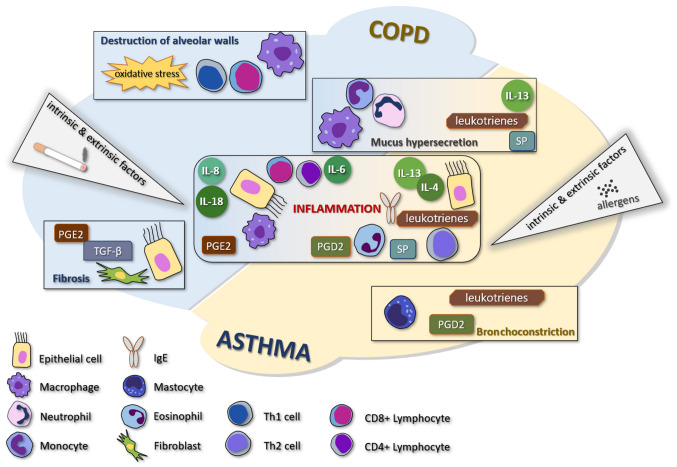
Chronic obstructive pulmonary disease (COPD) and asthma are chronic respiratory diseases with high prevalence and mortality that significantly alter the quality of life in affected patients. While the cellular and molecular mechanisms engaged in the development and evolution of these two conditions are different, COPD and asthma share a wide array of symptoms and clinical signs that may impede differential diagnosis. However, the distinct signaling pathways regulating cough and airway hyperresponsiveness employ the interaction of different cells, molecules, and receptors. Transient receptor potential cation channel subfamily V member 1 (TRPV1) plays a major role in cough and airway inflammation. Consequently, its agonist, capsaicin, is of substantial interest in exploring the cellular effects and regulatory pathways that mediate these respiratory conditions. Increasingly more studies emphasize the use of capsaicin for the inhalation cough challenge, yet the involvement of TRPV1 in cough, bronchoconstriction, and the initiation of inflammation has not been entirely revealed. This review outlines a comparative perspective on the effects of capsaicin and its receptor in the pathophysiology of COPD and asthma, underlying the complex entanglement of molecular signals that bridge the alteration of cellular function with the multitude of clinical effects.
慢性阻塞性肺疾病(COPD)和哮喘是患病率和死亡率较高的慢性呼吸道疾病,会显著改变患者的生活质量。虽然这两种疾病发生发展的细胞和分子机制不同,但COPD和哮喘有许多共同的症状和体征,可能会妨碍鉴别诊断。然而,调节咳嗽和气道高反应性的不同信号通路涉及不同细胞、分子和受体之间的相互作用。瞬时受体电位阳离子通道亚家族V成员1(TRPV1)在咳嗽和气道炎症中起主要作用。因此,其激动剂辣椒素对于探索介导这些呼吸道疾病的细胞效应和调节途径具有重要意义。越来越多的研究强调使用辣椒素进行吸入性咳嗽激发试验,然而TRPV1在咳嗽、支气管收缩和炎症起始中的作用尚未完全阐明。本综述概述了辣椒素及其受体在COPD和哮喘病理生理学中的作用的比较观点,强调了将细胞功能改变与多种临床效应联系起来的分子信号的复杂交织。