Strohbehn Ian A, Zhao Sophia, Seethapathy Harish, Lee Meghan, Rusibamayila Nifasha, Allegretti Andrew S, Parada Xavier Vela, Sise Meghan E
Department of Medicine, Division of Nephrology, Massachusetts General Hospital, Boston, Massachusetts, USA.
Kidney Int Rep. 2021 Oct;6(10):2565-2574. doi: 10.1016/j.ekir.2021.07.008. Epub 2021 Jul 15.
Acute kidney injury (AKI) is a common complication in patients with severe COVID-19. We sought to compare the AKI incidence and outcomes among patients hospitalized with COVID-19 and with influenza.
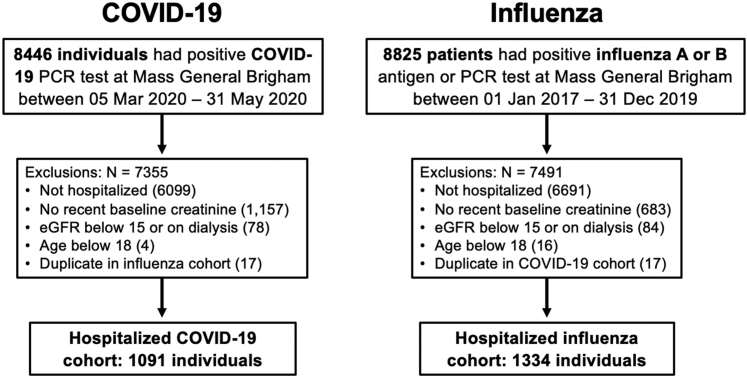
This was a retrospective cohort study of patients with COVID-19 hospitalized between March and May 2020 and historical controls hospitalized with influenza A or B between January 2017 and December 2019 within a large health care system. Cox proportional hazards models were used to compare the risk of AKI during hospitalization. Secondary outcomes included AKI recovery, mortality, new-onset chronic kidney disease (CKD), and ≥25% estimated glomerular filtration rate (eGFR) decline.
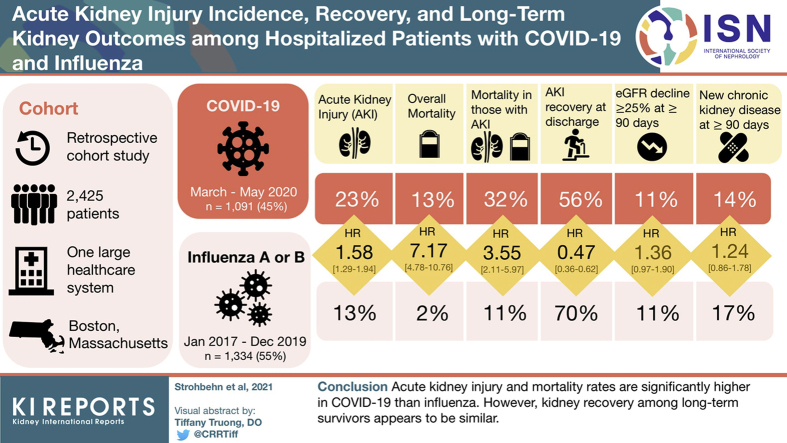
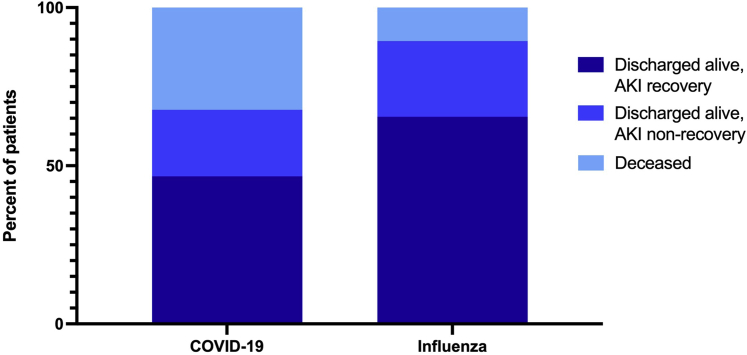
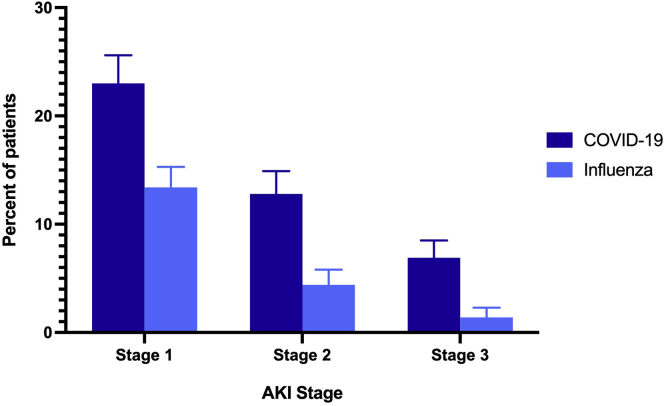
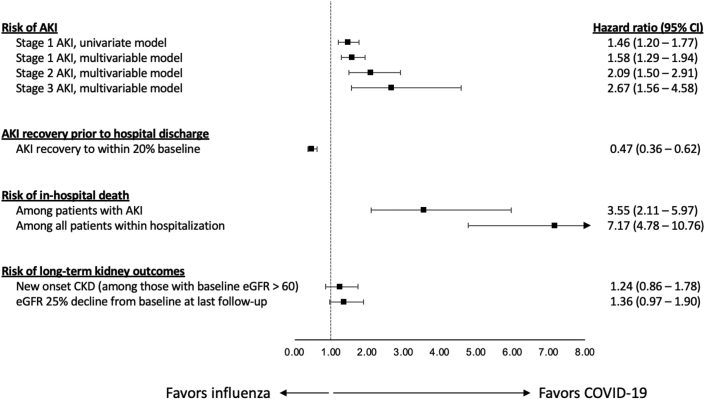
A total of 2425 patients were included; 1091 (45%) had COVID-19, and 1334 (55%) had influenza. The overall AKI rate was 23% and 13% in patients with COVID-19 and influenza, respectively. Compared with influenza, hospitalized patients with COVID-19 had an increased risk of developing AKI (adjusted hazard ratio [aHR] = 1.58; 95% confidence interval [CI], 1.29-1.94). Patients with AKI were more likely to die in the hospital when infected with COVID-19 versus influenza (aHR = 3.55; 95% CI, 2.11-5.97). Among patients surviving to hospital discharge, the rate of AKI recovery was lower in patients with COVID-19 (aHR = 0.47; 95% CI, 0.36-0.62); however, among patients followed for ≥90 days, new-onset CKD (aHR = 1.24; 95% CI, 0.86-1.78) and ≥25% eGFR decline at the last follow-up (aHR = 1.36, 95% CI, 0.97-1.90) were not significantly different between the cohorts.
AKI and mortality rates are significantly higher in patients with COVID-19 than influenza; however, kidney recovery among long-term survivors appears to be similar.
急性肾损伤(AKI)是重症新型冠状病毒肺炎(COVID-19)患者常见的并发症。我们试图比较COVID-19住院患者与流感住院患者的AKI发病率及预后情况。
这是一项回顾性队列研究,研究对象为2020年3月至5月期间因COVID-19住院的患者以及2017年1月至2019年12月期间在一个大型医疗系统内因甲型或乙型流感住院的历史对照患者。采用Cox比例风险模型比较住院期间发生AKI的风险。次要结局包括AKI恢复情况、死亡率、新发慢性肾脏病(CKD)以及估计肾小球滤过率(eGFR)下降≥25%。
共纳入2425例患者;1091例(45%)患有COVID-19,1334例(55%)患有流感。COVID-19患者和流感患者的总体AKI发生率分别为23%和13%。与流感患者相比,COVID-19住院患者发生AKI的风险增加(校正风险比[aHR]=1.58;95%置信区间[CI],1.29-1.94)。感染COVID-19的AKI患者比感染流感的患者更有可能死于医院(aHR=3.55;95%CI,2.11-5.97)。在存活至出院的患者中,COVID-19患者的AKI恢复率较低(aHR=0.47;95%CI,0.36-0.62);然而,在随访≥90天的患者中,两个队列之间新发CKD(aHR=1.24;95%CI,0.86-1.78)以及末次随访时eGFR下降≥25%(aHR=1.36,95%CI,0.97-1.90)并无显著差异。
COVID-19患者的AKI和死亡率显著高于流感患者;然而,长期存活者的肾脏恢复情况似乎相似。