Department of Veterinary Pathobiology, College of Veterinary Medicine, University of Missouri, Columbia, MO, USA.
Department of Genetics and Office of the Vice Chancellor for Research, Univeristy of North Carolina-Chapel Hill, Chapel Hill, NC, USA.
Mamm Genome. 2022 Mar;33(1):203-212. doi: 10.1007/s00335-021-09894-0. Epub 2021 Jul 27.
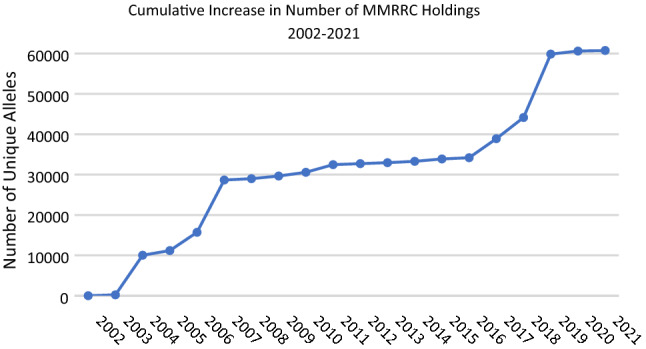
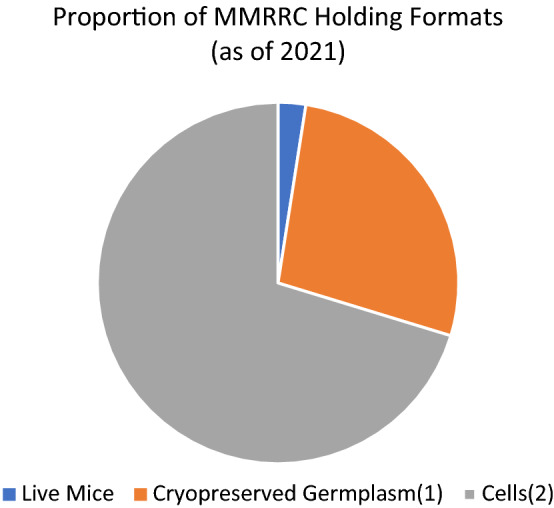
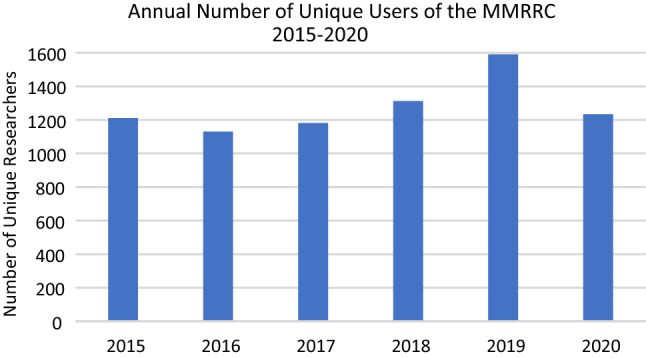
The Mutant Mouse Resource and Research Center (MMRRC) Program is the pre-eminent public national mutant mouse repository and distribution archive in the USA, serving as a national resource of mutant mice available to the global scientific community for biomedical research. Established more than two decades ago with grants from the National Institutes of Health (NIH), the MMRRC Program supports a Consortium of regionally distributed and dedicated vivaria, laboratories, and offices (Centers) and an Informatics Coordination and Service Center (ICSC) at three academic teaching and research universities and one non-profit genetic research institution. The MMRRC Program accepts the submission of unique, scientifically rigorous, and experimentally valuable genetically altered and other mouse models donated by academic and commercial scientists and organizations for deposition, maintenance, preservation, and dissemination to scientists upon request. The four Centers maintain an archive of nearly 60,000 mutant alleles as live mice, frozen germplasm, and/or embryonic stem (ES) cells. Since its inception, the Centers have fulfilled 13,184 orders for mutant mouse models from 9591 scientists at 6626 institutions around the globe. Centers also provide numerous services that facilitate using mutant mouse models obtained from the MMRRC, including genetic assays, microbiome analysis, analytical phenotyping and pathology, cryorecovery, mouse husbandry, infectious disease surveillance and diagnosis, and disease modeling. The ICSC coordinates activities between the Centers, manages the website (mmrrc.org) and online catalog, and conducts communication, outreach, and education to the research community. Centers preserve, secure, and protect mutant mouse lines in perpetuity, promote rigor and reproducibility in scientific experiments using mice, provide experiential training and consultation in the responsible use of mice in research, and pursue cutting edge technologies to advance biomedical studies using mice to improve human health. Researchers benefit from an expansive list of well-defined mouse models of disease that meet the highest standards of rigor and reproducibility, while donating investigators benefit by having their mouse lines preserved, protected, and distributed in compliance with NIH policies.
突变小鼠资源和研究中心(MMRRC)计划是美国首屈一指的公共国家突变小鼠库和分发档案,作为可用于全球科学界进行生物医学研究的突变小鼠国家资源。该计划成立于二十多年前,由美国国立卫生研究院(NIH)拨款支持,由分布在不同地区的专门动物饲养室、实验室和办公室(中心)以及一个信息协调和服务中心(ICSC)组成,该计划设在三所学术教学和研究型大学以及一家非营利遗传研究机构。MMRRC 计划接受来自学术和商业科学家和组织提交的独特、科学严谨且具有实验价值的遗传改变和其他小鼠模型,用于存放、维护、保存和根据请求向科学家分发。四个中心维护着近 60000 个突变等位基因的活鼠、冷冻种质和/或胚胎干细胞档案。自成立以来,该中心已完成了来自全球 6626 个机构的 9591 位科学家的 13184 个突变小鼠模型订单。中心还提供了许多便利使用从 MMRRC 获取的突变小鼠模型的服务,包括遗传检测、微生物组分析、分析表型和病理学、冷冻恢复、小鼠饲养、传染病监测和诊断以及疾病建模。ICSC 协调中心之间的活动,管理网站(mmrrc.org)和在线目录,并进行沟通、外联和教育,以服务于研究界。中心永久保存、保障和保护突变小鼠品系,促进使用小鼠进行科学实验的严谨性和可重复性,提供负责任使用小鼠进行研究的经验培训和咨询,并追求前沿技术,以推进使用小鼠进行生物医学研究,从而改善人类健康。研究人员受益于一系列经过严格定义的疾病小鼠模型,这些模型符合严格和可重复性的最高标准,而捐赠调查人员则受益于他们的小鼠品系按照 NIH 政策进行保存、保护和分发。