• 文献检索
  • 文档翻译
  • 深度研究
  • 学术资讯
  • Suppr Zotero 插件Zotero 插件
  • 邀请有礼
  • 套餐&价格
  • 历史记录
应用&插件
Suppr Zotero 插件Zotero 插件浏览器插件Mac 客户端Windows 客户端微信小程序
定价
高级版会员购买积分包购买API积分包
服务
文献检索文档翻译深度研究API 文档MCP 服务
关于我们
关于 Suppr公司介绍联系我们用户协议隐私条款
关注我们

Suppr 超能文献

核心技术专利:CN118964589B侵权必究
粤ICP备2023148730 号-1Suppr @ 2026

文献检索

告别复杂PubMed语法,用中文像聊天一样搜索,搜遍4000万医学文献。AI智能推荐,让科研检索更轻松。

立即免费搜索

文件翻译

保留排版,准确专业,支持PDF/Word/PPT等文件格式,支持 12+语言互译。

免费翻译文档

深度研究

AI帮你快速写综述,25分钟生成高质量综述,智能提取关键信息,辅助科研写作。

立即免费体验

乌干达已婚妇女使用现代避孕药具的个体和社区层面因素与多水平混合效应分析。

Multilevel mixed effects analysis of individual and community level factors associated with modern contraceptive use among married women in Uganda.

机构信息

Department of Statistical Methods and Actuarial Science, School of Statistics & Planning, College of Business and Management Sciences, Makerere University, P.O. Box 7062, Kampala, Uganda.

Department of Population Studies, School of Statistics & Planning, College of Business and Management Sciences, Makerere University, P.O. Box 7062, Kampala, Uganda.

出版信息

BMC Public Health. 2021 Jul 27;21(1):1457. doi: 10.1186/s12889-021-11069-0.

DOI:10.1186/s12889-021-11069-0
PMID:34315436
原文链接:https://pmc.ncbi.nlm.nih.gov/articles/PMC8314485/
Abstract

BACKGROUND

In spite of the universal right for women to decide freely for themselves when, and how many children they want to have in life, married women in Uganda are less likely to use modern contraceptives as compared to other marital categories. This study examines the individual and community factors associated with modern contraceptive use among married women in Uganda.

METHODS

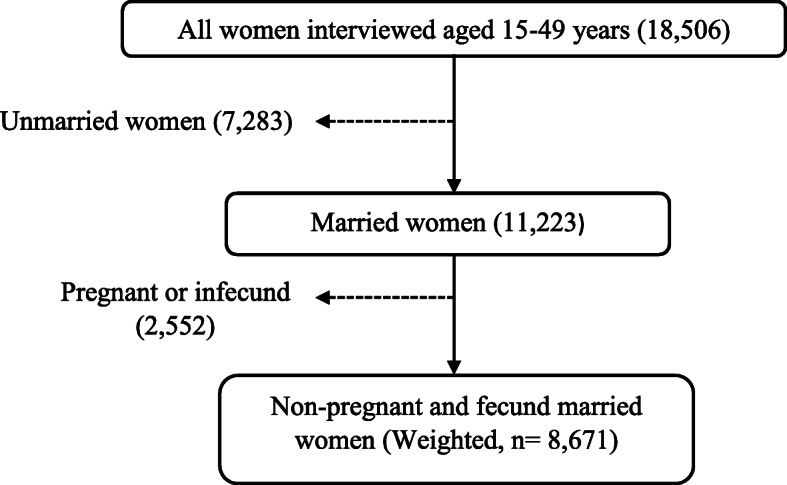
The study used data from the 2016 Uganda Demographic and Health Survey which comprised of 8671 married women aged 15-49 years who were fecund and non-pregnant at the time of the survey. Analysis was done using a multilevel mixed-effects logistic regression model.

RESULTS

Findings showed that married women who were; Muslims (AOR = 0.78, CI = 0.66-0.91), had more than five children (AOR = 0.76, CI = 0.61-0.98), staying in communities with high poverty (AOR = 0.78, CI = 0.65-0.93), with older age at first birth (AOR = 0.94, CI = 0.92-0.96) as well as having spousal age difference of more than 9 years (AOR = 0.86, CI = 0.76-0.98) were associated with low modern contraceptive use. Women living in communities with higher age at first marriage (AOR = 0.93, CI = 0.88-0.98) or higher sexual debut (AOR = 0.91, CI = 0.85-0.98) were also associated with reduced odds of modern contraception. In addition, older women (AOR = 1.03, CI = 1.01-1.04), having secondary/higher education (AOR = 1.93, CI = 1.58-2.37), living in a rich household (AOR = 1.32, CI = 1.14-1.53), short distance to health facility (AOR = 1.18, CI = 1.06-1.31), high community education (AOR = 1.38, CI = 1.17-1.62), high community exposure to family planning messages (AOR = 1.24, CI = 1.08-1.42), and communities with high proportion of women working (AOR = 1.22, CI = 1.06-1.39) were more likely to use modern contraceptives.

CONCLUSION

The study revealed that both individual and community factors were important in explaining the factors associated with modern contraceptive use among married women in Uganda. Therefore, there is need to invest in community based programs like: family planning outreach services, mass media campaigns and community mobilization activities to help in dissemination of family planning information, increase awareness and promotion in use of modern contraceptives. Also, expansion of higher education and the need to make family planning services available and accessible to areas with limited physical access to health facilities will lead to sustained increase in uptake of modern contraceptives.

摘要

背景

尽管女性拥有自由决定何时生育以及生育数量的普遍权利,但与其他婚姻群体相比,乌干达已婚女性使用现代避孕药具的可能性较低。本研究旨在探讨与乌干达已婚女性使用现代避孕药具相关的个体和社区因素。

方法

本研究使用了 2016 年乌干达人口与健康调查的数据,该调查涵盖了 8671 名年龄在 15-49 岁之间、有生育能力且在调查时未怀孕的已婚女性。分析采用多水平混合效应逻辑回归模型进行。

结果

研究结果表明,以下因素与已婚女性低现代避孕药具使用率相关:信仰伊斯兰教(AOR=0.78,CI=0.66-0.91)、子女数量超过五个(AOR=0.76,CI=0.61-0.98)、居住在贫困程度较高的社区(AOR=0.78,CI=0.65-0.93)、首次生育年龄较大(AOR=0.94,CI=0.92-0.96)以及配偶年龄相差超过 9 岁(AOR=0.86,CI=0.76-0.98)。此外,居住在首次结婚年龄较高的社区(AOR=0.93,CI=0.88-0.98)或首次性行为较早的社区(AOR=0.91,CI=0.85-0.98)的女性也与现代避孕药具使用减少有关。此外,年龄较大的女性(AOR=1.03,CI=1.01-1.04)、接受过中等/高等教育(AOR=1.93,CI=1.58-2.37)、生活在富裕家庭(AOR=1.32,CI=1.14-1.53)、距离卫生机构较近(AOR=1.18,CI=1.06-1.31)、社区教育程度较高(AOR=1.38,CI=1.17-1.62)、社区接受计划生育信息较多(AOR=1.24,CI=1.08-1.42)以及女性就业比例较高的社区(AOR=1.22,CI=1.06-1.39)更有可能使用现代避孕药具。

结论

本研究表明,个体和社区因素在解释乌干达已婚女性使用现代避孕药具的相关因素方面都很重要。因此,有必要投资于以社区为基础的项目,如计划生育外展服务、大众媒体宣传和社区动员活动,以帮助传播计划生育信息、提高认识并促进现代避孕药具的使用。此外,扩大中等教育并使计划生育服务在设施物理条件有限的地区能够获得和使用,将导致现代避孕药具的使用率持续增加。
https://cdn.ncbi.nlm.nih.gov/pmc/blobs/65b6/8314485/1210e1e05546/12889_2021_11069_Fig1_HTML.jpg

相似文献

1
Multilevel mixed effects analysis of individual and community level factors associated with modern contraceptive use among married women in Uganda.乌干达已婚妇女使用现代避孕药具的个体和社区层面因素与多水平混合效应分析。
BMC Public Health. 2021 Jul 27;21(1):1457. doi: 10.1186/s12889-021-11069-0.
2
Individual and community level factors associated with modern contraceptive utilization among married women in the emerging region of Ethiopia: a multilevel mixed effects analysis of the 2019 Ethiopia Mini-Demographic and health survey.个体和社区层面因素与埃塞俄比亚新兴地区已婚妇女现代避孕方法利用的关系:2019 年埃塞俄比亚迷你人口与健康调查的多水平混合效应分析。
BMC Womens Health. 2023 Dec 7;23(1):652. doi: 10.1186/s12905-023-02822-1.
3
Coverage and determinants of modern contraceptive use in sub-Saharan Africa: further analysis of demographic and health surveys.撒哈拉以南非洲地区现代避孕方法的使用情况及决定因素:人口与健康调查的进一步分析。
Reprod Health. 2022 Jan 21;19(1):18. doi: 10.1186/s12978-022-01332-x.
4
Four in ten married women demands satisfied by modern contraceptives in high fertility sub-Saharan Africa countries: a multilevel analysis of demographic and health surveys.高生育率撒哈拉以南非洲国家中,十分之四的已婚妇女要求通过现代避孕药具得到满足:人口与健康调查的多层次分析。
BMC Public Health. 2022 Nov 24;22(1):2169. doi: 10.1186/s12889-022-14610-x.
5
Association between exposure to family planning messages on different mass media channels and the utilization of modern contraceptives among young women in Sierra Leone: insights from the 2019 Sierra Leone Demographic Health Survey.不同大众媒体渠道发布的计划生育信息与塞拉利昂年轻女性现代避孕措施使用率之间的关联:来自 2019 年塞拉利昂人口健康调查的见解。
BMC Womens Health. 2022 Sep 16;22(1):376. doi: 10.1186/s12905-022-01974-w.
6
Modern contraceptive utilization and its associated factors among married women in Senegal: a multilevel analysis.塞内加尔已婚妇女现代避孕方法的利用及其影响因素:多水平分析。
BMC Public Health. 2021 Jan 28;21(1):231. doi: 10.1186/s12889-021-10252-7.
7
Determinants of unmet need for contraceptive method among young married women in Ethiopia: Multilevel analysis of Ethiopia Demographic and Health Survey 2016.埃塞俄比亚年轻已婚女性避孕方法需求未满足的决定因素:基于 2016 年埃塞俄比亚人口与健康调查的多水平分析
PLoS One. 2024 Sep 5;19(9):e0306068. doi: 10.1371/journal.pone.0306068. eCollection 2024.
8
Individual and community level factors associated with modern contraceptive utilization among women in Ethiopia: Multilevel modeling analysis.个体和社区层面因素与埃塞俄比亚妇女现代避孕方法利用的关联:多水平模型分析。
PLoS One. 2024 May 16;19(5):e0303803. doi: 10.1371/journal.pone.0303803. eCollection 2024.
9
Spatial variations and multilevel mixed effect analysis on determinants factors of modern contraceptive utilization among reproductive age women in Ethiopia; proven by Ethiopian mini demographic health survey 2019.埃塞俄比亚 2019 年微型人口健康调查:生殖年龄妇女现代避孕方法利用的决定因素的空间变化和多层次混合效应分析
BMC Womens Health. 2023 Feb 22;23(1):77. doi: 10.1186/s12905-022-02030-3.
10
Complex samples logistic regression analysis of predictors of the current use of modern contraceptive among married or in-union women in Sierra Leone: Insight from the 2013 demographic and health survey.塞拉利昂已婚或同居妇女当前使用现代避孕方法的影响因素的复杂样本逻辑回归分析:来自 2013 年人口与健康调查的见解。
PLoS One. 2020 Apr 16;15(4):e0231630. doi: 10.1371/journal.pone.0231630. eCollection 2020.

引用本文的文献

1
Individual and community level factors influencing modern contraceptive use among women of reproductive age in South Africa: a multilevel analysis.南非育龄妇女现代避孕方法使用情况的个体和社区层面影响因素:一项多层次分析
Contracept Reprod Med. 2025 Aug 25;10(1):53. doi: 10.1186/s40834-025-00392-1.
2
The Effect of Women's Empowerment on Unmet Needs for Family Planning in Tanzania: Analysis of 2022 Tanzania Demographic and Health Survey (TDHS).妇女赋权对坦桑尼亚计划生育未满足需求的影响:2022年坦桑尼亚人口与健康调查(TDHS)分析
BMC Public Health. 2025 Aug 21;25(1):2863. doi: 10.1186/s12889-025-23945-0.
3
Community and Individual Education Influences on Sexual and Reproductive Health Knowledge in Uganda: A Human Capital and Social Learning Perspective.

本文引用的文献

1
Determinants of unintended pregnancies among currently married women in Uganda.乌干达目前已婚妇女意外怀孕的决定因素。
J Health Popul Nutr. 2020 Dec 7;39(1):15. doi: 10.1186/s41043-020-00218-7.
2
Determinants of modern contraceptive use among married women of reproductive age: a cross-sectional study in rural Zambia.育龄已婚妇女现代避孕方法使用的决定因素:赞比亚农村的一项横断面研究。
BMJ Open. 2020 Mar 31;10(3):e030980. doi: 10.1136/bmjopen-2019-030980.
3
Individual and community level associates of contraceptive use in Ethiopia: a multilevel mixed effects analysis.
乌干达社区和个人教育对性与生殖健康知识的影响:人力资本与社会学习视角
Popul Res Policy Rev. 2025;44(4):38. doi: 10.1007/s11113-025-09958-y. Epub 2025 Jun 17.
4
Utilization of modern contraceptive methods among women of reproductive age in Senegal: A multilevel mixed-effects analysis.塞内加尔育龄妇女现代避孕方法的使用情况:多层次混合效应分析
PLoS One. 2025 May 20;20(5):e0323899. doi: 10.1371/journal.pone.0323899. eCollection 2025.
5
Factors influencing exclusive breastfeeding in Sub-Saharan Africa: analysis of demographic and health surveys.撒哈拉以南非洲地区纯母乳喂养的影响因素:人口与健康调查分析
BMC Public Health. 2025 May 15;25(1):1790. doi: 10.1186/s12889-025-23045-z.
6
Effects of family planning education given to married illiterate women of reproductive age via visual material support on family planning related attitudes and contraceptive preferences: the example of Viranşehir, Türkiye.通过视觉材料支持对已婚育龄文盲妇女进行计划生育教育对计划生育相关态度和避孕偏好的影响:以土耳其维兰谢希尔为例。
BMC Womens Health. 2025 May 9;25(1):219. doi: 10.1186/s12905-025-03756-6.
7
Beyond individual-level factors that influence family planning uptake among women with diabetes mellitus: a systematic literature review.影响糖尿病女性计划生育措施采用率的个体层面因素之外:一项系统文献综述
BMC Public Health. 2025 Jan 24;25(1):317. doi: 10.1186/s12889-024-20784-3.
8
Validation of the contraception-focused Preference-aligned Fertility Management Index in Uganda and Nigeria.以避孕为重点的偏好一致生育管理指数在乌干达和尼日利亚的验证。
Contraception. 2025 Apr;144:110813. doi: 10.1016/j.contraception.2025.110813. Epub 2025 Jan 10.
9
"We provide the methods to others but we don't use the methods ourselves": challenges with utilization of modern contraception among Female Healthcare Workers at two tertiary teaching hospitals, Northern Uganda.“我们把方法提供给他人,自己却不用这些方法”:乌干达北部两家三级教学医院女性医护人员使用现代避孕方法面临的挑战
Contracept Reprod Med. 2024 Oct 31;9(1):54. doi: 10.1186/s40834-024-00313-8.
10
Prevalence, distribution and factors associated with modern contraceptive use among women of reproductive age in Uganda: evidence from UDHS 2016.乌干达育龄妇女现代避孕方法的使用情况、分布及相关因素:来自2016年乌干达人口与健康调查的证据
Contracept Reprod Med. 2024 Jun 28;9(1):32. doi: 10.1186/s40834-024-00288-6.
埃塞俄比亚避孕措施使用情况的个体及社区层面关联因素:一项多层次混合效应分析
Arch Public Health. 2019 Oct 30;77:46. doi: 10.1186/s13690-019-0371-z. eCollection 2019.
4
Improved contraceptive use among women and men in Uganda between 1995-2016: A repeated cross-sectional population study.1995-2016 年乌干达男女避孕措施使用的改善:一项重复的横断面人群研究。
PLoS One. 2019 Jul 18;14(7):e0219963. doi: 10.1371/journal.pone.0219963. eCollection 2019.
5
Community and health systems barriers and enablers to family planning and contraceptive services provision and use in Kabwe District, Zambia.赞比亚卡布韦区计划生育及避孕服务提供与使用中的社区和卫生系统障碍及促进因素
BMC Health Serv Res. 2018 May 31;18(1):390. doi: 10.1186/s12913-018-3136-4.
6
Partner Support for Family Planning and Modern Contraceptive Use in Luanda, Angola.安哥拉罗安达地区伴侣对计划生育及现代避孕方法使用的支持
Afr J Reprod Health. 2017 Jun;21(2):35-48. doi: 10.29063/ajrh2017/v21i2.5.
7
Community influences on modern contraceptive use among young women in low and middle-income countries: a cross-sectional multi-country analysis.社区对中低收入国家年轻女性现代避孕方法使用的影响:一项多国家横断面分析。
BMC Public Health. 2018 Apr 2;18(1):430. doi: 10.1186/s12889-018-5331-y.
8
Women decision-making capacity and intimate partner violence among women in sub-Saharan Africa.撒哈拉以南非洲地区女性的决策能力与亲密伴侣暴力行为
Arch Public Health. 2018 Jan 29;76:5. doi: 10.1186/s13690-018-0253-9. eCollection 2018.
9
Modern contraceptive use, unmet need, and demand satisfied among women of reproductive age who are married or in a union in the focus countries of the Family Planning 2020 initiative: a systematic analysis using the Family Planning Estimation Tool.计划生育 2020 倡议重点国家中已婚或处于伴侣关系的育龄妇女的现代避孕措施使用、未满足的避孕需求和需求得到满足情况:利用计划生育估计工具进行的系统分析。
Lancet. 2018 Mar 3;391(10123):870-882. doi: 10.1016/S0140-6736(17)33104-5. Epub 2017 Dec 5.
10
The family planning conundrum in Afghanistan.阿富汗的计划生育难题。
Health Promot Int. 2018 Apr 1;33(2):311-317. doi: 10.1093/heapro/daw081.