Kim Bong Jun, Youn Dong Hyuk, Chang In Bok, Kang Keunsoo, Jeon Jin Pyeong
Institute of New Frontier Stroke Research, Hallym University College of Medicine, Chuncheon, Korea.
Department of Neurosurgery, Hallym University College of Medicine, Chuncheon, Korea.
J Korean Neurosurg Soc. 2022 Jan;65(1):4-12. doi: 10.3340/jkns.2021.0035. Epub 2021 Jul 29.
We reported the differentially methylated genes in patients with subarachnoid hemorrhage (SAH) using bioinformatics analyses to explore the biological characteristics of the development of delayed cerebral ischemia (DCI).
DNA methylation profiles obtained from 40 SAH patients from an epigenome-wide association study were analyzed. Functional enrichment analysis, protein-protein interaction (PPI) network, and module analyses were carried out.
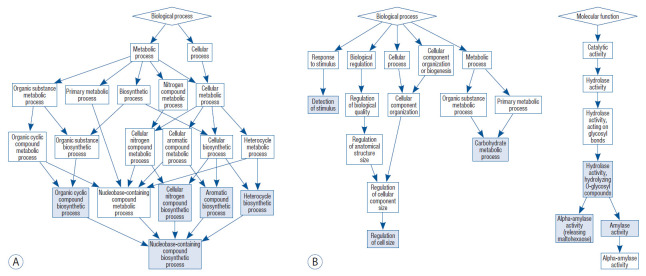
A total of 13 patients (32.5%) experienced DCI during the follow-up. In total, we categorized the genes into the two groups of hypermethylation (n=910) and hypomethylation (n=870). The hypermethylated genes referred to biological processes of organic cyclic compound biosynthesis, nucleobase-containing compound biosynthesis, heterocycle biosynthesis, aromatic compound biosynthesis and cellular nitrogen compound biosynthesis. The hypomethylated genes referred to biological processes of carbohydrate metabolism, the regulation of cell size, and the detection of a stimulus, and molecular functions of amylase activity, and hydrolase activity. Based on PPI network and module analysis, three hypermethylation modules were mainly associated with antigen-processing, Golgi-to-ER retrograde transport, and G alpha (i) signaling events, and two hypomethylation modules were associated with post-translational protein phosphorylation and the regulation of natural killer cell chemotaxis. VHL, KIF3A, KIFAP3, RACGAP1, and OPRM1 were identified as hub genes for hypermethylation, and ALB and IL5 as hub genes for hypomethylation.
This study provided novel insights into DCI pathogenesis following SAH. Differently methylated hub genes can be useful biomarkers for the accurate DCI diagnosis.
我们使用生物信息学分析报告蛛网膜下腔出血(SAH)患者中差异甲基化基因,以探索迟发性脑缺血(DCI)发生发展的生物学特征。
分析来自一项全基因组关联研究的40例SAH患者的DNA甲基化谱。进行功能富集分析、蛋白质-蛋白质相互作用(PPI)网络分析和模块分析。
共有13例患者(32.5%)在随访期间发生DCI。我们总共将基因分为高甲基化组(n = 910)和低甲基化组(n = 870)。高甲基化基因涉及有机环状化合物生物合成、含核碱基化合物生物合成、杂环生物合成、芳香族化合物生物合成和细胞氮化合物生物合成等生物学过程。低甲基化基因涉及碳水化合物代谢、细胞大小调节和刺激检测等生物学过程,以及淀粉酶活性和水解酶活性等分子功能。基于PPI网络和模块分析,三个高甲基化模块主要与抗原加工、高尔基体到内质网逆行转运和Gα(i)信号事件相关,两个低甲基化模块与蛋白质翻译后磷酸化和自然杀伤细胞趋化性调节相关。VHL、KIF3A、KIFAP3、RACGAP1和OPRM1被鉴定为高甲基化的枢纽基因,ALB和IL5被鉴定为低甲基化的枢纽基因。
本研究为SAH后DCI的发病机制提供了新的见解。差异甲基化的枢纽基因可作为准确诊断DCI的有用生物标志物。