Departments of Physiology, McGill University, Montreal, Qc, Canada.
Departments of Medicine, McGill University, Montreal, Qc, Canada.
Rev Endocr Metab Disord. 2022 Apr;23(2):265-277. doi: 10.1007/s11154-021-09679-5. Epub 2021 Jul 29.
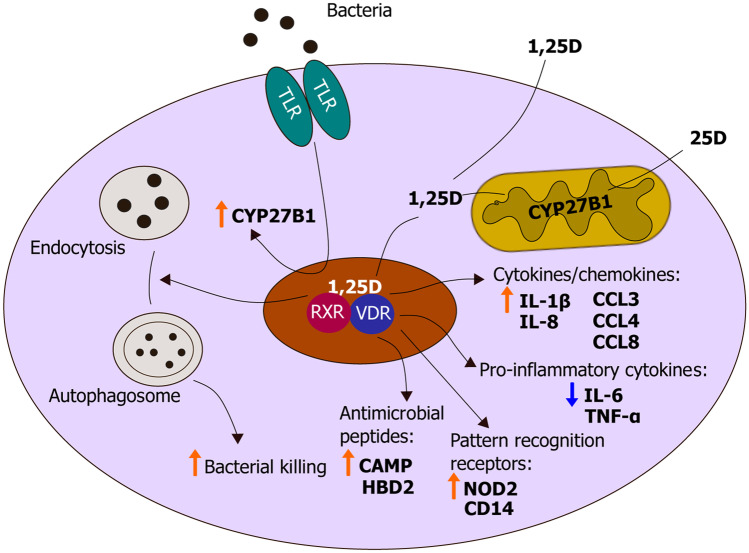
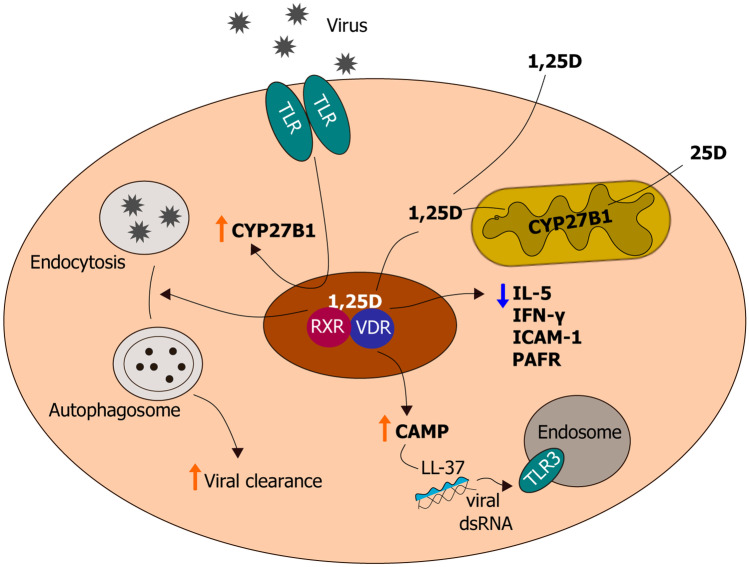
Vitamin D, best known for its role in skeletal health, has emerged as a key regulator of innate immune responses to microbial threat. In immune cells such as macrophages, expression of CYP27B1, the 25-hydroxyvitamin D 1α-hydroxylase, is induced by immune-specific inputs, leading to local production of hormonal 1,25-dihydroxyvitamin D (1,25D) at sites of infection, which in turn directly induces the expression of genes encoding antimicrobial peptides. Vitamin D signaling is active upstream and downstream of pattern recognition receptors, which promote front-line innate immune responses. Moreover, 1,25D stimulates autophagy, which has emerged as a mechanism critical for control of intracellular pathogens such as M. tuberculosis. Strong laboratory and epidemiological evidence links vitamin D deficiency to increased rates of conditions such as dental caries, as well as inflammatory bowel diseases arising from dysregulation of innate immune handling intestinal flora. 1,25D is also active in signaling cascades that promote antiviral innate immunity; 1,25D-induced expression of the antimicrobial peptide CAMP/LL37, originally characterized for its antibacterial properties, is a key component of antiviral responses. Poor vitamin D status is associated with greater susceptibility to viral infections, including those of the respiratory tract. Although the severity of the COVID-19 pandemic has been alleviated in some areas by the arrival of vaccines, it remains important to identify therapeutic interventions that reduce disease severity and mortality, and accelerate recovery. This review outlines of our current knowledge of the mechanisms of action of vitamin D signaling in the innate immune system. It also provides an assessment of the therapeutic potential of vitamin D supplementation in infectious diseases, including an up-to-date analysis of the putative benefits of vitamin D supplementation in the ongoing COVID-19 crisis.
维生素 D 是一种以调节骨骼健康而闻名的物质,它已成为先天免疫反应对微生物威胁的关键调节剂。在巨噬细胞等免疫细胞中,CYP27B1(25-羟维生素 D 1α-羟化酶)的表达受免疫特异性输入诱导,导致感染部位局部产生激素 1,25-二羟维生素 D(1,25D),进而直接诱导编码抗菌肽的基因表达。维生素 D 信号在模式识别受体的上游和下游均活跃,促进一线先天免疫反应。此外,1,25D 刺激自噬,自噬已成为控制结核分枝杆菌等细胞内病原体的关键机制。强有力的实验室和流行病学证据表明,维生素 D 缺乏与龋齿等疾病的发生率增加有关,也与先天免疫失调引起的炎症性肠病有关。1,25D 还在促进抗病毒先天免疫的信号级联反应中发挥作用;最初因其抗菌特性而被表征的抗菌肽 CAMP/LL37 的 1,25D 诱导表达,是抗病毒反应的关键组成部分。维生素 D 状态不佳与病毒感染的易感性增加有关,包括呼吸道感染。尽管一些地区疫苗的到来缓解了 COVID-19 大流行的严重程度,但确定减少疾病严重程度和死亡率并加速康复的治疗干预措施仍然很重要。这篇综述概述了我们目前对维生素 D 信号在先天免疫系统中的作用机制的了解。它还评估了维生素 D 补充在传染病中的治疗潜力,包括对维生素 D 补充在当前 COVID-19 危机中潜在益处的最新分析。