Fletcher Jane, Bishop Emma L, Harrison Stephanie R, Swift Amelia, Cooper Sheldon C, Dimeloe Sarah K, Raza Karim, Hewison Martin
Nutrition Nurses, University Hospitals Birmingham NHS Trust, Queen Elizabeth Hospital Birmingham, Mindelsohn Way, Edgbaston, Birmingham, UK.
School of Nursing, Institute of Clinical Sciences, University of Birmingham, Edgbaston, Birmingham, UK.
Endocr Connect. 2022 Mar 31;11(3):e210554. doi: 10.1530/EC-21-0554.
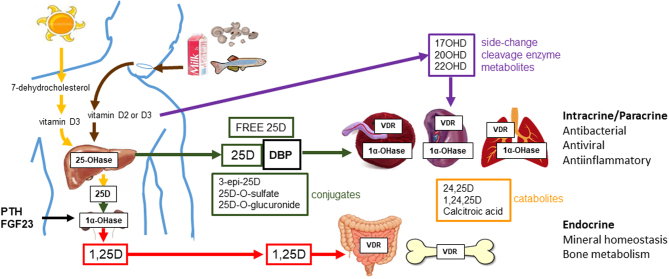
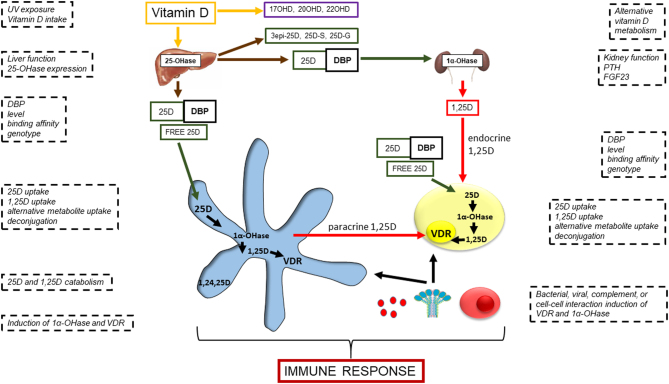
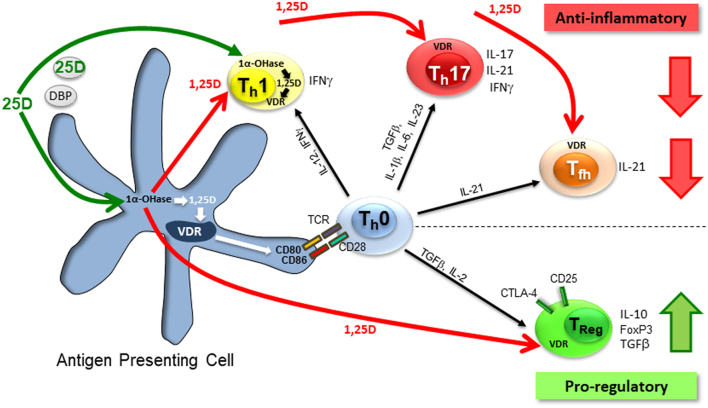
Vitamin D has well-documented effects on calcium homeostasis and bone metabolism but recent studies suggest a much broader role for this secosteroid in human health. Key components of the vitamin D system, notably the vitamin D receptor (VDR) and the vitamin D-activating enzyme (1α-hydroxylase), are present in a wide array of tissues, notably macrophages, dendritic cells and T lymphocytes (T cells) from the immune system. Thus, serum 25-hydroxyvitamin D (25D) can be converted to hormonal 1,25-dihydroxyvitamin D (1,25D) within immune cells, and then interact with VDR and promote transcriptional and epigenomic responses in the same or neighbouring cells. These intracrine and paracrine effects of 1,25D have been shown to drive antibacterial or antiviral innate responses, as well as to attenuate inflammatory T cell adaptive immunity. Beyond these mechanistic observations, association studies have reported the correlation between low serum 25D levels and the risk and severity of human immune disorders including autoimmune diseases such as inflammatory bowel disease, multiple sclerosis, type 1 diabetes and rheumatoid arthritis. The proposed explanation for this is that decreased availability of 25D compromises immune cell synthesis of 1,25D leading to impaired innate immunity and over-exuberant inflammatory adaptive immunity. The aim of the current review is to explore the mechanistic basis for immunomodulatory effects of 25D and 1,25D in greater detail with specific emphasis on how vitamin D-deficiency (low serum levels of 25D) may lead to dysregulation of macrophage, dendritic cell and T cell function and increase the risk of inflammatory autoimmune disease.
维生素D对钙稳态和骨代谢的影响已有充分记载,但最近的研究表明,这种甾体激素在人类健康中发挥着更为广泛的作用。维生素D系统的关键成分,尤其是维生素D受体(VDR)和维生素D激活酶(1α-羟化酶),存在于多种组织中,特别是免疫系统中的巨噬细胞、树突状细胞和T淋巴细胞(T细胞)。因此,血清25-羟基维生素D(25D)可在免疫细胞内转化为激素1,25-二羟基维生素D(1,25D),然后与VDR相互作用,促进同一细胞或邻近细胞中的转录和表观基因组反应。1,25D的这些内分泌和旁分泌作用已被证明可驱动抗菌或抗病毒的先天反应,以及减弱炎症性T细胞适应性免疫。除了这些机制性观察结果外,关联研究报告了低血清25D水平与包括炎症性肠病、多发性硬化症、1型糖尿病和类风湿性关节炎等自身免疫性疾病在内的人类免疫疾病的风险和严重程度之间的相关性。对此提出的解释是,25D可用性的降低会损害免疫细胞合成1,25D,导致先天免疫受损和过度旺盛的炎症性适应性免疫。本综述的目的是更详细地探讨25D和1,25D免疫调节作用的机制基础,特别强调维生素D缺乏(低血清25D水平)如何导致巨噬细胞、树突状细胞和T细胞功能失调,并增加炎症性自身免疫疾病的风险。