F. Hoffmann-La Roche Ltd, Basel, Switzerland.
BC Cancer Centre for Lymphoid Cancer, Vancouver, BC, Canada.
Blood Adv. 2021 Aug 10;5(15):2945-2957. doi: 10.1182/bloodadvances.2021004770.
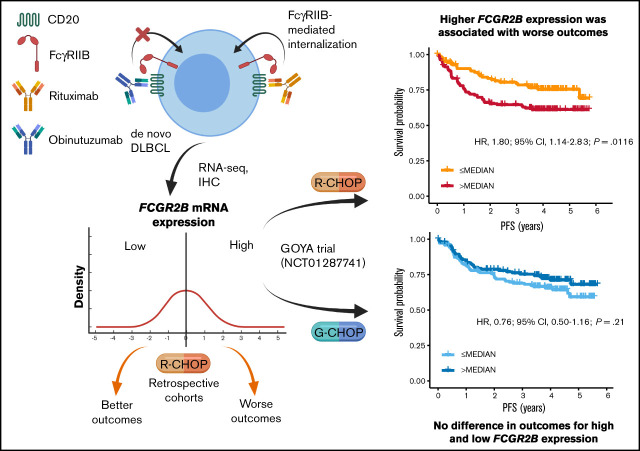
Fc γ receptor IIB (FcγRIIB) is an inhibitory molecule capable of reducing antibody immunotherapy efficacy. We hypothesized its expression could confer resistance in patients with diffuse large B-cell lymphoma (DLBCL) treated with anti-CD20 monoclonal antibody (mAb) chemoimmunotherapy, with outcomes varying depending on mAb (rituximab [R]/obinutuzumab [G]) because of different mechanisms of action. We evaluated correlates between FCGR2B messenger RNA and/or FcγRIIB protein expression and outcomes in 3 de novo DLBCL discovery cohorts treated with R plus cyclophosphamide, doxorubicin, vincristine, and prednisone (R-CHOP) reported by Arthur, Schmitz, and Reddy, and R-CHOP/G-CHOP-treated patients in the GOYA trial (NCT01287741). In the discovery cohorts, higher FCGR2B expression was associated with significantly shorter progression-free survival (PFS; Arthur: hazard ratio [HR], 1.09; 95% confidence interval [CI], 1.01-1.19; P = .0360; Schmitz: HR, 1.13; 95% CI, 1.02-1.26; P = .0243). Similar results were observed in GOYA with R-CHOP (HR, 1.26; 95% CI, 1.00-1.58; P = .0455), but not G-CHOP (HR, 0.91; 95% CI, 0.69-1.20; P = .50). A nonsignificant trend that high FCGR2B expression favored G-CHOP over R-CHOP was observed (HR, 0.67; 95% CI, 0.44-1.02; P = .0622); however, low FCGR2B expression favored R-CHOP (HR, 1.58; 95% CI, 1.00-2.50; P = .0503). In Arthur and GOYA, FCGR2B expression was associated with tumor FcγRIIB expression; correlating with shorter PFS for R-CHOP (HR, 2.17; 95% CI, 1.04-4.50; P = .0378), but not G-CHOP (HR, 1.37; 95% CI, 0.66-2.87; P = .3997). This effect was independent of established prognostic biomarkers. High FcγRIIB/FCGR2B expression has prognostic value in R-treated patients with DLBCL and may confer differential responsiveness to R-CHOP/G-CHOP.
Fcγ 受体 IIB(FcγRIIB)是一种抑制分子,能够降低抗体免疫疗法的疗效。我们假设它的表达可能会使接受抗 CD20 单克隆抗体(mAb)化疗免疫治疗的弥漫性大 B 细胞淋巴瘤(DLBCL)患者产生耐药性,由于作用机制不同,结果因 mAb(利妥昔单抗[R]/奥滨尤妥珠单抗[G])而异。我们评估了 3 个新诊断的 DLBCL 发现队列中 FCGR2B 信使 RNA 和/或 FcγRIIB 蛋白表达与接受由 Arthur、Schmitz 和 Reddy 报道的 R 加环磷酰胺、多柔比星、长春新碱和泼尼松(R-CHOP)治疗和接受 GOYA 试验(NCT01287741)的 R-CHOP/G-CHOP 治疗的患者的结果之间的相关性。在发现队列中,较高的 FCGR2B 表达与无进展生存期(PFS)显著缩短相关(Arthur:风险比[HR],1.09;95%置信区间[CI],1.01-1.19;P=0.0360;Schmitz:HR,1.13;95%CI,1.02-1.26;P=0.0243)。GOYA 中也观察到了类似的结果(R-CHOP:HR,1.26;95%CI,1.00-1.58;P=0.0455),但在 G-CHOP 中未观察到(HR,0.91;95%CI,0.69-1.20;P=0.50)。观察到高 FCGR2B 表达有利于 G-CHOP 而非 R-CHOP 的趋势(HR,0.67;95%CI,0.44-1.02;P=0.0622);然而,低 FCGR2B 表达有利于 R-CHOP(HR,1.58;95%CI,1.00-2.50;P=0.0503)。在 Arthur 和 GOYA 中,FCGR2B 表达与肿瘤 FcγRIIB 表达相关;与 R-CHOP 的较短 PFS 相关(HR,2.17;95%CI,1.04-4.50;P=0.0378),但与 G-CHOP 无关(HR,1.37;95%CI,0.66-2.87;P=0.3997)。这种效应独立于既定的预后生物标志物。高 FcγRIIB/FCGR2B 表达在接受 R 治疗的 DLBCL 患者中具有预后价值,并且可能赋予对 R-CHOP/G-CHOP 的不同反应性。