Infectious Disease Group, Predictive Science Inc., San Diego, California, United States.
MRC Centre for Outbreak Analysis and Modelling, Department of Infectious Disease Epidemiology, School of Public Health, Imperial College London, United Kingdom.
PLoS Comput Biol. 2021 Jul 29;17(7):e1009230. doi: 10.1371/journal.pcbi.1009230. eCollection 2021 Jul.
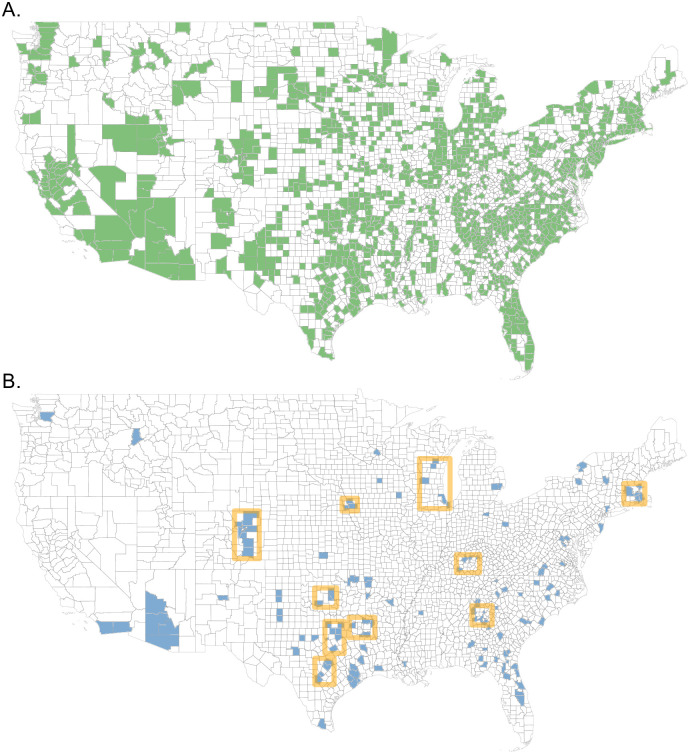
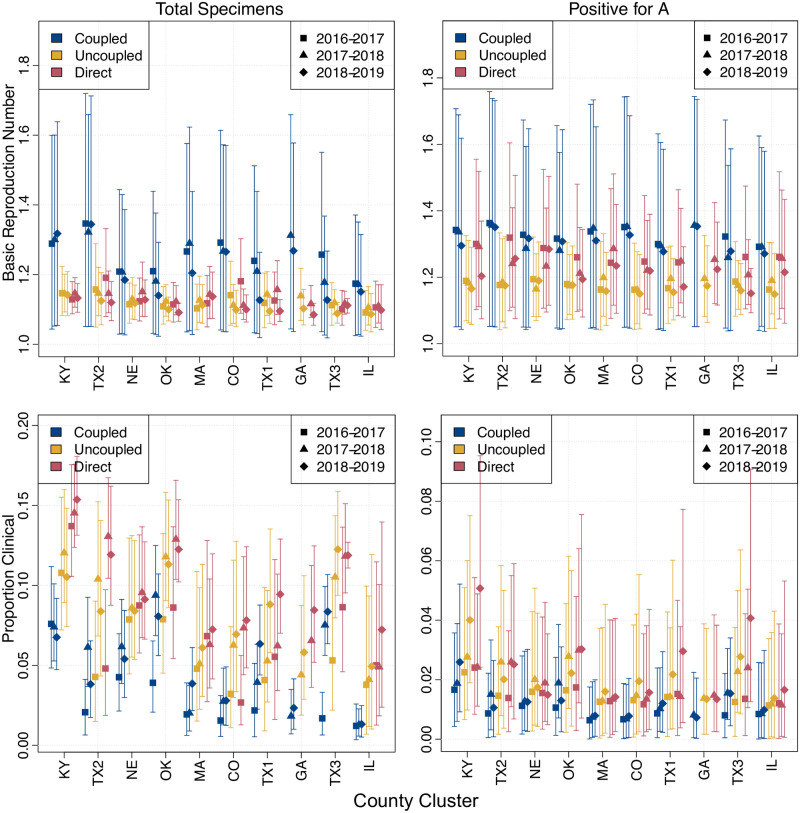
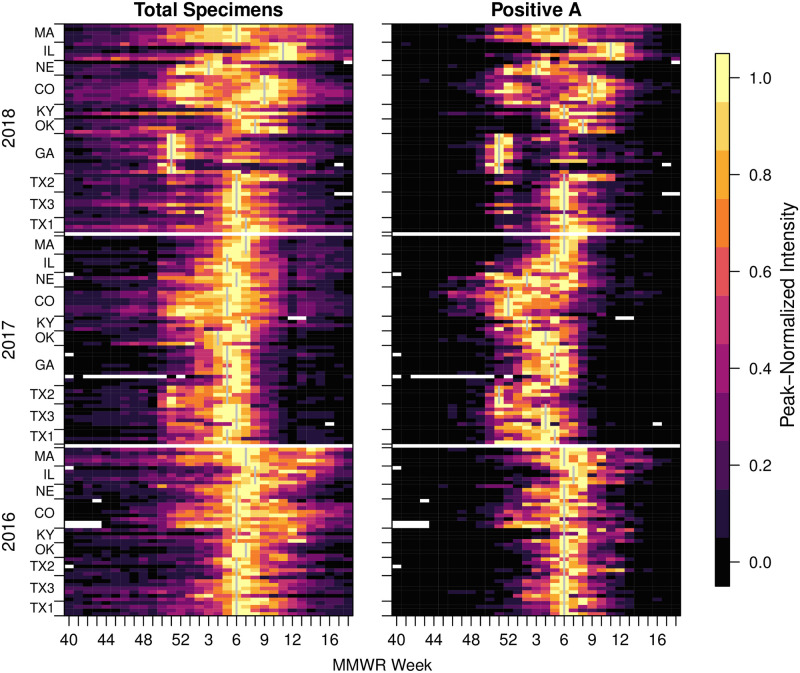
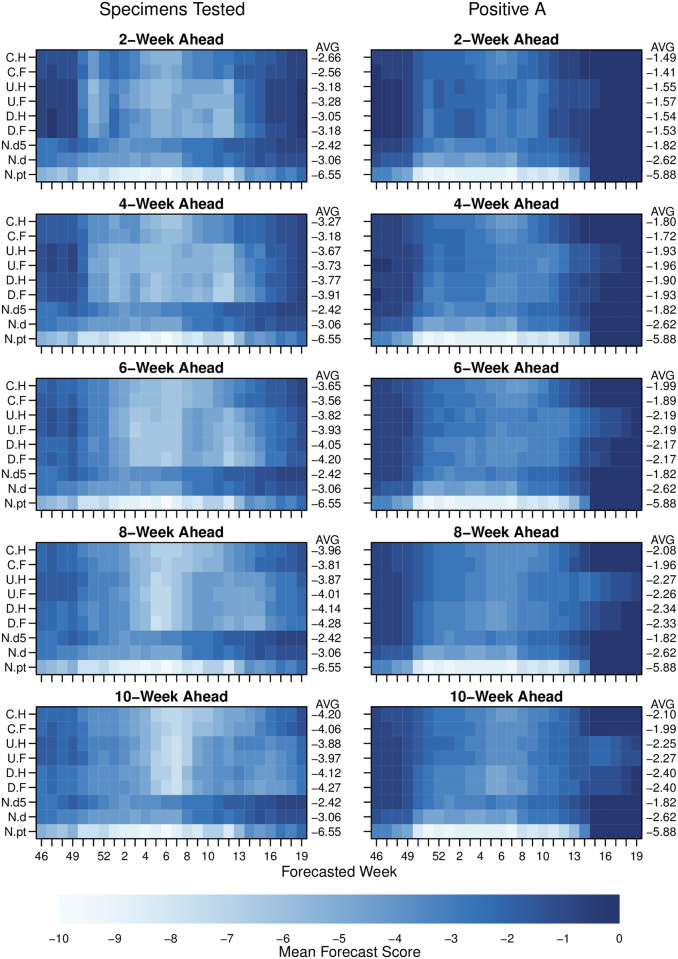
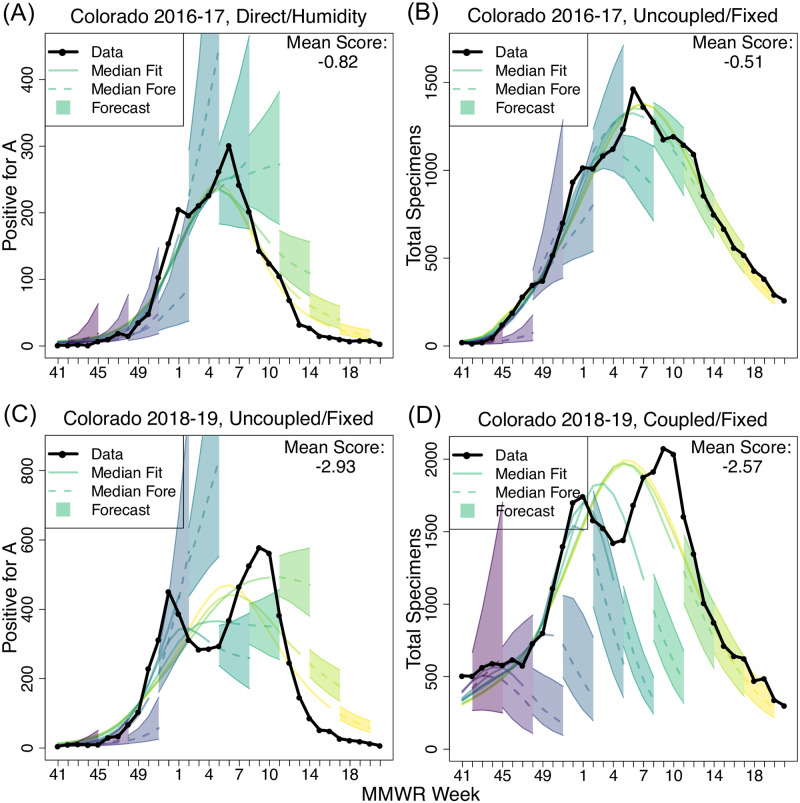
Influenza incidence forecasting is used to facilitate better health system planning and could potentially be used to allow at-risk individuals to modify their behavior during a severe seasonal influenza epidemic or a novel respiratory pandemic. For example, the US Centers for Disease Control and Prevention (CDC) runs an annual competition to forecast influenza-like illness (ILI) at the regional and national levels in the US, based on a standard discretized incidence scale. Here, we use a suite of forecasting models to analyze type-specific incidence at the smaller spatial scale of clusters of nearby counties. We used data from point-of-care (POC) diagnostic machines over three seasons, in 10 clusters, capturing: 57 counties; 1,061,891 total specimens; and 173,909 specimens positive for Influenza A. Total specimens were closely correlated with comparable CDC ILI data. Mechanistic models were substantially more accurate when forecasting influenza A positive POC data than total specimen POC data, especially at longer lead times. Also, models that fit subpopulations of the cluster (individual counties) separately were better able to forecast clusters than were models that directly fit to aggregated cluster data. Public health authorities may wish to consider developing forecasting pipelines for type-specific POC data in addition to ILI data. Simple mechanistic models will likely improve forecast accuracy when applied at small spatial scales to pathogen-specific data before being scaled to larger geographical units and broader syndromic data. Highly local forecasts may enable new public health messaging to encourage at-risk individuals to temporarily reduce their social mixing during seasonal peaks and guide public health intervention policy during potentially severe novel influenza pandemics.
流感发病率预测用于促进更好的卫生系统规划,并可能用于允许高危个体在严重季节性流感流行或新型呼吸道大流行期间改变其行为。例如,美国疾病控制与预防中心 (CDC) 每年都会根据标准化离散发病率量表,在美国的地区和国家层面上进行流感样疾病 (ILI) 的预测竞赛。在这里,我们使用一系列预测模型来分析更小空间尺度的集群附近县的特定类型的发病率。我们使用了三个季节、10 个集群中的即时护理 (POC) 诊断机器的数据,涵盖了:57 个县;1,061,891 份总标本;以及 173,909 份甲型流感阳性标本。总标本与可比的 CDC ILI 数据密切相关。当预测甲型流感阳性 POC 数据时,机制模型比预测总标本 POC 数据的准确性要高得多,尤其是在更长的预测时间内。此外,分别拟合集群子人群(单个县)的模型比直接拟合聚合集群数据的模型更能够预测集群。公共卫生当局可能希望考虑除 ILI 数据之外,还为特定类型的 POC 数据开发预测模型。在将简单的机制模型应用于特定病原体数据的小空间尺度以提高预测准确性之前,将其扩展到更大的地理区域和更广泛的综合征数据,可能会提高预测准确性。高度本地化的预测可以鼓励高危个体在季节性高峰期间暂时减少社交活动,并在潜在严重的新型流感大流行期间指导公共卫生干预政策,从而为新的公共卫生信息传递提供支持。