Leclercq Gabrielle, Haegel Hélène, Schneider Anneliese, Giusti Anna Maria, Marrer-Berger Estelle, Boetsch Christophe, Walz Antje-Christine, Pulko Vesna, Sam Johannes, Challier John, Ferlini Cristiano, Odermatt Alex, Umaña Pablo, Bacac Marina, Klein Christian
Roche Pharma Research and Early Development, Roche Innovation Centre Zurich, Schlieren, Switzerland
Department of Pharmaceutical Sciences, Division of Molecular and Systems Toxicology, University of Basel, Basel, Switzerland.
J Immunother Cancer. 2021 Jul;9(7). doi: 10.1136/jitc-2021-002582.
T cell engagers are bispecific antibodies recognizing, with one moiety, the CD3ε chain of the T cell receptor and, with the other moiety, specific tumor surface antigens. Crosslinking of CD3 upon simultaneous binding to tumor antigens triggers T cell activation, proliferation and cytokine release, leading to tumor cell killing. Treatment with T cell engagers can be associated with safety liabilities due to on-target on-tumor, on-target off-tumor cytotoxic activity and cytokine release syndrome (CRS). Tyrosine kinases such as SRC, LCK or ZAP70 are involved in downstream signaling pathways after engagement of the T cell receptor and blocking these kinases might serve to abrogate T cell activation when required (online supplemental material 1). Dasatinib was previously identified as a potent kinase inhibitor that switches off CAR T cell functionality.
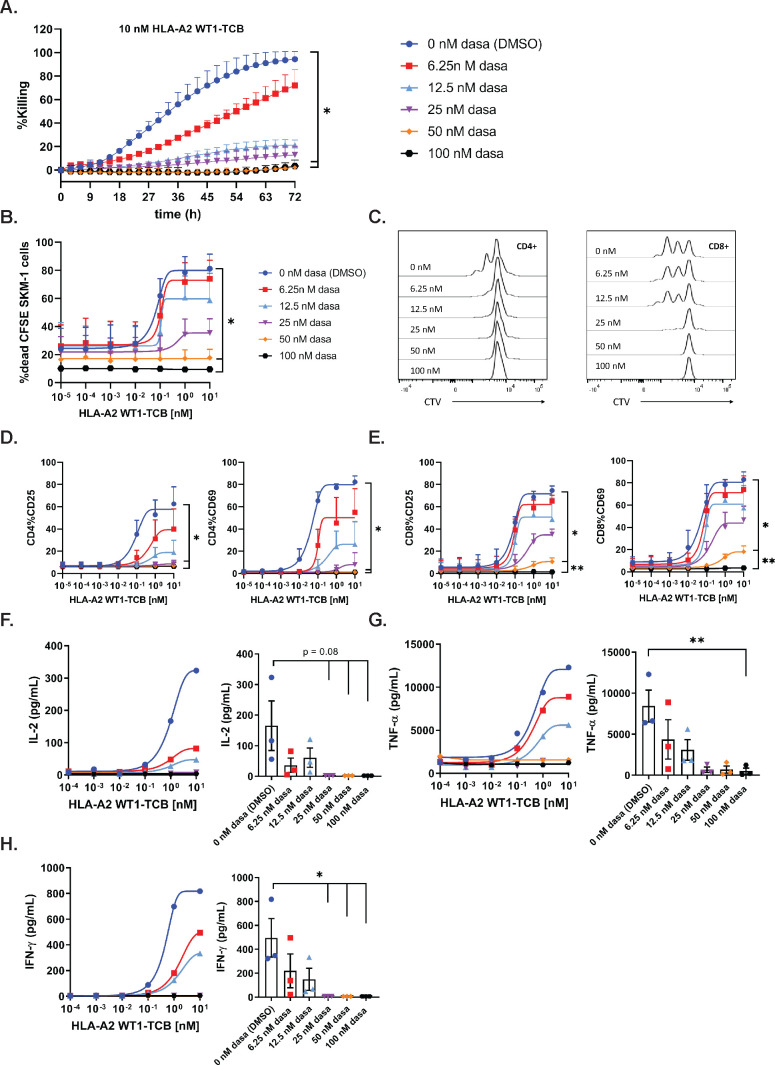
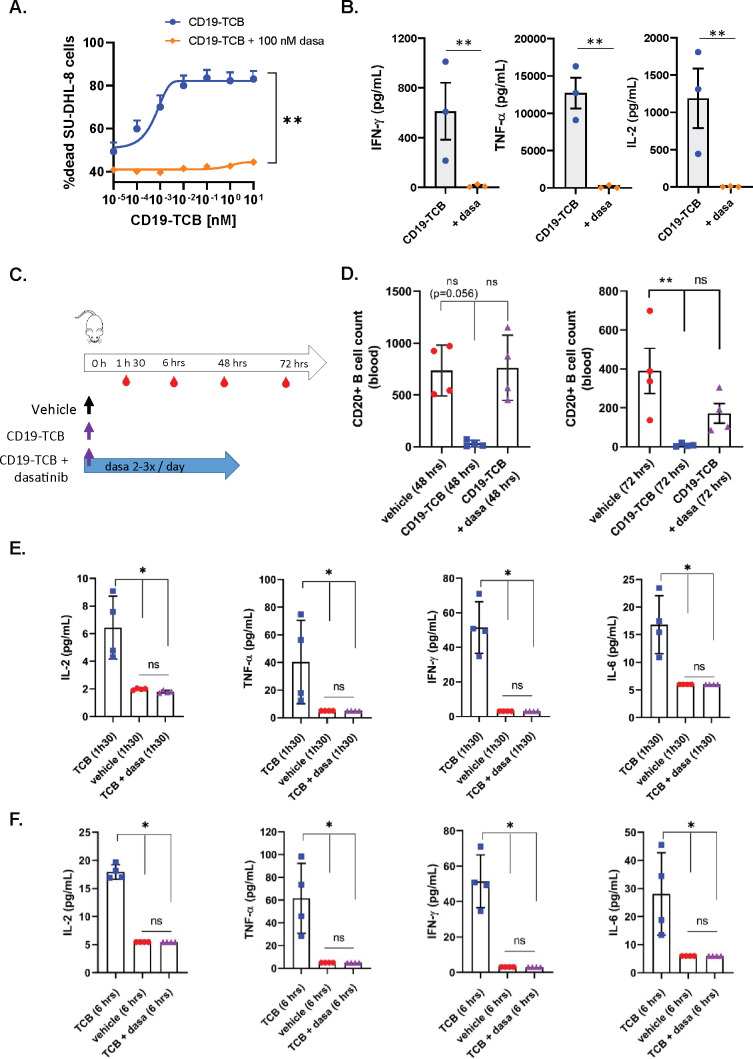
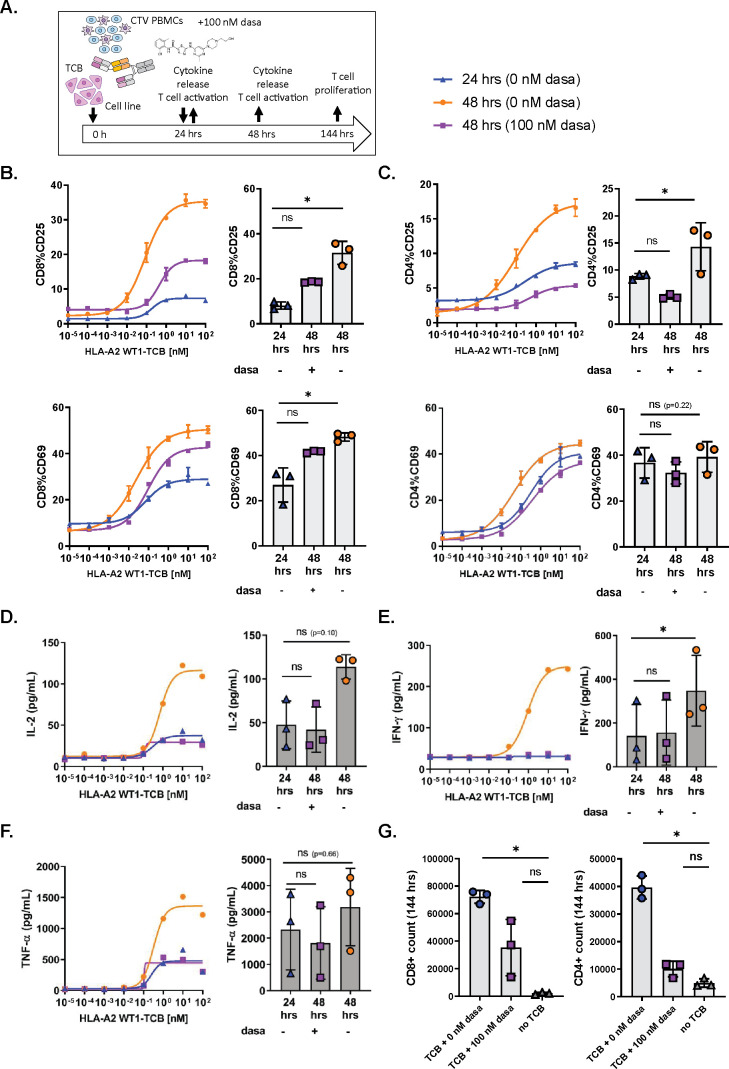
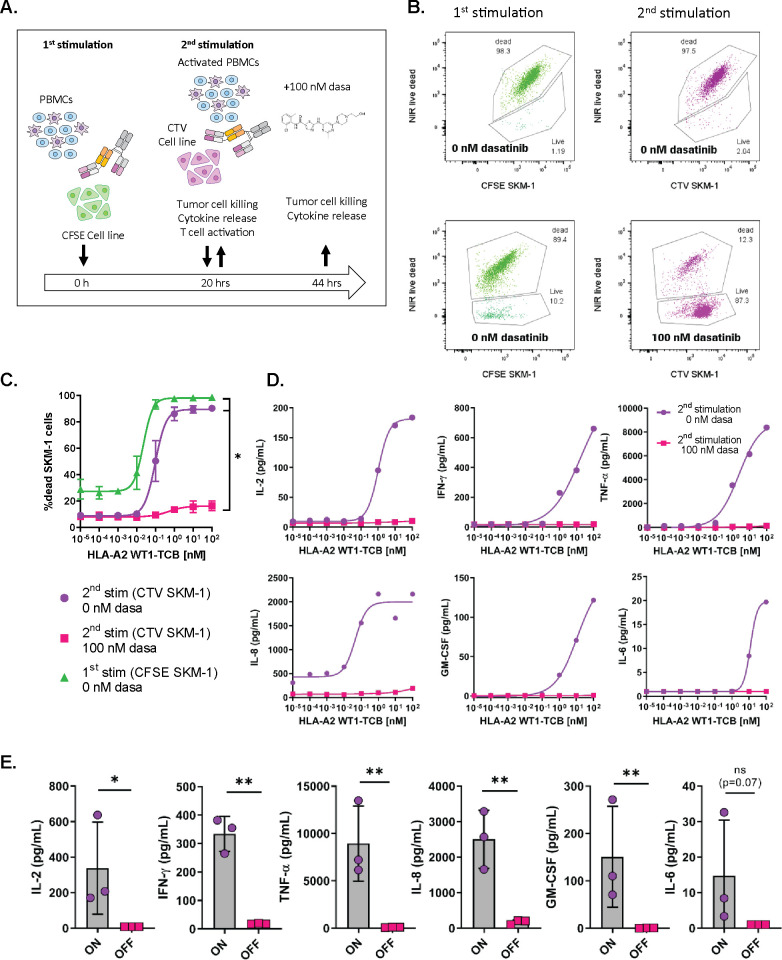
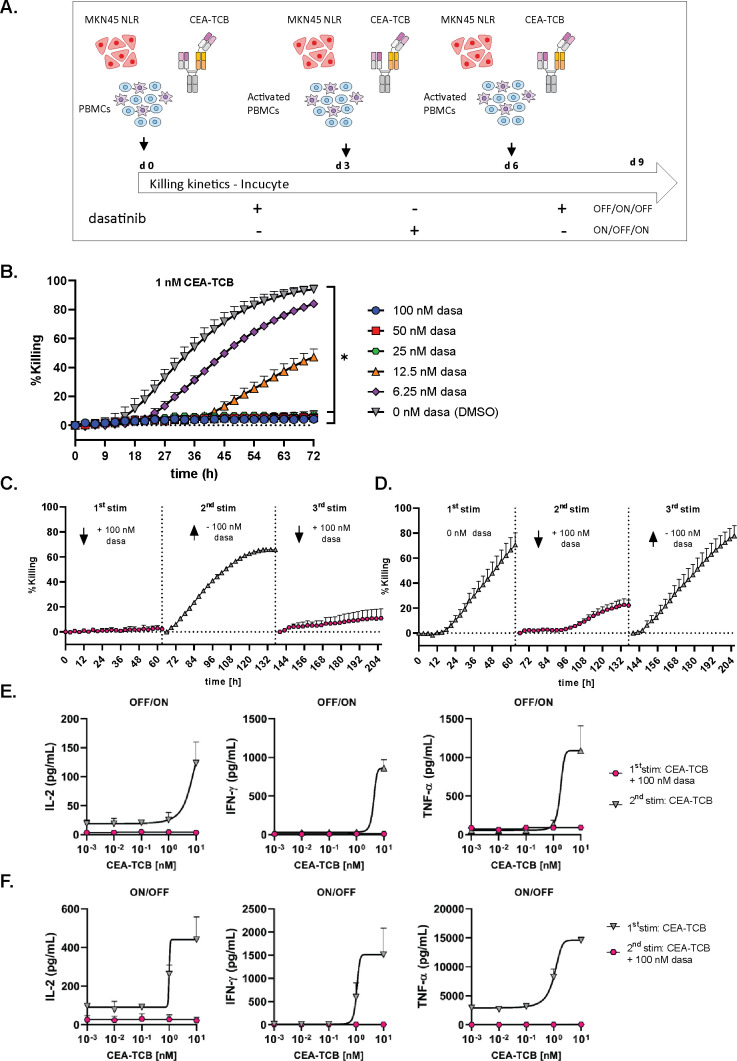
Using an in vitro model of target cell killing by human peripheral blood mononuclear cells, we assessed the effects of dasatinib combined with 2+1 T cell bispecific antibodies (TCBs) including CEA-TCB, CD19-TCB or HLA-A2 WT1-TCB on T cell activation, proliferation and target cell killing measured by flow cytometry and cytokine release measured by Luminex. To determine the effective dose of dasatinib, the Incucyte system was used to monitor the kinetics of TCB-mediated target cell killing in the presence of escalating concentrations of dasatinib. Last, the effects of dasatinib were evaluated in vivo in humanized NSG mice co-treated with CD19-TCB. The count of CD20 blood B cells was used as a readout of efficacy of TCB-mediated killing and cytokine levels were measured in the serum.
Dasatinib concentrations above 50 nM prevented cytokine release and switched off-target cell killing, which were subsequently restored on removal of dasatinib. In addition, dasatinib prevented CD19-TCB-mediated B cell depletion in humanized NSG mice. These data confirm that dasatinib can act as a rapid and reversible on/off switch for activated T cells at pharmacologically relevant doses as they are applied in patients according to the label.
Taken together, we provide evidence for the use of dasatinib as a pharmacological on/off switch to mitigate off-tumor toxicities or CRS by T cell bispecific antibodies.
T细胞衔接器是双特异性抗体,其一个部分识别T细胞受体的CD3ε链,另一个部分识别特定肿瘤表面抗原。CD3在与肿瘤抗原同时结合时发生交联,触发T细胞活化、增殖和细胞因子释放,导致肿瘤细胞杀伤。由于靶向肿瘤、靶向非肿瘤细胞毒性活性和细胞因子释放综合征(CRS),用T细胞衔接器治疗可能存在安全风险。酪氨酸激酶如SRC、LCK或ZAP70参与T细胞受体结合后的下游信号通路,在需要时阻断这些激酶可能有助于消除T细胞活化(在线补充材料1)。达沙替尼先前被鉴定为一种有效的激酶抑制剂,可关闭嵌合抗原受体(CAR)T细胞功能。
使用人外周血单个核细胞杀伤靶细胞的体外模型,我们评估了达沙替尼与2+1 T细胞双特异性抗体(TCB)联合使用的效果,这些TCB包括癌胚抗原(CEA)-TCB、CD19-TCB或HLA-A2 WT1-TCB,通过流式细胞术检测T细胞活化、增殖和靶细胞杀伤情况,通过Luminex检测细胞因子释放情况。为了确定达沙替尼的有效剂量,使用Incucyte系统监测在达沙替尼浓度不断升高的情况下TCB介导的靶细胞杀伤动力学。最后,在与CD19-TCB联合治疗的人源化NSG小鼠体内评估达沙替尼的效果。将CD20血液B细胞计数用作TCB介导杀伤效果的读数,并检测血清中的细胞因子水平。
达沙替尼浓度高于50 nM可防止细胞因子释放并关闭靶细胞杀伤,在去除达沙替尼后这些作用随后恢复。此外,达沙替尼可防止CD19-TCB介导的人源化NSG小鼠B细胞耗竭。这些数据证实,按照药品标签应用时,达沙替尼在药理学相关剂量下可作为活化T细胞的快速可逆开关。
综上所述,我们提供了证据支持使用达沙替尼作为药理学开关,以减轻T细胞双特异性抗体引起的非肿瘤毒性或CRS。