Department of NanoEngineering, University of California San Diego, La Jolla, CA 92093, United States of America.
School of Medicine, University of California San Diego, La Jolla, CA 92093, United States of America.
Biofabrication. 2021 Aug 13;13(4). doi: 10.1088/1758-5090/ac1992.
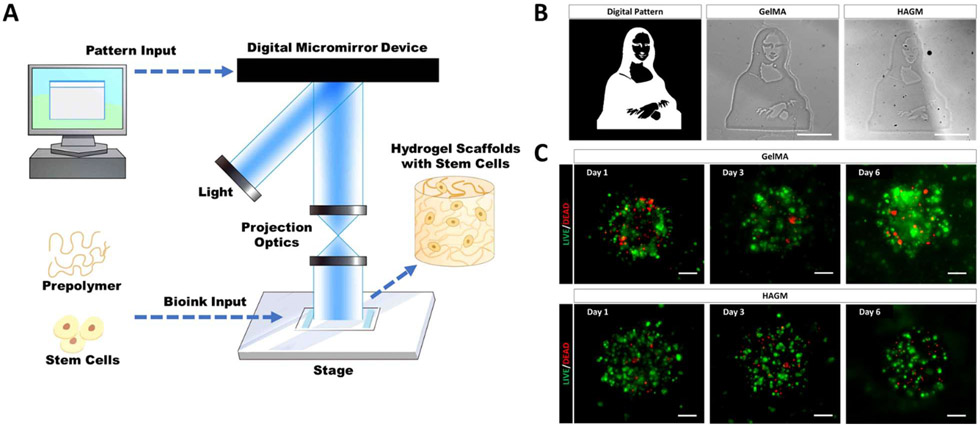
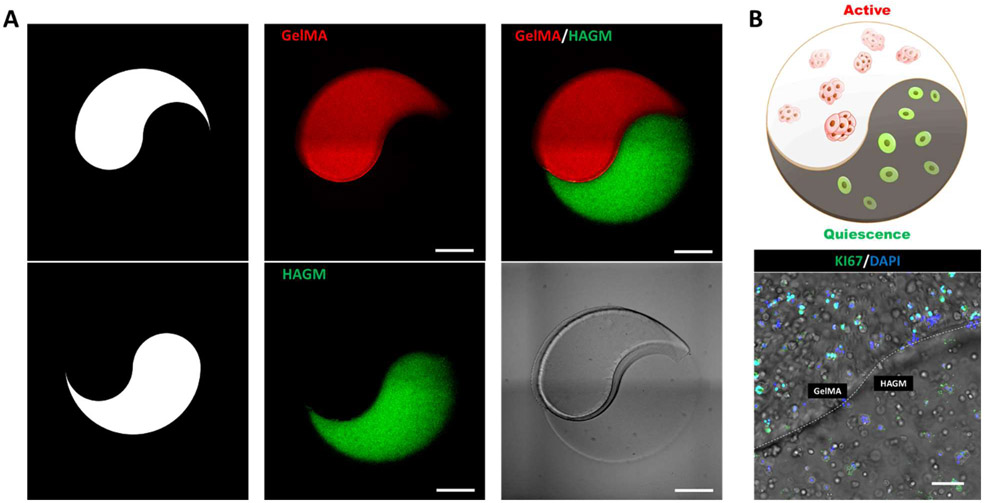
Limbal stem cell deficiency and corneal disorders are among the top global threats for human vision. Emerging therapies that integrate stem cell transplantation with engineered hydrogel scaffolds for biological and mechanical support are becoming a rising trend in the field. However, methods for high-throughput fabrication of hydrogel scaffolds, as well as knowledge of the interaction between limbal stem/progenitor cells (LSCs) and the surrounding extracellular matrix (ECM) are still much needed. Here, we employed digital light processing (DLP)-based bioprinting to fabricate hydrogel scaffolds encapsulating primary LSCs and studied the ECM-dependent LSC phenotypes. The DLP-based bioprinting with gelatin methacrylate (GelMA) or hyaluronic acid glycidyl methacrylate (HAGM) generated microscale hydrogel scaffolds that could support the viability of the encapsulated primary rabbit LSCs (rbLSCs) in culture. Immunocytochemistry and transcriptional analysis showed that the encapsulated rbLSCs remained active in GelMA-based scaffolds while exhibited quiescence in the HAGM-based scaffolds. The primary human LSCs encapsulated within bioprinted scaffolds showed consistent ECM-dependent active/quiescent statuses. Based on these results, we have developed a novel bioprinted dual ECM 'Yin-Yang' model encapsulating LSCs to support both active and quiescent statues. Our findings provide valuable insights towards stem cell therapies and regenerative medicine for corneal reconstruction.
角膜缘干细胞缺乏和角膜疾病是全球人类视力面临的主要威胁之一。将干细胞移植与工程化水凝胶支架相结合,为生物和机械支持提供新兴疗法,正在成为该领域的一个新兴趋势。然而,仍然需要高通量制造水凝胶支架的方法,以及了解角膜缘干细胞/祖细胞(LSCs)与周围细胞外基质(ECM)之间的相互作用。在这里,我们采用基于数字光处理(DLP)的生物打印技术来制造包封原代 LSCs 的水凝胶支架,并研究了 ECM 依赖性 LSC 表型。基于 DLP 的生物打印技术,使用明胶甲基丙烯酰(GelMA)或透明质酸缩水甘油甲基丙烯酰(HAGM),可以生成微尺度水凝胶支架,这些支架可以在培养中支持包封的原代兔 LSCs(rbLSCs)的活力。免疫细胞化学和转录分析表明,包封在 GelMA 支架中的 rbLSCs 保持活跃,而在 HAGM 支架中则处于静止状态。包封在生物打印支架中的原代人 LSCs 表现出一致的 ECM 依赖性活跃/静止状态。基于这些结果,我们开发了一种新型的生物打印双重 ECM“阴阳”模型来包封 LSCs,以支持其活跃和静止状态。我们的研究结果为角膜重建的干细胞治疗和再生医学提供了有价值的见解。