Department for Trauma-, Hand- and Reconstructive Surgery, University Hospital Frankfurt, Goethe University, Theodor-Stern-Kai 7, Frankfurt, Germany.
Medical Faculty, Frankfurt Interdisciplinary Simulation Center FIneST, Goethe University, Frankfurt, Germany.
Eur J Trauma Emerg Surg. 2022 Oct;48(5):3793-3801. doi: 10.1007/s00068-021-01695-z. Epub 2021 Jul 30.
Every physician must be able to sufficiently master medical emergencies, especially in medical areas where emergencies occur frequently such as in the emergency room or emergency surgery. This contrasts with the observation that medical students and young residents often feel insufficiently prepared to handle medical emergencies. It is therefore necessary to train them in the treatment of emergency patients. The aim of this study is to analyze the influence of the assignment of manikin versus simulated patients during a training for undergraduate medical students on learning outcomes and the perceived realism.
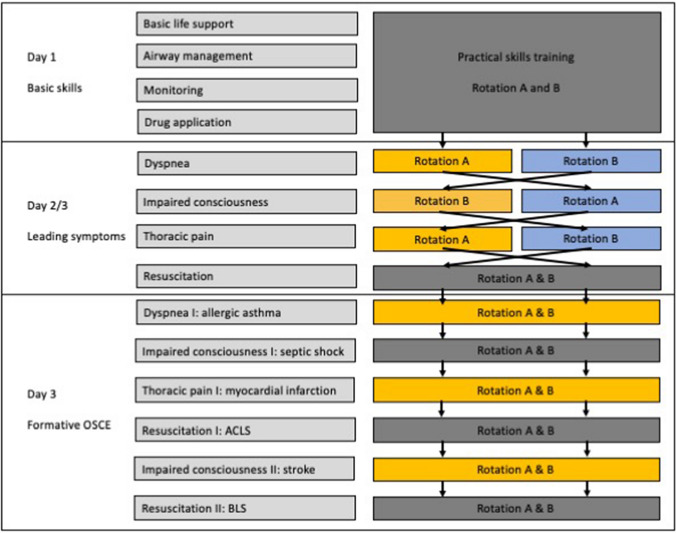
The study had a prospective cross-over design and took place in a 3-day emergency medicine training for undergraduate medical students. Students completed three teaching units ('chest pain', 'impaired consciousness', 'dyspnea'), either with manikin or simulated patient. Using a questionnaire after each unit, overall impression, didactics, content, the quality of practical exercises, and the learning success were evaluated. The gained competences were measured in a 6-station objective structured clinical examination (OSCE) at the end of training.
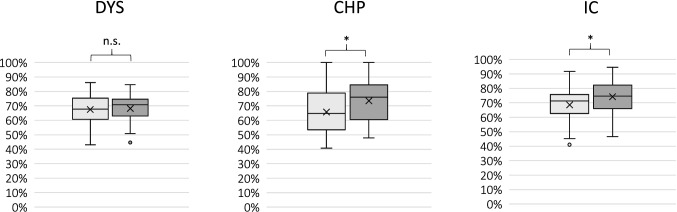
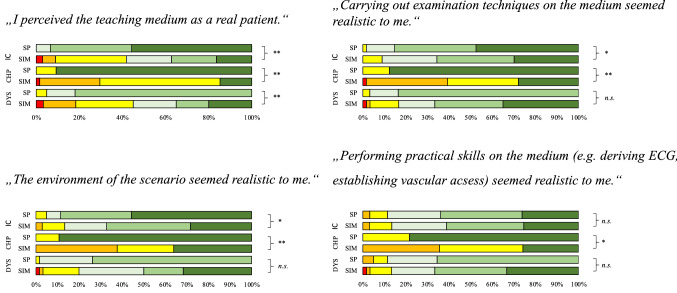
126 students participated. Students rated simulated patients as significantly more realistic than manikins regarding the possibility to carry out examination techniques and taking medical history. 54.92% of the students would prefer to train with simulated patients in the future. Regarding the gained competences for 'chest pain' and 'impaired consciousness', students who trained with a manikin scored less in the OSCE station than the simulated patients-group.
Simulated patients are rated more realistic than manikins and seem to be superior to manikins regarding gained competence.
每位医生都必须能够熟练掌握医疗急救,尤其是在急诊室或急诊手术等急救频繁发生的医学领域。然而,医学学生和年轻住院医师经常感到自己对处理医疗急救准备不足,这与上述观点形成了鲜明对比。因此,有必要对他们进行急救患者的治疗培训。本研究旨在分析在本科医学生急救培训中分配模拟人和模拟患者对学习成果和感知真实性的影响。
该研究采用前瞻性交叉设计,在为期 3 天的本科医学生急诊医学培训中进行。学生完成三个教学单元(“胸痛”、“意识障碍”、“呼吸困难”),分别使用模拟人和模拟患者。在每个单元后使用问卷评估整体印象、教学、内容、实践练习的质量和学习成功。在培训结束时,通过 6 站客观结构化临床考试(OSCE)来衡量获得的能力。
共有 126 名学生参与了研究。学生认为模拟患者在进行检查技术和采集病史方面比模拟人更真实。54.92%的学生表示将来更愿意接受模拟患者培训。在“胸痛”和“意识障碍”方面获得的能力方面,使用模拟人的学生在 OSCE 站的得分低于使用模拟患者组的学生。
模拟患者比模拟人更真实,在获得的能力方面似乎优于模拟人。