Division of Orthopedic Surgery, McMaster University, Hamilton, ON, Canada.
Department of Orthopedics, Henry Ford Health System, Detroit, MI.
Spine (Phila Pa 1976). 2021 Sep 1;46(17):1165-1171. doi: 10.1097/BRS.0000000000003981.
General population utility valuation study.
The aim of this study was to develop a technique for calculating utilities from the Spine Oncology Study Group Outcomes Questionnaire v2.0 (SOSGOQ2.0).
The ability to calculate quality-adjusted life-years (QALYs) for metastatic spine disease would enhance treatment decision-making and facilitate economic analysis. QALYs are calculated using utilities.
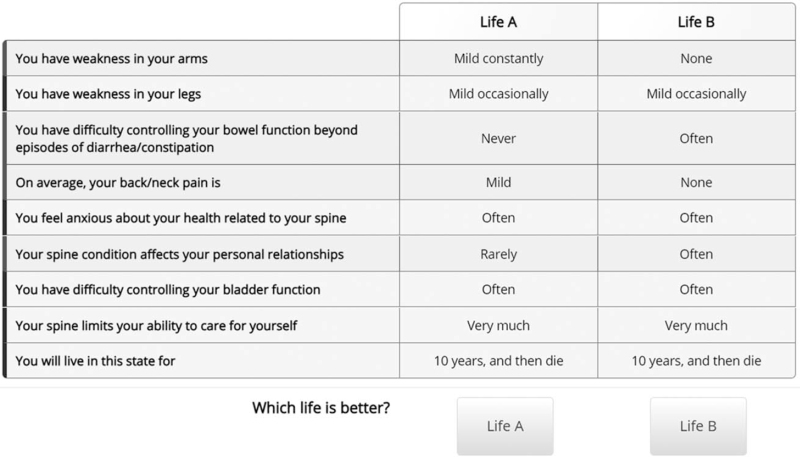
Using a hybrid concept-retention and factorial analysis shortening approach, we first shortened the SOSGOQ2.0 to eight items (SOSGOQ-8D). This was done to lessen the cognitive burden of the utility valuation exercise. A general population sample of 2730 adults was then asked to evaluate 12 choice sets based on SOSGOQ-8D health states in a Discrete Choice Experiment. A utility scoring rubric was then developed using a mixed multinomial-logit regression model.
We were able to reduce the SOSGOQ2.0 to an SOSGOQ-8D with a mean error of 0.003 and mean absolute error of 3.078 compared to the full questionnaire. The regression model demonstrated good predictive performance and was used to develop a utility scoring rubric. Regression results revealed that participants did not regard all SOSGOQ-8D items as equally important.
We provide a simple technique for converting the SOSGOQ2.0 to utilities. The ability to evaluate QALYs in metastatic spine disease will facilitate economic analysis and patient counseling. We also quantify the importance of individual SOSGOQ-8D items. Clinicians should heed these findings and offer treatments that maximize function in the most important items.Level of Evidence: 3.
一般人群效用估值研究。
本研究旨在开发一种从脊柱肿瘤研究组结局问卷 2.0 版(SOSGOQ2.0)计算效用的技术。
计算转移性脊柱疾病的质量调整生命年(QALYs)将增强治疗决策并促进经济分析。QALYs 通过效用计算。
我们首先使用混合概念保留和因子分析缩短方法将 SOSGOQ2.0 缩短为 8 个项目(SOSGOQ-8D),以减轻效用估值练习的认知负担。然后,我们要求一个 2730 名成年人的一般人群样本在离散选择实验中根据 SOSGOQ-8D 健康状况评估 12 个选择集。然后使用混合多项逻辑回归模型开发了一个效用评分表。
我们能够将 SOSGOQ2.0 减少到 SOSGOQ-8D,平均误差为 0.003,平均绝对误差为 3.078,与完整问卷相比。回归模型表现出良好的预测性能,并用于开发效用评分表。回归结果表明,参与者并不认为 SOSGOQ-8D 的所有项目都同样重要。
我们提供了一种将 SOSGOQ2.0 转换为效用的简单技术。评估转移性脊柱疾病中 QALYs 的能力将促进经济分析和患者咨询。我们还量化了 SOSGOQ-8D 各个项目的重要性。临床医生应注意这些发现,并提供能在最重要项目中最大化功能的治疗方法。
3 级。