Institute of Public Health and Clinical Nutrition, School of Medicine, University of Eastern Finland, Kuopio, FINLAND.
Children's Health and Exercise Research Centre, Sport and Health Sciences, University of Exeter, Exeter, UNITED KINGDOM.
Med Sci Sports Exerc. 2022 Jan 1;54(1):141-152. doi: 10.1249/MSS.0000000000002757.
This study aimed to determine whether estimated cardiorespiratory fitness (CRF), fat mass (FM), lean mass (LM), and adiponectin bidirectionally associate with arterial function and structure and if CRF mediates the relationship between cardiometabolic health and arterial outcomes in 9- to 11-yr-old children drawn from the Avon Longitudinal Study of Parents and Children birth cohort, United Kingdom.
Brachial artery flow-mediated dilation (FMD), distensibility coefficient (DC), and carotid-radial pulse wave velocity (PWV) were measured by ultrasonography; CRF was measured during the submaximal ergometer test; total FM, trunk FM, and LM were measured by dual-energy x-ray absorptiometry; plasma adiponectin was measured by enzyme assay; and cardiometabolic health was computed based on the International Diabetes Federation criteria for diagnosing metabolic syndrome. We tested bidirectionality by including CRF, FM, LM, and adiponectin as exposures and FMD, DC, and PWV as outcomes, alternatively.
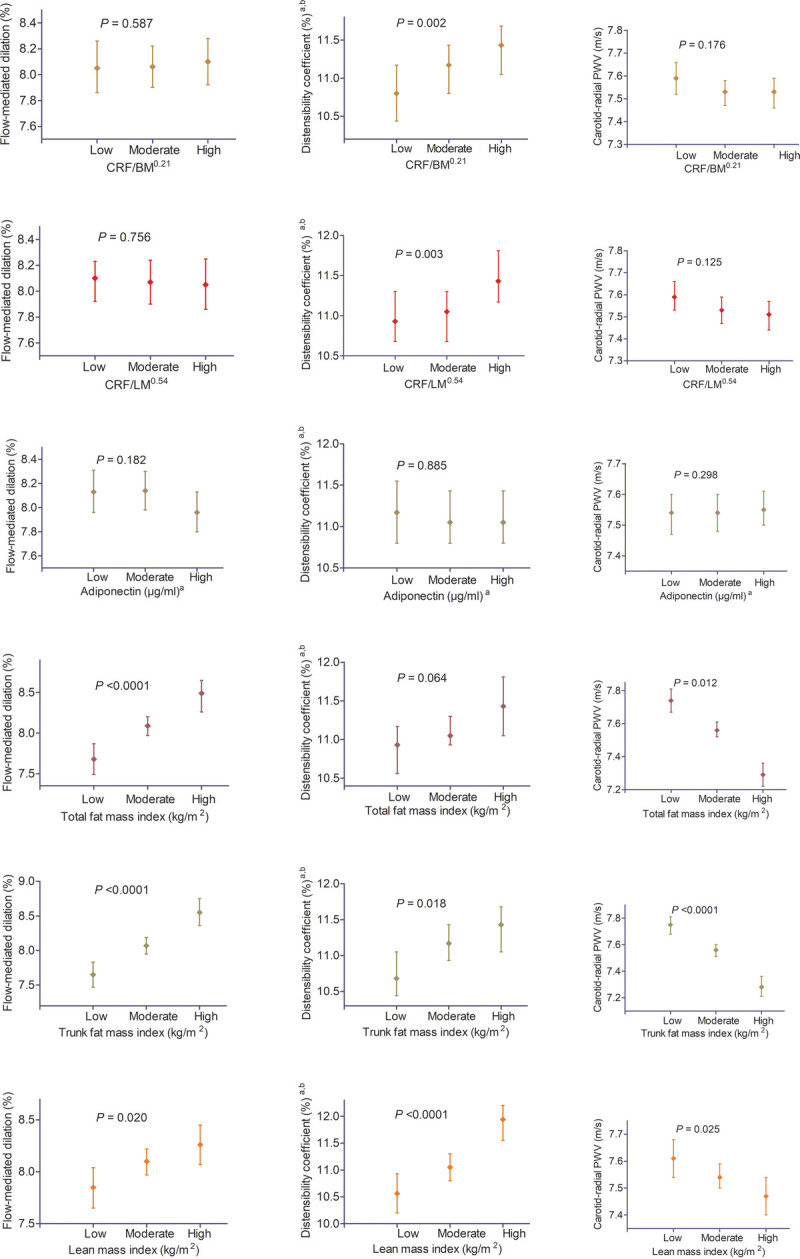
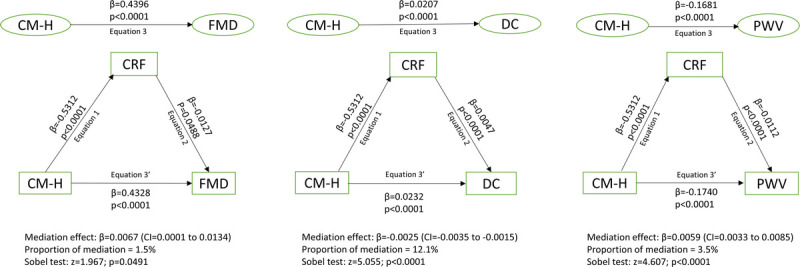
Among 5566 participants (2816 (51%) girls; median age, 9.75 yr), CRF per body mass0.21 was directly related to DC (β (95% confidence interval) = 0.004 (<0.0001 to 0.008); P = 0.046), whereas CRF per LM0.54 was inversely associated with PWV (-0.034 (-0.063 to -0.003); 0.032) after adjusting for covariates. These associations remained in bidirectional analyses. Total FM, trunk FM, and LM were bidirectionally and positively associated with FMD and DC. Total FM and trunk FM but not LM had bidirectional and inverse associations with PWV. Adiponectin was not related to FMD, DC, or PWV. CRF partially mediated the associations of cardiometabolic health with FMD (1.5% mediation), DC (12.1% mediation), and PWV (3.5% mediation).
Associations of poor cardiometabolic health with adverse arterial structure and function in childhood may be mitigated by increasing CRF. Higher CRF was associated with better arterial structure whereas higher total FM and trunk FM were associated with better arterial function and structure. In the reverse analysis, healthy arterial structure and function were independently associated with increased total FM and trunk FM, suggesting an "arterial paradox."
本研究旨在确定在英国阿冯纵向研究父母和儿童出生队列中,9 至 11 岁儿童的估计心肺功能(CRF)、脂肪量(FM)、瘦体量(LM)和脂联素是否与动脉功能和结构双向相关,以及 CRF 是否介导了代谢健康与动脉结果之间的关系。
通过超声测量肱动脉血流介导的扩张(FMD)、扩张系数(DC)和颈动脉-桡动脉脉搏波速度(PWV);在次最大测功计试验期间测量 CRF;通过双能 X 射线吸收法测量总 FM、躯干 FM 和 LM;通过酶联免疫吸附法测量血浆脂联素;并根据国际糖尿病联合会代谢综合征诊断标准计算代谢健康。我们通过将 CRF、FM、LM 和脂联素作为暴露因素,并将 FMD、DC 和 PWV 作为结果因素,交替纳入模型,来测试双向关系。
在 5566 名参与者中(2816 名(51%)女孩;中位年龄 9.75 岁),按体重 0.21 计算的 CRF 与 DC 呈直接相关(β(95%置信区间)= 0.004(<0.0001 至 0.008);P = 0.046),而按 LM 0.54 计算的 CRF 与 PWV 呈负相关(-0.034(-0.063 至 -0.003);0.032),调整协变量后。这些关联在双向分析中仍然存在。总 FM、躯干 FM 和 LM 与 FMD 和 DC 呈双向正相关。总 FM 和躯干 FM 与 PWV 呈双向负相关,但 LM 无相关性。脂联素与 FMD、DC 或 PWV 无关。CRF 部分介导了代谢健康与 FMD(1.5%介导)、DC(12.1%介导)和 PWV(3.5%介导)之间的关联。
儿童时期不良代谢健康与动脉结构和功能不良的关联可能通过增加 CRF 得到缓解。较高的 CRF 与更好的动脉结构相关,而较高的总 FM 和躯干 FM 与更好的动脉功能和结构相关。在反向分析中,健康的动脉结构和功能与总 FM 和躯干 FM 的增加独立相关,这表明存在“动脉悖论”。