Institute of Clinical Medicine, University of Tartu Estonia.
Department of Radiology University of Tartu Estonia.
J Am Heart Assoc. 2024 Nov 19;13(22):e035790. doi: 10.1161/JAHA.124.035790. Epub 2024 Nov 7.
Our aim was to assess the relationships of cardiovascular health metrics, cardiorespiratory fitness, lean mass, and fat percentage with arterial structure and function from childhood to adolescence.
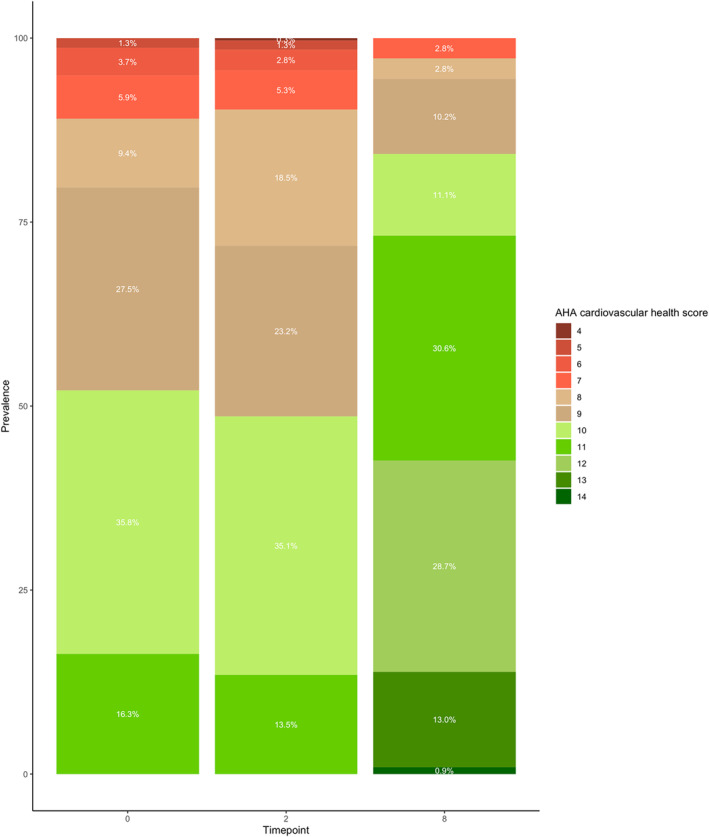
Five hundred four children aged 6 to 9 years were examined in the PANIC (Physical Activity and Nutrition in Children) study at baseline, 2 and 8 years later. The associations of adjusted American Heart Association cardiovascular health metrics (smoking status, body mass index-SD score, moderate-to-vigorous physical activity, diet quality, plasma total cholesterol, systolic blood pressure, plasma glucose categorized into poor, intermediate, and ideal), the American Heart Association cardiovascular health score, cardiorespiratory fitness measured by maximal oxygen uptake in a bicycle exercise test, lean mass and fat percentage with carotid intima-media thickness (cIMT) and pulse wave velocity (PWV) were analyzed cross-sectionally and longitudinally in 277 participants at age 15 to 17 years. Higher American Heart Association cardiovascular health score at baseline was associated with lower PWV at 8-year follow-up (ß, -0.19 [95% CI, -0.32 to -0.05]). Higher body mass index-SD score and systolic blood pressure were associated with higher cIMT (ß, 0.18 [95% CI, 0.05-0.31]); and (ß, 0.13 [95% CI, 0.00-0.25]; respectively) and PWV (ß, 0.20 [95% CI, 0.07-0.34]) and (ß, 0.13 [95% CI, 0.00-0.26]; respectively) at 8-year follow-up. Higher moderate-to-vigorous physical activity was associated with higher cIMT (ß, 0.25 [95% CI, 0.07-0.43]); yet lower PWV (ß, -0.25 [95% CI, -0.44 to -0.06]) at 8-year follow-up. Better cardiorespiratory fitness (ß, 0.29 [95% CI, 0.08-0.51]) and higher lean mass (ß, 0.51 [95% CI, 0.03-0.98]) were associated with higher cIMT after accounting for American Heart Association cardiovascular health score at 8-year follow-up.
While our results suggest that higher cardiometabolic risk factors in childhood may exert unfavorable effects on arterial health during adolescence, we demonstrated the complexity of relationships between cardiovascular health metrics and arterial health indicators in childhood and adolescence. We found different associations of cardiovascular health metrics with cIMT and PWV in childhood and adolescence, calling for caution when interpreting the results of various cardiovascular risk factors with measures of arterial health, particularly in youth.
URL: https://www.clinicaltrials.gov; Unique identifier: NCT01803776.
我们的目的是评估心血管健康指标、心肺适能、瘦体重和体脂百分比与儿童到青少年期动脉结构和功能的关系。
在 PANIC(儿童体育活动和营养)研究中,504 名 6 至 9 岁的儿童在基线、2 年和 8 年后接受了检查。使用经过调整的美国心脏协会心血管健康指标(吸烟状况、体重指数-SD 评分、中等到剧烈体力活动、饮食质量、血浆总胆固醇、收缩压、血糖分为差、中、优)、美国心脏协会心血管健康评分、通过自行车运动试验测量的最大摄氧量评估的心肺适能、瘦体重和体脂百分比与颈动脉内膜中层厚度(cIMT)和脉搏波速度(PWV)之间的关系在 277 名 15 至 17 岁的参与者中进行了横断面和纵向分析。基线时较高的美国心脏协会心血管健康评分与 8 年随访时较低的 PWV 相关(β,-0.19[95%CI,-0.32 至-0.05])。较高的体重指数-SD 评分和收缩压与较高的 cIMT 相关(β,0.18[95%CI,0.05-0.31])和(β,0.13[95%CI,0.00-0.25]),以及 8 年随访时的 PWV(β,0.20[95%CI,0.07-0.34])和(β,0.13[95%CI,0.00-0.26])。较高的中等到剧烈体力活动与较高的 cIMT 相关(β,0.25[95%CI,0.07-0.43]),但与 8 年随访时的 PWV 较低相关(β,-0.25[95%CI,-0.44 至-0.06])。更好的心肺适能(β,0.29[95%CI,0.08-0.51])和更高的瘦体重(β,0.51[95%CI,0.03-0.98])与 8 年随访时的 cIMT 相关,同时考虑了美国心脏协会心血管健康评分。
虽然我们的研究结果表明,儿童时期较高的心血管代谢危险因素可能会在青春期对动脉健康产生不利影响,但我们在儿童和青少年时期发现了心血管健康指标与动脉健康指标之间关系的复杂性。我们发现心血管健康指标与儿童和青少年时期的 cIMT 和 PWV 存在不同的相关性,因此在解释各种心血管危险因素与动脉健康测量结果时需要谨慎,尤其是在年轻人中。