
肉桂醛对高脂饮食大鼠诱导型一氧化氮合酶活性及一氧化氮诱导的胰岛胰岛素分泌的影响
The Effect of Cinnamaldehyde on iNOS Activity and NO-Induced Islet Insulin Secretion in High-Fat-Diet Rats.
作者信息
Ataie Zomorrod, Dastjerdi Mohammad, Farrokhfall Khadijeh, Ghiravani Zahra
机构信息
Islamic Azad University, Zahedan Branch, Faculty of Medicine, Zahedan, Iran.
Medical Toxicology and Drug Abuse Research Center (MTDRC), Birjand University of Medical Sciences, Birjand, Iran.
出版信息
Evid Based Complement Alternat Med. 2021 Jul 13;2021:9970678. doi: 10.1155/2021/9970678. eCollection 2021.
INTRODUCTION
Obesity and insulin resistance are associated with alterations in nitric oxide level and insulin secretion. Previous studies demonstrated that cinnamaldehyde (CNMA) improved islet insulin secretion and restored nitric oxide (NO) level, but its underlying mechanisms have not been investigated. This study aimed to investigate the effect of CNMA on inducible nitric oxide synthase (iNOS) activity and NO-induced islet insulin secretion in high-fat-diet (HFD) treated rats.
MATERIALS AND METHODS
Forty male Wistar rats (12 weeks old) were randomly divided into four equal groups, namely, control, CNMA, HFD, and HFD + CNMA. Control and CNMA groups were treated with standard laboratory animals' diet, while HFD and HDF + CNMA groups were fed with an HFD diet enriched with 25% / tail fat for 16 weeks. CNMA was administrated orally (20 mg/kg body weight, daily) during the study period. Islet insulin secretion and the inducible NOS activity in the presence or absence of L-NAME (NO synthase inhibitor, 5 mmol/L) were evaluated.
RESULTS
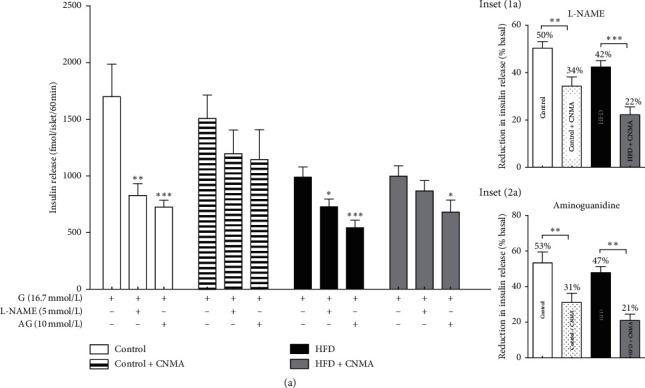
L-NAME-suppressed insulin secretion in control, HFD, and HFD + CNMA groups; however, in the CNMA group, it could not exhibit such effect ( < 0.01). Islets of HFD-treated animals showed significantly higher iNOS activity than controls. CNMA treatment significantly suppressed iNOS activities in CNMA and HFD + CNMA groups compared with control and HFD, respectively.
CONCLUSION
These results suggest that the beneficial effect of CNMA on insulin secretion might be due to its inhibitory effect on iNOS activity.
引言
肥胖和胰岛素抵抗与一氧化氮水平及胰岛素分泌的改变有关。先前的研究表明,肉桂醛(CNMA)可改善胰岛胰岛素分泌并恢复一氧化氮(NO)水平,但其潜在机制尚未得到研究。本研究旨在探讨CNMA对高脂饮食(HFD)处理的大鼠诱导型一氧化氮合酶(iNOS)活性及NO诱导的胰岛胰岛素分泌的影响。
材料与方法
40只12周龄雄性Wistar大鼠随机分为四组,每组数量相等,即对照组、CNMA组、HFD组和HFD + CNMA组。对照组和CNMA组给予标准实验室动物饮食,而HFD组和HDF + CNMA组喂食富含25% / 尾脂肪的高脂饮食16周。在研究期间,CNMA经口给药(20 mg/kg体重,每日)。评估有无L-NAME(NO合酶抑制剂,5 mmol/L)存在时的胰岛胰岛素分泌和诱导型NOS活性。
结果
L-NAME抑制对照组、HFD组和HFD + CNMA组的胰岛素分泌;然而,在CNMA组中,它未表现出这种作用(<0.01)。HFD处理动物的胰岛iNOS活性显著高于对照组。与对照组和HFD组相比,CNMA处理分别显著抑制了CNMA组和HFD + CNMA组的iNOS活性。
结论
这些结果表明,CNMA对胰岛素分泌的有益作用可能归因于其对iNOS活性的抑制作用。


 Zotero 插件