Laboratorio de Nutrición Experimental, Instituto Nacional de Pediatría, Ciudad de México, México.
Nutr Diabetes. 2020 Jul 2;10(1):24. doi: 10.1038/s41387-020-0127-4.
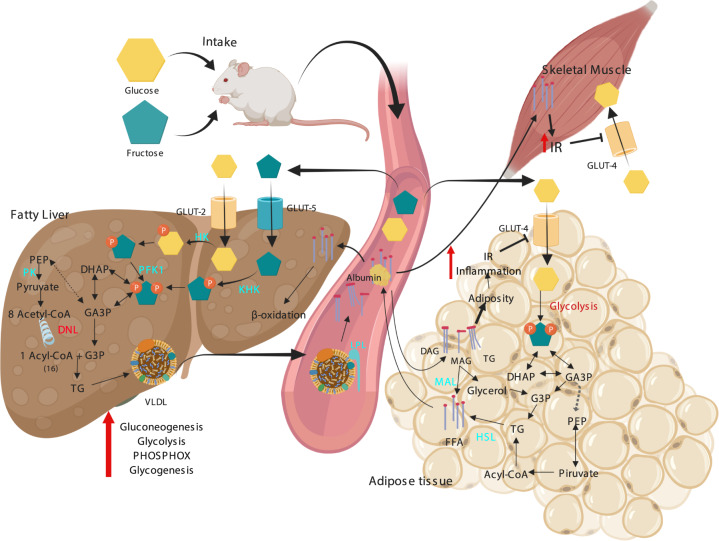
Metabolic syndrome (MS) is a condition that includes obesity, insulin resistance, dyslipidemias among other, abnormalities that favors type 2 Diabetes Mellitus (T2DM) and cardiovascular diseases development. Three main diet-induced metabolic syndrome models in rats exist: High carbohydrate diet (HCHD), high fat diet (HFD), and high carbohydrate-high fat diet (HCHHFD). We analyzed data from at least 35 articles per diet, from different research groups, to determine their effect on the development of the MS, aimed to aid researchers in choosing the model that better suits their research question; and also the best parameter that defines obesity, as there is no consensus to determine this condition in rats. For the HCHD we found a mild effect on body weight gain and fasting blood glucose levels (FBG), but significant increases in triglycerides, fasting insulin, insulin resistance and visceral fat accumulation. HFD had the greater increase in the parameters previously mentioned, followed by HCHHFD, which had a modest effect on FBG levels. Therefore, to study early stages of MS a HCHD is recommended, while HFD and HCHHFD better reproduce more severe stages of MS. We recommend the assessment of visceral fat accumulation as a good estimate for obesity in the rat.
代谢综合征(MS)是一种包含肥胖、胰岛素抵抗、血脂异常等异常的病症,它有利于 2 型糖尿病(T2DM)和心血管疾病的发展。大鼠存在三种主要的饮食诱导代谢综合征模型:高碳水化合物饮食(HCHD)、高脂肪饮食(HFD)和高碳水化合物高脂肪饮食(HCHHFD)。我们分析了每个饮食组至少 35 篇来自不同研究小组的文章的数据,以确定它们对 MS 发展的影响,旨在帮助研究人员选择更适合其研究问题的模型;并确定肥胖的最佳参数,因为目前尚无确定大鼠肥胖状况的共识。对于 HCHD,我们发现它对体重增加和空腹血糖水平(FBG)的影响较轻,但对甘油三酯、空腹胰岛素、胰岛素抵抗和内脏脂肪积累的影响显著增加。HFD 对上述参数的影响最大,其次是 HCHHFD,它对 FBG 水平的影响适中。因此,为了研究 MS 的早期阶段,建议使用 HCHD,而 HFD 和 HCHHFD 则更能模拟 MS 的更严重阶段。我们建议将内脏脂肪积累评估作为大鼠肥胖的一个很好的估计。