Egenolf Nadine, Zu Altenschildesche Caren Meyer, Kreß Luisa, Eggermann Katja, Namer Barbara, Gross Franziska, Klitsch Alexander, Malzacher Tobias, Kampik Daniel, Malik Rayaz A, Kurth Ingo, Sommer Claudia, Üçeyler Nurcan
Department of Neurology, University of Würzburg, Germany.
Institute of Human Genetics, Medical Faculty, RWTH Aachen University, Aachen, Nordrhein-Westfalen, Germany.
Ther Adv Neurol Disord. 2021 Mar 23;14:17562864211004318. doi: 10.1177/17562864211004318. eCollection 2021.
Small fiber neuropathy (SFN) is increasingly suspected in patients with pain of uncertain origin, and making the diagnosis remains a challenge lacking a diagnostic gold standard.
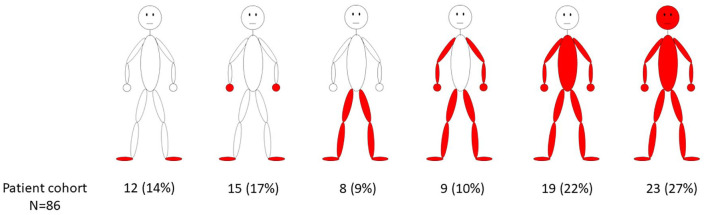
In this case-control study, we prospectively recruited 86 patients with a medical history and clinical phenotype suggestive of SFN. Patients underwent neurological examination, quantitative sensory testing (QST), and distal and proximal skin punch biopsy, and were tested for pain-associated gene loci. Fifty-five of these patients additionally underwent pain-related evoked potentials (PREP), corneal confocal microscopy (CCM), and a quantitative sudomotor axon reflex test (QSART).
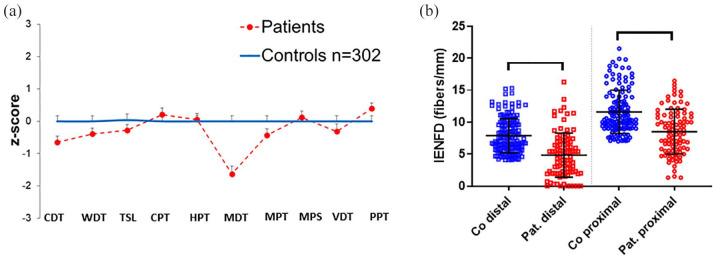
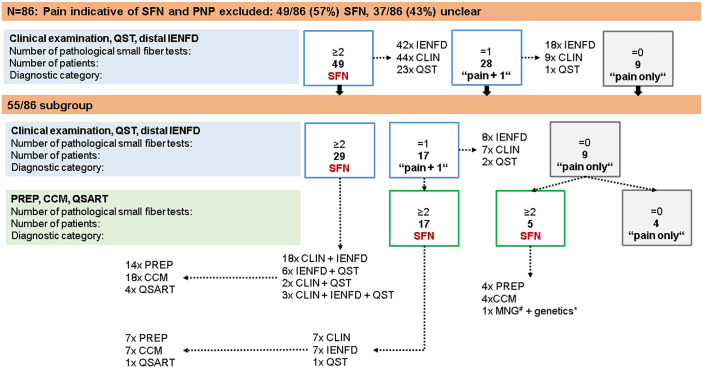
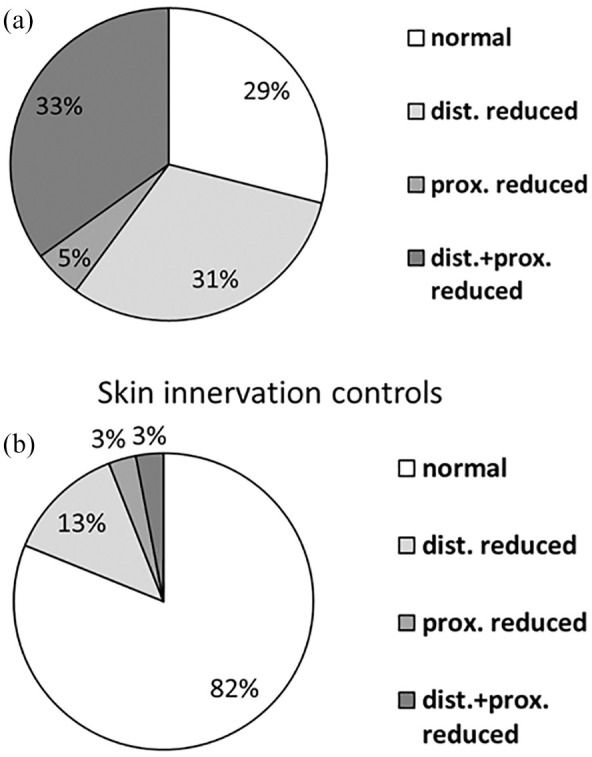
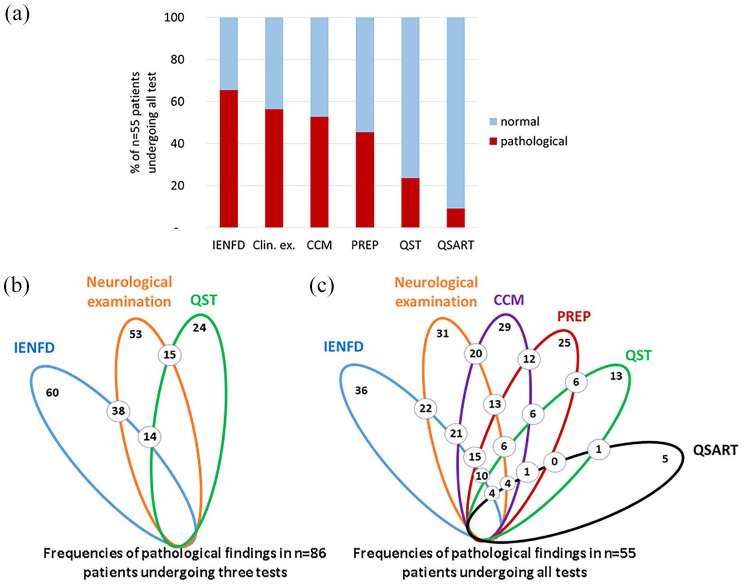
Abnormal distal intraepidermal nerve fiber density (IENFD) (60/86, 70%) and neurological examination (53/86, 62%) most frequently reflected small fiber disease. Adding CCM and/or PREP further increased the number of patients with small fiber impairment to 47/55 (85%). Genetic testing revealed potentially pathogenic gene variants in 14/86 (16%) index patients. QST, QSART, and proximal IENFD were of lower impact.
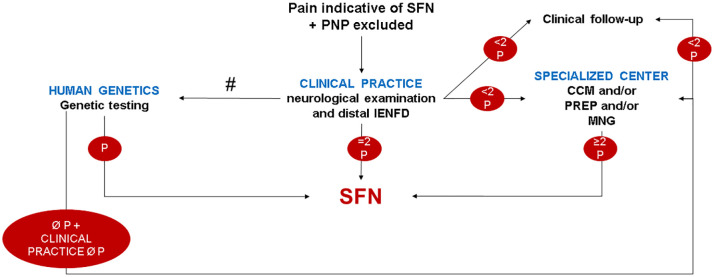
We propose to diagnose SFN primarily based on the results of neurological examination and distal IENFD, with more detailed phenotyping in specialized centers.
对于病因不明的疼痛患者,越来越怀疑其患有小纤维神经病变(SFN),而由于缺乏诊断金标准,做出诊断仍然是一项挑战。
在这项病例对照研究中,我们前瞻性招募了86例有SFN病史和临床表型的患者。患者接受了神经系统检查、定量感觉测试(QST)、远端和近端皮肤活检,并检测了疼痛相关基因位点。其中55例患者还接受了疼痛相关诱发电位(PREP)、角膜共聚焦显微镜检查(CCM)以及定量汗腺轴突反射试验(QSART)。
远端表皮内神经纤维密度(IENFD)异常(60/86,70%)和神经系统检查异常(53/86,62%)最常反映小纤维疾病。增加CCM和/或PREP进一步使小纤维损伤患者数量增加至47/55(85%)。基因检测在14/86(16%)的索引患者中发现了潜在致病基因变异。QST、QSART和近端IENFD的影响较小。
我们建议主要根据神经系统检查结果和远端IENFD来诊断SFN,在专科中心进行更详细的表型分析。