Benz Luke S, Lopez Michael J
Medidata Solutions, Inc., New York, USA.
National Football League, Skidmore College, Saratoga Springs, USA.
Adv Stat Anal. 2023;107(1-2):205-232. doi: 10.1007/s10182-021-00413-9. Epub 2021 Jul 27.
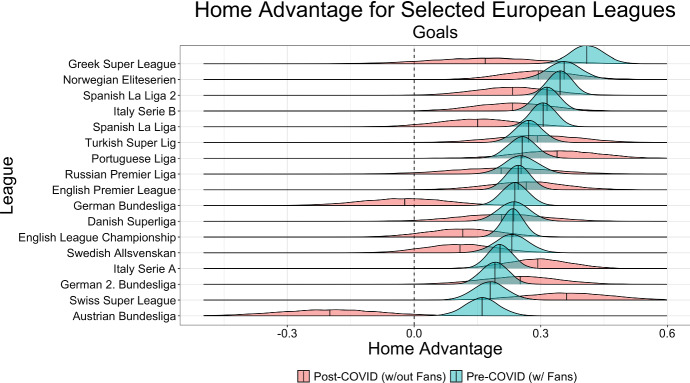
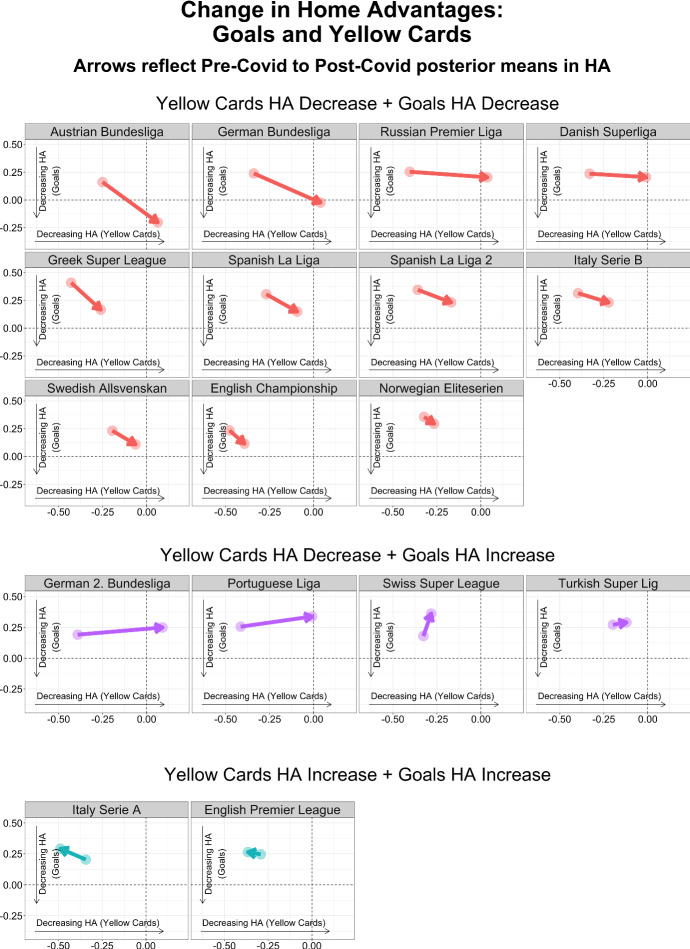
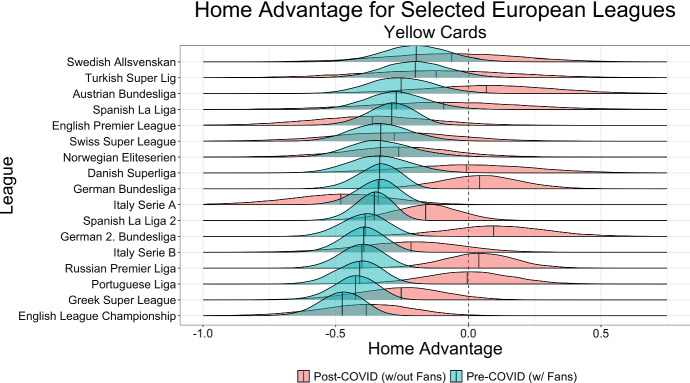
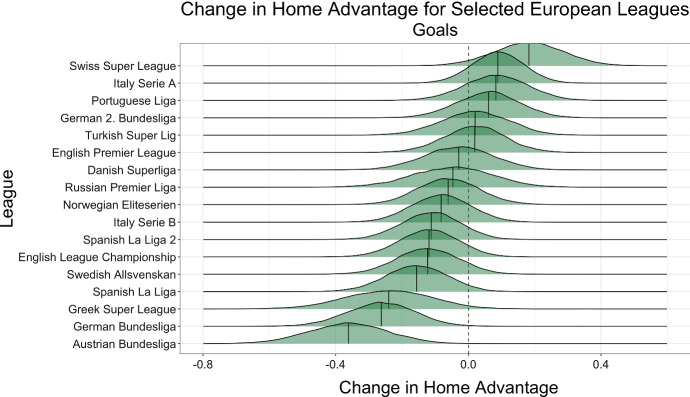
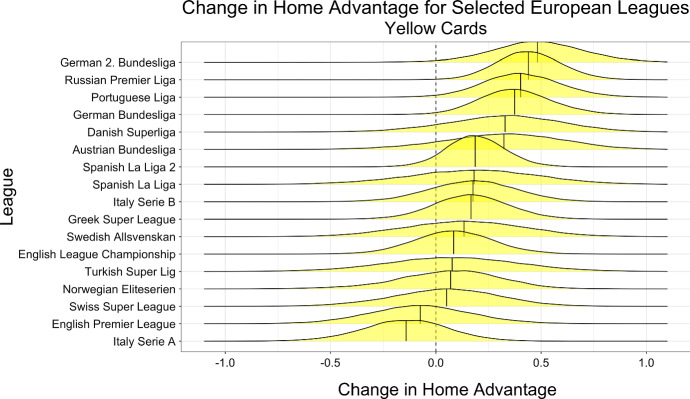
In wake of the Covid-19 pandemic, 2019-2020 soccer seasons across the world were postponed and eventually made up during the summer months of 2020. Researchers from a variety of disciplines jumped at the opportunity to compare the rescheduled games, played in front of empty stadia, to previous games, played in front of fans. To date, most of this post-Covid soccer research has used linear regression models, or versions thereof, to estimate potential changes to the home advantage. However, we argue that leveraging the Poisson distribution would be more appropriate and use simulations to show that bivariate Poisson regression (Karlis and Ntzoufras in J R Stat Soc Ser D Stat 52(3):381-393, 2003) reduces absolute bias when estimating the home advantage benefit in a single season of soccer games, relative to linear regression, by almost 85%. Next, with data from 17 professional soccer leagues, we extend bivariate Poisson models estimate the change in home advantage due to games being played without fans. In contrast to current research that suggests a drop in the home advantage, our findings are mixed; in some leagues, evidence points to a decrease, while in others, the home advantage may have risen. Altogether, this suggests a more complex causal mechanism for the impact of fans on sporting events.
在新冠疫情之后,全球2019 - 2020赛季的足球赛事被推迟,最终于2020年夏季进行补赛。来自各个学科的研究人员纷纷抓住这个机会,将在没有观众的体育场举行的重新安排的比赛与之前有球迷观赛的比赛进行比较。迄今为止,大多数新冠疫情后的足球研究都使用线性回归模型或其变体来估计主场优势的潜在变化。然而,我们认为利用泊松分布会更合适,并通过模拟表明,相对于线性回归,双变量泊松回归(Karlis和Ntzoufras于2003年发表在《皇家统计学会系列D统计》第52卷第3期,第381 - 393页)在估计一个足球赛季主场优势收益时,能将绝对偏差降低近85%。接下来,利用来自17个职业足球联赛的数据,我们扩展双变量泊松模型来估计因无球迷观赛而导致的主场优势变化。与目前认为主场优势下降的研究不同,我们的研究结果不一;在一些联赛中,有证据表明主场优势下降,而在另一些联赛中,主场优势可能有所上升。总体而言,这表明球迷对体育赛事影响的因果机制更为复杂。