Su Houcheng, Lin Bin, Huang Xiaoshuang, Li Jiao, Jiang Kailin, Duan Xuliang
College of Information Engineering, Sichuan Agricultural University, Ya'an, China.
College of Science, Sichuan Agricultural University, Ya'an, China.
Front Bioeng Biotechnol. 2021 Jul 14;9:696251. doi: 10.3389/fbioe.2021.696251. eCollection 2021.
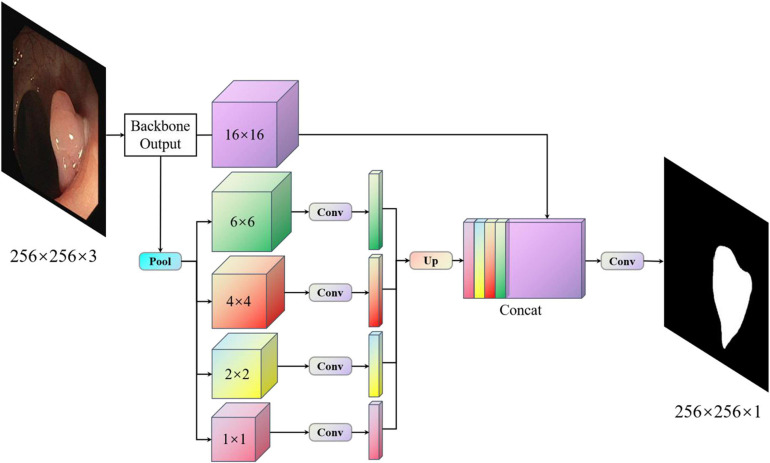
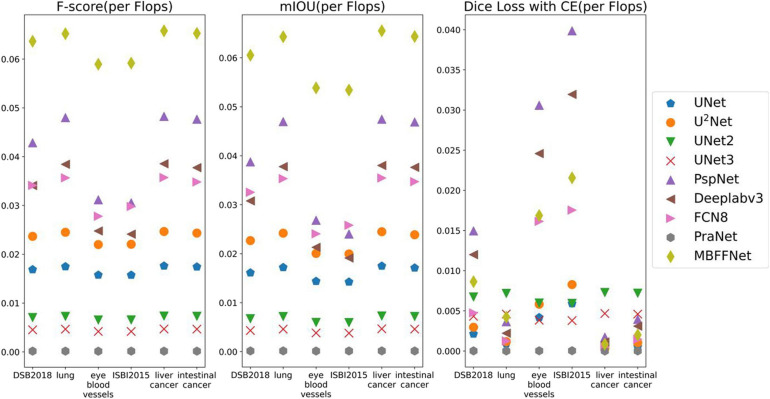
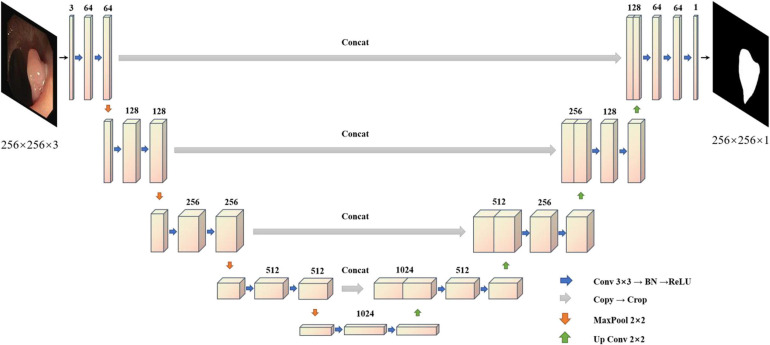
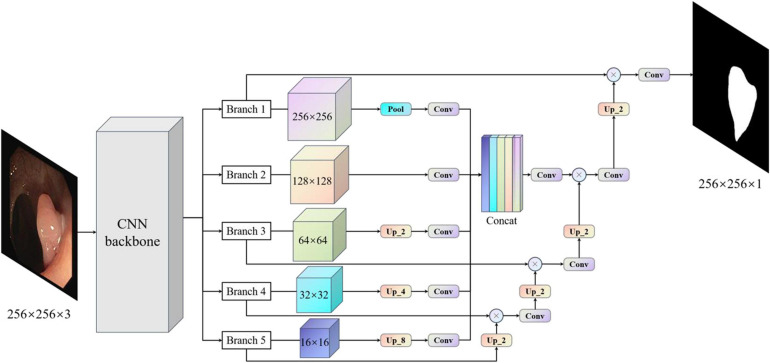
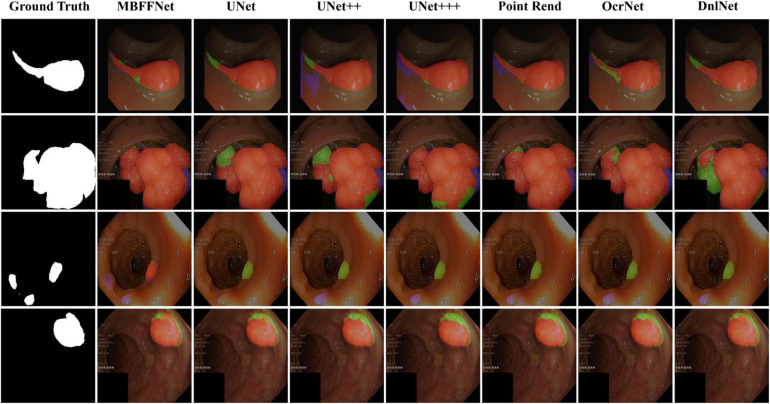
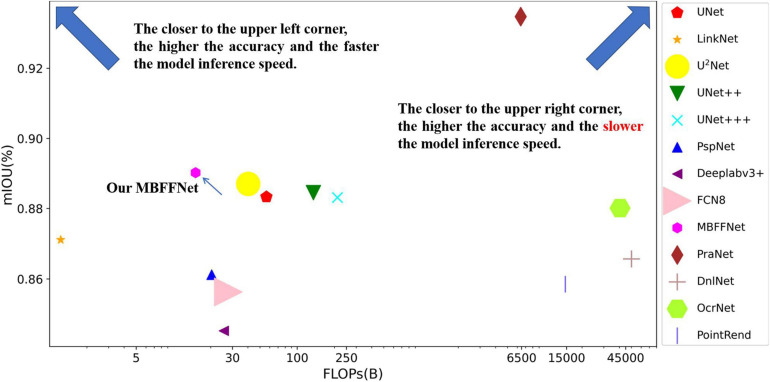
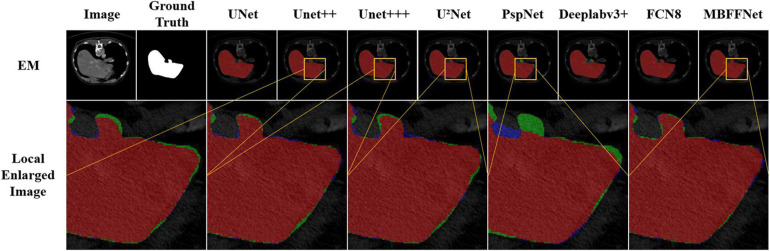
Colonoscopy is currently one of the main methods for the detection of rectal polyps, rectal cancer, and other diseases. With the rapid development of computer vision, deep learning-based semantic segmentation methods can be applied to the detection of medical lesions. However, it is challenging for current methods to detect polyps with high accuracy and real-time performance. To solve this problem, we propose a multi-branch feature fusion network (MBFFNet), which is an accurate real-time segmentation method for detecting colonoscopy. First, we use UNet as the basis of our model architecture and adopt stepwise sampling with channel multiplication to integrate features, which decreases the number of flops caused by stacking channels in UNet. Second, to improve model accuracy, we extract features from multiple layers and resize feature maps to the same size in different ways, such as up-sampling and pooling, to supplement information lost in multiplication-based up-sampling. Based on mIOU and Dice loss with cross entropy (CE), we conduct experiments in both CPU and GPU environments to verify the effectiveness of our model. The experimental results show that our proposed MBFFNet is superior to the selected baselines in terms of accuracy, model size, and flops. mIOU, score, and Dice loss with CE reached 0.8952, 0.9450, and 0.1602, respectively, which were better than those of UNet, UNet++, and other networks. Compared with UNet, the flop count decreased by 73.2%, and the number of participants also decreased. The actual segmentation effect of MBFFNet is only lower than that of PraNet, the number of parameters is 78.27% of that of PraNet, and the flop count is 0.23% that of PraNet. In addition, experiments on other types of medical tasks show that MBFFNet has good potential for general application in medical image segmentation.
结肠镜检查是目前检测直肠息肉、直肠癌和其他疾病的主要方法之一。随着计算机视觉的快速发展,基于深度学习的语义分割方法可应用于医学病变检测。然而,当前方法要实现高精度和实时性的息肉检测具有挑战性。为解决此问题,我们提出了一种多分支特征融合网络(MBFFNet),这是一种用于检测结肠镜检查的准确实时分割方法。首先,我们以UNet作为模型架构的基础,并采用带通道乘法的逐步采样来整合特征,这减少了UNet中堆叠通道所导致的浮点运算量。其次,为提高模型精度,我们从多个层提取特征,并以不同方式(如向上采样和池化)将特征图调整为相同大小,以补充基于乘法的向上采样中丢失的信息。基于平均交并比(mIOU)以及带有交叉熵(CE)的骰子损失,我们在CPU和GPU环境中进行实验以验证模型的有效性。实验结果表明,我们提出的MBFFNet在准确性、模型大小和浮点运算量方面优于所选的基线模型。mIOU、得分以及带有CE的骰子损失分别达到了0.8952、0.9450和0.1602,优于UNet、UNet++和其他网络。与UNet相比,浮点运算量减少了73.2%,参数量也有所减少。MBFFNet的实际分割效果仅略低于PraNet,参数数量为PraNet的78.27%,浮点运算量为PraNet的0.23%。此外,在其他类型医学任务上的实验表明,MBFFNet在医学图像分割的通用应用方面具有良好潜力。