Soffientini Ugo, Beaton Nigel, Baweja Sukriti, Weiss Emmanuel, Bihari Chhagan, Habtesion Abeba, Patel Vishal, Paradis Valerie, Sharma Archana, Luong Tu Vinh, Hall Andrew, Nadar Aida, Sarin Shiv, Chokshi Shilpa, Williams Roger, Py Benedicte, Moreau Richard, Jalan Rajiv, Mehta Gautam
Institute for Liver and Digestive Health, UCL, London, United Kingdom.
Institute of Hepatology, Foundation for Liver Research, London, United Kingdom.
Front Cell Dev Biol. 2021 Jul 15;9:668459. doi: 10.3389/fcell.2021.668459. eCollection 2021.
The development of multi-organ injury in cirrhosis is associated with increased intestinal permeability, translocation of gut-derived bacterial products [e.g., lipopolysaccharide (LPS)] into the circulation, and increased non-apoptotic hepatocyte cell death. Pyroptosis is a non-apoptotic, lytic form of cell death mediated by the LPS-sensing caspase(s)-4/11 (caspase-4 in humans, caspase-11 in mice), which leads to activation of the effector protein Gasdermin D (GSDMD) and subsequent formation of pores in the plasma membrane. Endoplasmic reticulum (ER) stress, a feature of cirrhosis, has been identified as a factor promoting the activation of caspase-11, thus increasing sensitivity of the cell to LPS-mediated pyroptosis. The aim of this study was to determine the role of bacterial LPS in the activation of hepatic caspase(s)-4/11 and progression of hepatic and extra-hepatic organ injury in cirrhosis.
Human liver samples from patients with stable cirrhosis (SC) or acutely decompensated cirrhosis (AD) were analyzed for caspase-4 activation by immunohistochemistry. Wild-type and mice underwent CCl treatment by gavage to induce advanced liver fibrosis, and subsequently low-dose injection of LPS to mimic bacterial translocation and induce multi-organ injury. Liver, kidney, and brain function were assessed by plasma ALT/creatinine and brain water respectively. The activity of inflammatory caspases was assessed by fluorometric assay and the occurrence of pyroptosis and overall cell death in liver tissue by GSDMD cleavage and TUNEL assay, respectively. Primary human hepatocytes were cultured according to standard techniques.
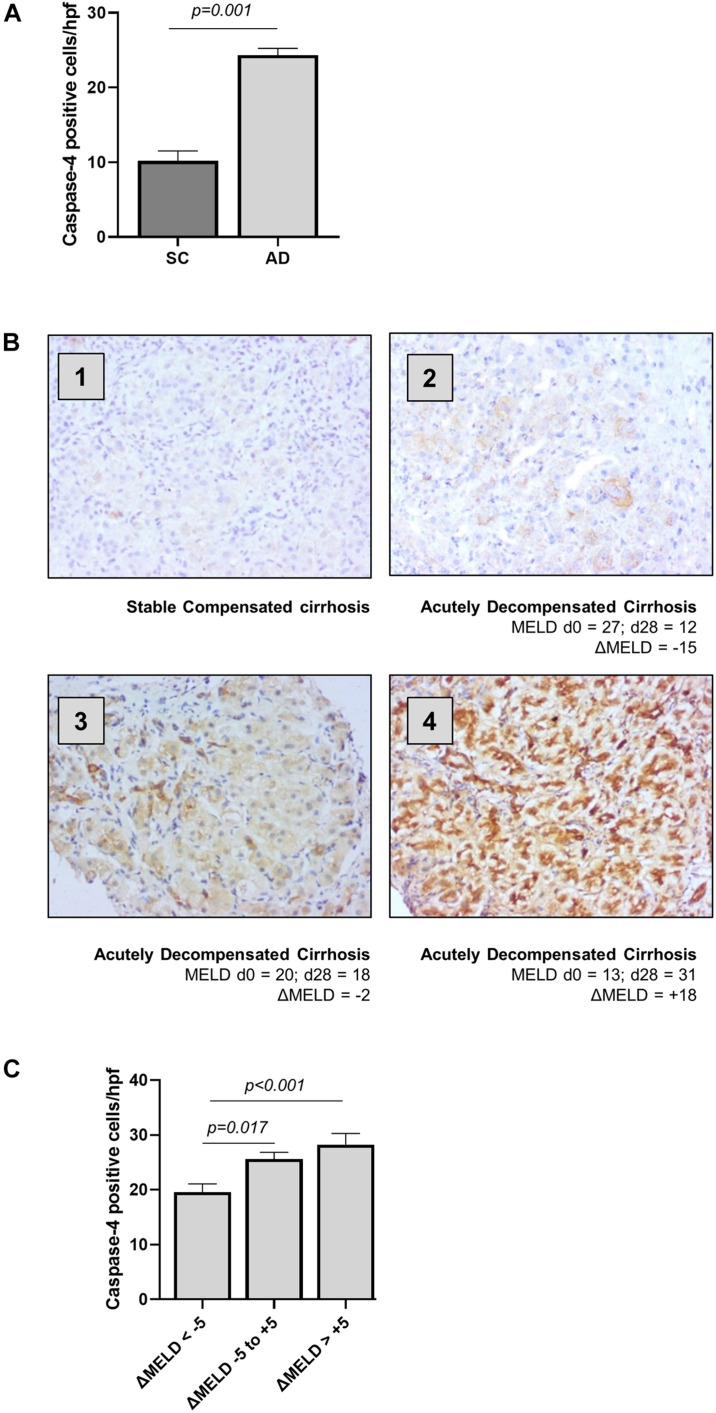
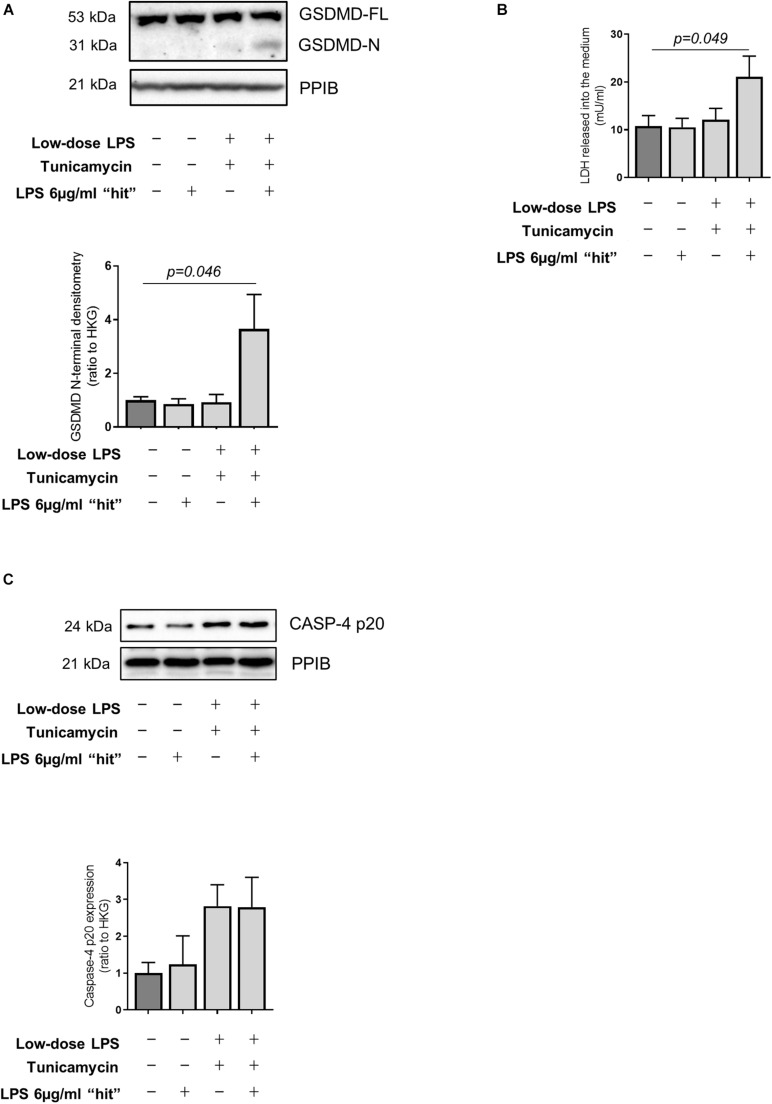
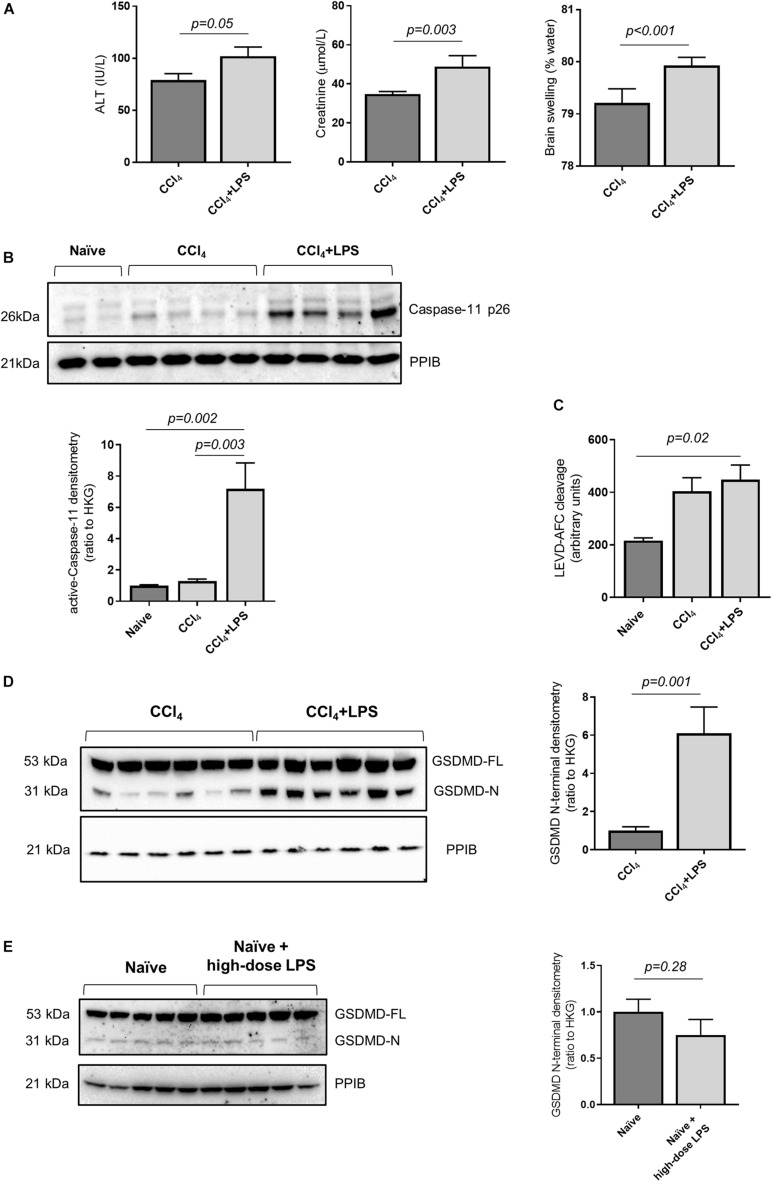
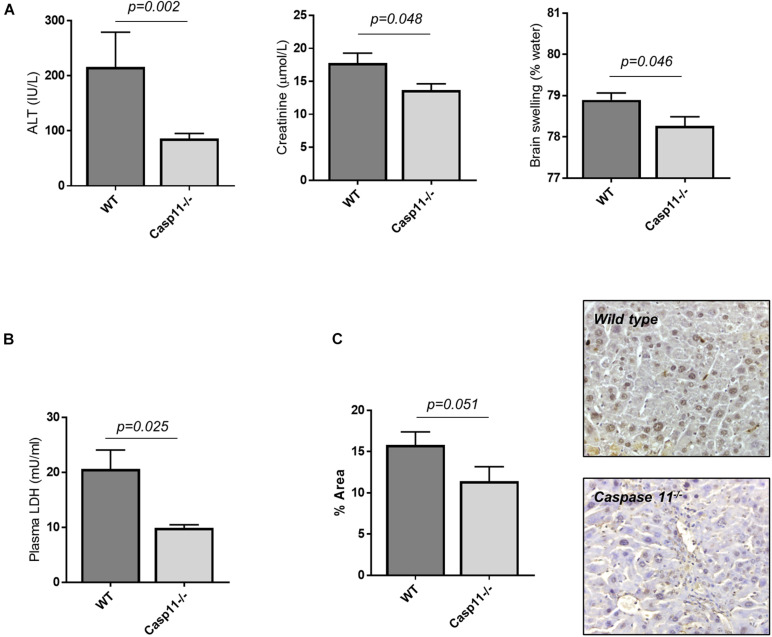
Human liver samples demonstrated increased caspase-4 activation in AD cirrhosis. Caspase-4 activation was associated with MELD score and circulating levels of LDH. Wild-type mice treated with CCl developed significant multi-organ injury (increased ALT, creatinine, and brain water) upon LPS injection, and showed increased hepatic GSDMD cleavage compared to mice treated with CCl alone. Primary human hepatocytes could be sensitized to pyroptosis by pre-treatment with the ER-stress inducer tunicamycin and LPS. mice treated with CCl + LPS were significantly protected from multi-organ injury compared to wild-type CCl + LPS.
These data demonstrate for the first time a causal relationship between LPS-mediated activation of caspase(s)-4/11 and development of hepatic and extra-hepatic injury in cirrhosis.
肝硬化多器官损伤的发生与肠通透性增加、肠道来源的细菌产物[如脂多糖(LPS)]向循环系统的移位以及非凋亡性肝细胞死亡增加有关。细胞焦亡是一种由LPS感应半胱天冬酶-4/11(人类为半胱天冬酶-4,小鼠为半胱天冬酶-11)介导的非凋亡性溶解性细胞死亡形式,其导致效应蛋白Gasdermin D(GSDMD)活化,随后在质膜上形成孔道。内质网(ER)应激是肝硬化的一个特征,已被确定为促进半胱天冬酶-11活化的一个因素,从而增加细胞对LPS介导的细胞焦亡的敏感性。本研究的目的是确定细菌LPS在肝硬化中肝半胱天冬酶-4/11活化以及肝和肝外器官损伤进展中的作用。
采用免疫组织化学方法分析稳定期肝硬化(SC)或急性失代偿期肝硬化(AD)患者的人肝组织样本中半胱天冬酶-4的活化情况。野生型和 小鼠经口灌胃给予CCl4以诱导晚期肝纤维化,随后低剂量注射LPS以模拟细菌移位并诱导多器官损伤。分别通过血浆ALT/肌酐和脑含水量评估肝、肾和脑功能。通过荧光测定法评估炎性半胱天冬酶的活性,分别通过GSDMD裂解和TUNEL测定法评估肝组织中细胞焦亡的发生情况和总体细胞死亡情况。原代人肝细胞按照标准技术进行培养。
人肝组织样本显示AD肝硬化中半胱天冬酶-4活化增加。半胱天冬酶-4活化与终末期肝病模型(MELD)评分和乳酸脱氢酶(LDH)循环水平相关。经CCl4处理的野生型小鼠在注射LPS后出现显著的多器官损伤(ALT、肌酐和脑含水量增加),与仅经CCl4处理的小鼠相比,肝GSDMD裂解增加。原代人肝细胞经内质网应激诱导剂衣霉素和LPS预处理后可对细胞焦亡敏感。与野生型CCl4 + LPS小鼠相比,经CCl4 + LPS处理的 小鼠多器官损伤得到显著保护。
这些数据首次证明了LPS介导的半胱天冬酶-4/11活化与肝硬化中肝和肝外损伤的发生之间存在因果关系。