Wang Hejie, Qin Yibin, Zhao Wu, Yuan Tingting, Yang Chunjie, Mi Xue, Zhao Ping, Lu Ying, Lu Bingxia, Chen Zhongwei, He Ying, Yang Cui, Yi Xianfeng, Wu Zhuyue, Chen Ying, Wei Zuzhang, Huang Weijian, Ouyang Kang
College of Animal Science and Technology, Guangxi University, Nanning, China.
Department of Virology, Guangxi Veterinary Research Institute, Nanning, China.
Front Vet Sci. 2021 Jul 16;8:701612. doi: 10.3389/fvets.2021.701612. eCollection 2021.
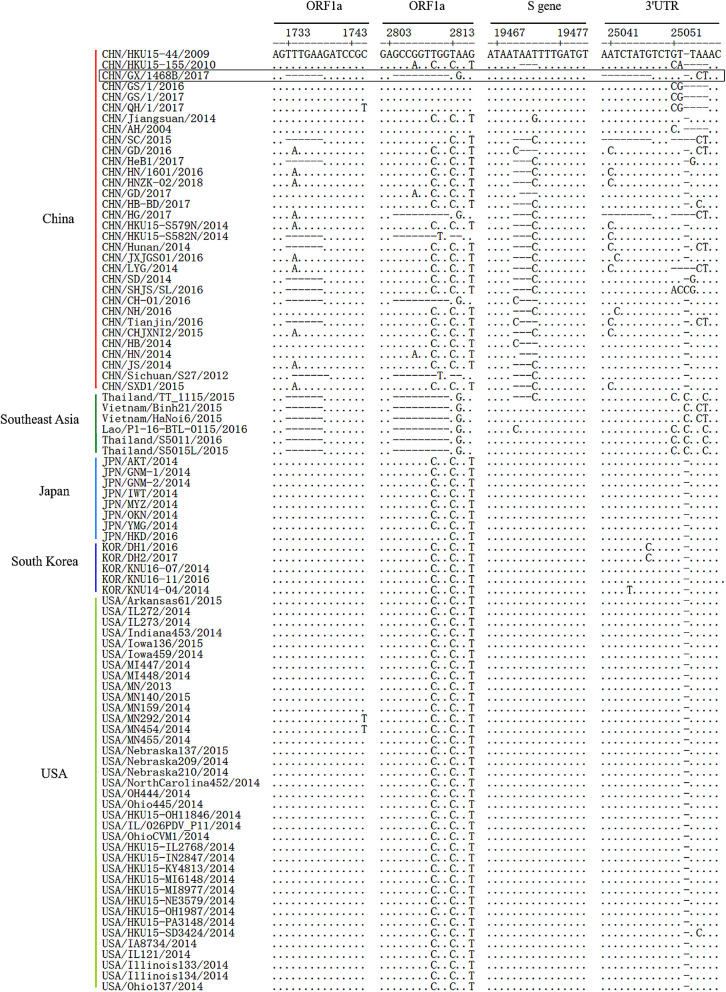
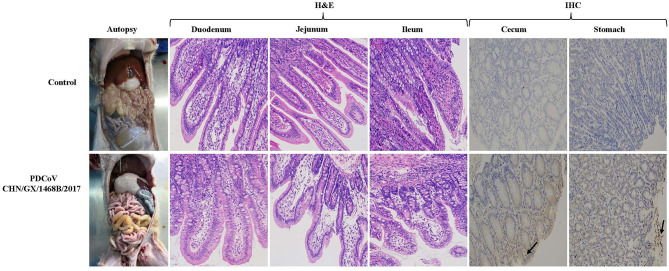
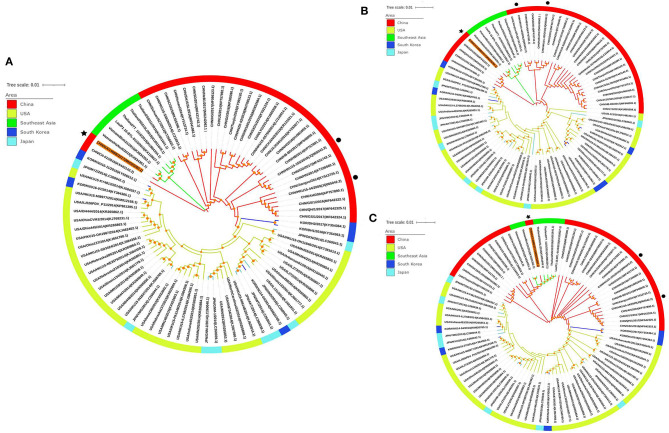
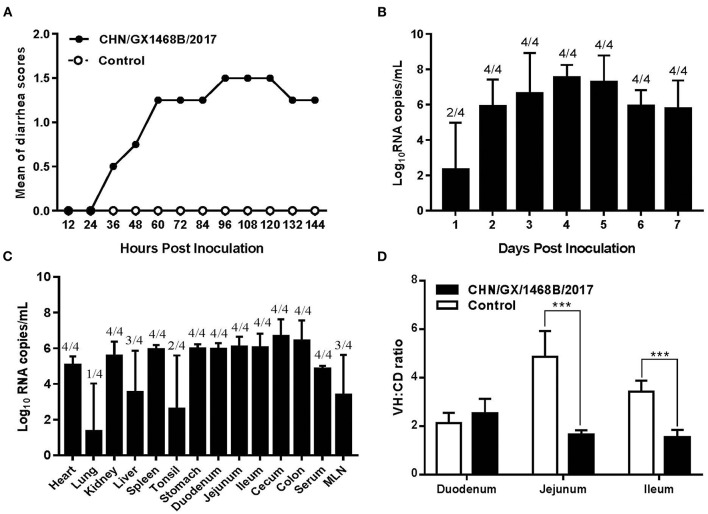
Farmers involved in the lucrative pork trading business between China and Southeast Asian countries should be aware of a recently discovered novel porcine deltacoronavirus (PDCoV) in Guangxi province, China. A PDCoV strain, CHN/GX/1468B/2017, was isolated from the small intestinal contents of piglets with diarrhea from this region, with a titer of 1 × 10 TCID/mL on LLC-PK cells. The full-length genome sequence consists of 25,399 nt as determined by next-generation sequencing and this was deposited in the GenBank (accession number MN025260.1). Genomic analysis showed that CHN/GX/1468B/2017 strain had 96.999.4% nucleotide homology with other 87 referenced PDCoV strains from different areas, and contained 6 and 9-nt deletions at positions 1,7331,738 and 2,804~2,812, respectively, in the ORF1a gene. Phylogenetic analyses based on the whole gene sequence as well as S protein and ORF1a/1b protein sequences all showed that this strain was closely related to the Southeast Asia strain. When 7-day-old piglets were inoculated orally with the CHN/GX/1468B/2017 strain, they developed severe diarrhea, with a peak of fecal viral shedding at 4 days post-infection. Although no death or fever were observed, the CHN/GX/1468B/2017 strain produced a wide range of tissue tropism, with the main target being the intestine. Importantly, the VH:CD ratios of the jejunum and ileum in infected piglets were significantly lower than controls. These results indicate that CHN/GX/1468B/2017, isolated in China, is a novel PDCoV Southeast Asia-like strain with distinct genetic characteristics and pathogenicity. This finding enriches the international information on the genetic diversity of PDCoV.
参与中国与东南亚国家之间利润丰厚的猪肉贸易业务的养殖户应注意,中国广西最近发现了一种新型猪德尔塔冠状病毒(PDCoV)。从该地区腹泻仔猪的小肠内容物中分离出一株PDCoV毒株CHN/GX/1468B/2017,在LLC-PK细胞上的滴度为1×10 TCID/mL。通过下一代测序确定其全长基因组序列由25399个核苷酸组成,并已存入GenBank(登录号MN025260.1)。基因组分析表明,CHN/GX/1468B/2017毒株与来自不同地区的其他87株参考PDCoV毒株的核苷酸同源性为96.9%至99.4%,在ORF1a基因的1733至1738位和2804至2812位分别有6个和9个核苷酸缺失。基于全基因序列以及S蛋白和ORF1a/1b蛋白序列的系统发育分析均表明,该毒株与东南亚毒株密切相关。用CHN/GX/1468B/2017毒株口服接种7日龄仔猪后,它们出现严重腹泻,感染后4天粪便病毒排出量达到峰值。虽然未观察到死亡或发热,但CHN/GX/1468B/2017毒株具有广泛的组织嗜性,主要靶器官是肠道。重要的是,感染仔猪空肠和回肠的VH:CD比值显著低于对照组。这些结果表明,在中国分离的CHN/GX/1468B/2017是一种具有独特遗传特征和致病性的新型东南亚样PDCoV毒株。这一发现丰富了关于PDCoV遗传多样性的国际信息。