Hwang Yunjae, Kim Jisoo, Yim Changyong, Park Hyung Wook
School of Mechanical and Nuclear Engineering, Ulsan National Institute of Science and Technology (UNIST), UNIST-gil 50, Eonyang-eup, Ulju-gun, Ulsan 44919, Republic of Korea.
Department of Advanced Science and Technology Convergence, Kyungpook National University (KNU), 2559, Gyeongsang-daero, Sangju-si, Gyeongsangbuk-do 37224, Republic of Korea.
ACS Omega. 2021 Jul 13;6(29):19134-19143. doi: 10.1021/acsomega.1c02475. eCollection 2021 Jul 27.
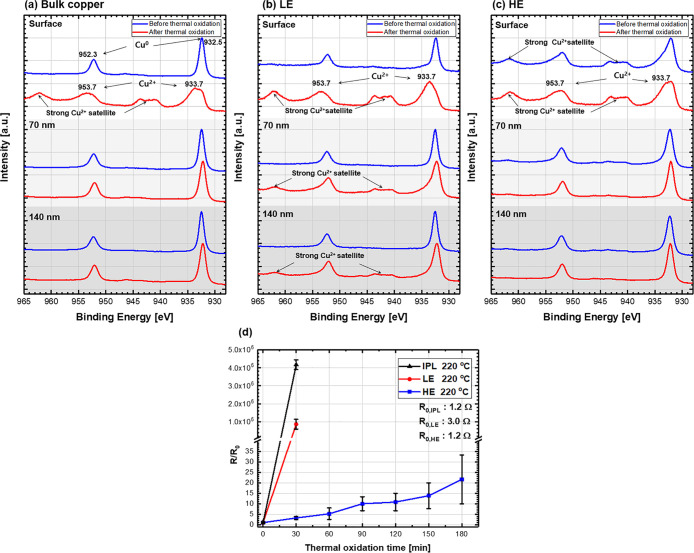
Thermal oxidation resistance is an important property in printed electronics for sustaining electrical conductivity for long time and/or under harsh environments such as high temperature. This study reports the fabrication of copper nanoparticles (CuNPs)-based conductive tracks using large pulsed electron beam (LPEB) by irradiation on CuNPs to be sintered. With an acceleration voltage of 11 kV, the LPEB irradiation induced deep-sintering of CuNPs so that the sintered CuNPs exhibited bulk-like electrical conductivity. Consequently, the sintered Cu tracks maintained high electrical conductivity at 220 °C without using any thermal oxidation protection additive, such as silver, carbon nanotube, and graphene. In contrast, the films irradiated with an acceleration voltage of 8 kV and irradiated by intense pulsed light (IPL) showed fast oxidation characteristics and a corresponding reduction of electrical conductivities under high temperatures owing to a thin sintered layer. The performance of highly thermal oxidation-resistant Cu films sintered by LPEB irradiations was demonstrated through the device performance of a Joule heater.
在印刷电子领域,抗热氧化性是一项重要性能,有助于在长时间和/或高温等恶劣环境下保持导电性。本研究报告了利用大脉冲电子束(LPEB)对铜纳米颗粒(CuNPs)进行辐照烧结来制备基于CuNPs的导电线路。在11 kV的加速电压下,LPEB辐照促使CuNPs深度烧结,使得烧结后的CuNPs呈现出块状材料的导电性。因此,烧结后的铜线路在220°C下无需使用任何热氧化保护添加剂(如银、碳纳米管和石墨烯)就能保持高导电性。相比之下,用8 kV加速电压辐照并用强脉冲光(IPL)辐照的薄膜由于烧结层较薄,在高温下表现出快速氧化特性以及相应的电导率降低。通过焦耳加热器的器件性能展示了LPEB辐照烧结的高抗热氧化铜薄膜的性能。