Vollum Institute, Oregon Health & Science University, Portland, OR 97239, USA.
Vollum Institute, Oregon Health & Science University, Portland, OR 97239, USA.
J Neurosci Methods. 2021 Oct 1;362:109298. doi: 10.1016/j.jneumeth.2021.109298. Epub 2021 Jul 31.
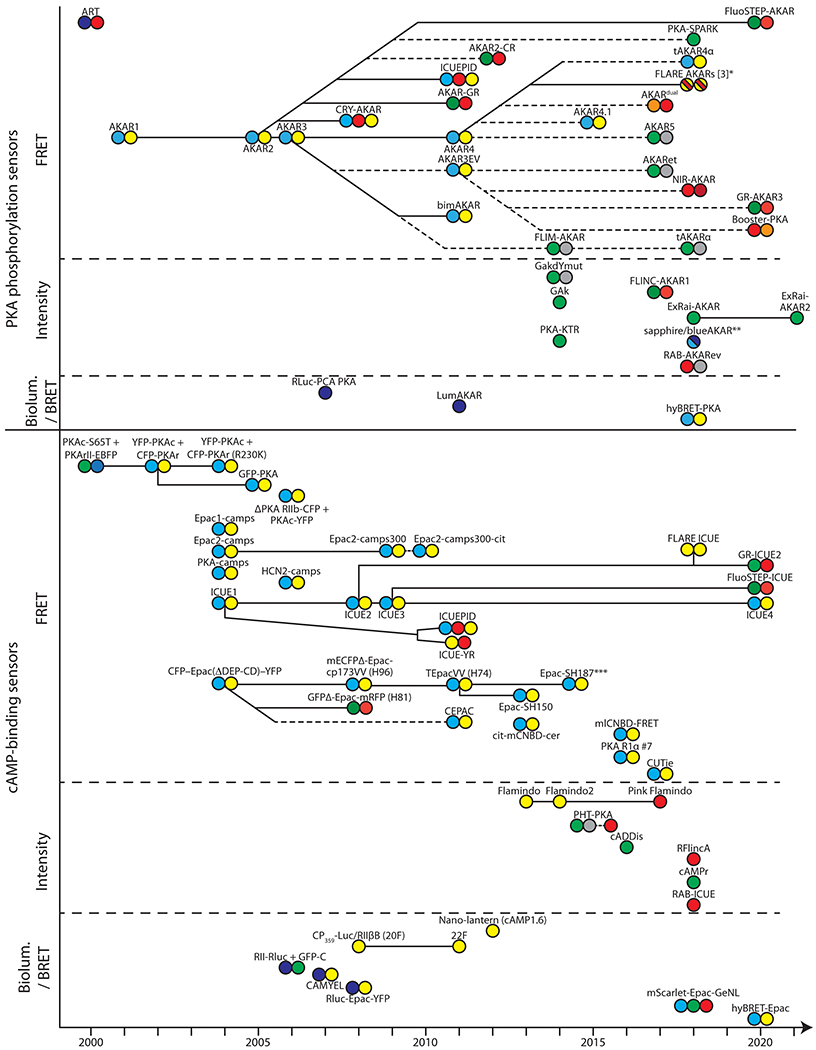
Cyclic adenosine monophosphate (cAMP) is a universal second messenger that plays a crucial role in diverse biological functions, ranging from transcription to neuronal plasticity, and from development to learning and memory. In the nervous system, cAMP integrates inputs from many neuromodulators across a wide range of timescales - from seconds to hours - to modulate neuronal excitability and plasticity in brain circuits during different animal behavioral states. cAMP signaling events are both cell-specific and subcellularly compartmentalized. The same stimulus may result in different, sometimes opposite, cAMP dynamics in different cells or subcellular compartments. Additionally, the activity of protein kinase A (PKA), a major cAMP effector, is also spatiotemporally regulated. For these reasons, many laboratories have made great strides toward visualizing the intracellular dynamics of cAMP and PKA. To date, more than 80 genetically encoded sensors, including original and improved variants, have been published. It is starting to become possible to visualize cAMP and PKA signaling events in vivo, which is required to study behaviorally relevant cAMP/PKA signaling mechanisms. Despite significant progress, further developments are needed to enhance the signal-to-noise ratio and practical utility of these sensors. This review summarizes the recent advances and challenges in genetically encoded cAMP and PKA sensors with an emphasis on in vivo imaging in the brain during behavior.
环磷酸腺苷 (cAMP) 是一种普遍的第二信使,在转录、神经元可塑性、发育、学习和记忆等多种生物学功能中起着关键作用。在神经系统中,cAMP 整合了来自多种神经调质的输入,跨越广泛的时间尺度——从秒到小时——以调节不同动物行为状态下大脑回路中的神经元兴奋性和可塑性。cAMP 信号事件具有细胞特异性和亚细胞区室化。相同的刺激可能导致不同细胞或亚细胞区室中不同的、有时相反的 cAMP 动力学。此外,蛋白激酶 A (PKA) 的活性,一种主要的 cAMP 效应物,也受到时空调节。出于这些原因,许多实验室在可视化 cAMP 和 PKA 的细胞内动力学方面取得了重大进展。迄今为止,已经发表了超过 80 种遗传编码传感器,包括原始和改进的变体。现在已经可以在体内可视化 cAMP 和 PKA 信号事件,这对于研究与行为相关的 cAMP/PKA 信号机制是必需的。尽管取得了重大进展,但仍需要进一步发展来提高这些传感器的信噪比和实际效用。本综述总结了遗传编码 cAMP 和 PKA 传感器的最新进展和挑战,重点介绍了在行为期间大脑中的体内成像。