Department of Chemistry, Kongju National University, Gongju 32588, Korea.
Green Chemistry & Materials Group, Korea Institute of Industrial Technology (KITECH), Cheonan 31056, Korea.
Biosensors (Basel). 2021 Jan 31;11(2):39. doi: 10.3390/bios11020039.
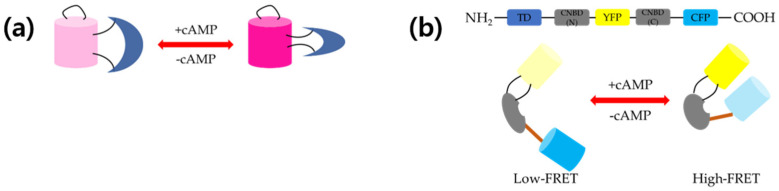
Cyclic adenosine monophosphate (cAMP) plays a key role in signal transduction pathways as a second messenger. Studies on the cAMP dynamics provided useful scientific insights for drug development and treatment of cAMP-related diseases such as some cancers and prefrontal cortex disorders. For example, modulation of cAMP-mediated intracellular signaling pathways by anti-tumor drugs could reduce tumor growth. However, most early stage tools used for measuring the cAMP level in living organisms require cell disruption, which is not appropriate for live cell imaging or animal imaging. Thus, in the last decades, tools were developed for real-time monitoring of cAMP distribution or signaling dynamics in a non-invasive manner. Genetically-encoded sensors based on fluorescent proteins and luciferases could be powerful tools to overcome these drawbacks. In this review, we discuss the recent genetically-encoded cAMP sensors advances, based on single fluorescent protein (FP), Föster resonance energy transfer (FRET), single luciferase, and bioluminescence resonance energy transfer (BRET) for real-time non-invasive imaging.
环磷酸腺苷(cAMP)作为第二信使在信号转导途径中起着关键作用。对 cAMP 动态的研究为药物开发和治疗与 cAMP 相关的疾病(如某些癌症和前额叶皮层疾病)提供了有用的科学见解。例如,抗肿瘤药物对 cAMP 介导的细胞内信号通路的调节可以减少肿瘤生长。然而,大多数用于测量活生物体中 cAMP 水平的早期工具都需要细胞破坏,这不适用于活细胞成像或动物成像。因此,在过去的几十年中,开发了用于非侵入性实时监测 cAMP 分布或信号动力学的工具。基于荧光蛋白和荧光素酶的基因编码传感器可以成为克服这些缺点的有力工具。在这篇综述中,我们讨论了基于单荧光蛋白(FP)、荧光共振能量转移(FRET)、单荧光素酶和生物发光共振能量转移(BRET)的最新基因编码 cAMP 传感器的进展,用于实时非侵入性成像。