Cecins Erin, Hill Kylie, Taaffe Dennis R, Manners David, Hill Anne-Marie, Newton Robert U, Galvão Daniel A, Cavalheri Vinicius
Curtin School of Allied Health, Faculty of Health Science, Curtin University, Perth, WA, Australia.
Physiotherapy Department, St John of God Midland Hospital, Perth, WA, Australia.
Pilot Feasibility Stud. 2021 Aug 3;7(1):151. doi: 10.1186/s40814-021-00893-1.
Chronic obstructive pulmonary disease (COPD) is a disorder linked with a multitude of extra pulmonary manifestations (also known as treatable traits), including low bone mineral density (BMD). To date, no specific guidelines exist for the management of BMD in this population. Impact loading exercise has been identified as an intervention that improves or maintains BMD in other populations. However, the feasibility of and tolerance to impact loading exercise has not been tested in people with COPD. The aim of the proposed study will be to investigate the feasibility and tolerance of adding impact loading exercise to a standard pulmonary rehabilitation programme (PRP) in people with COPD and report its effects on bone health, balance and falls risk.
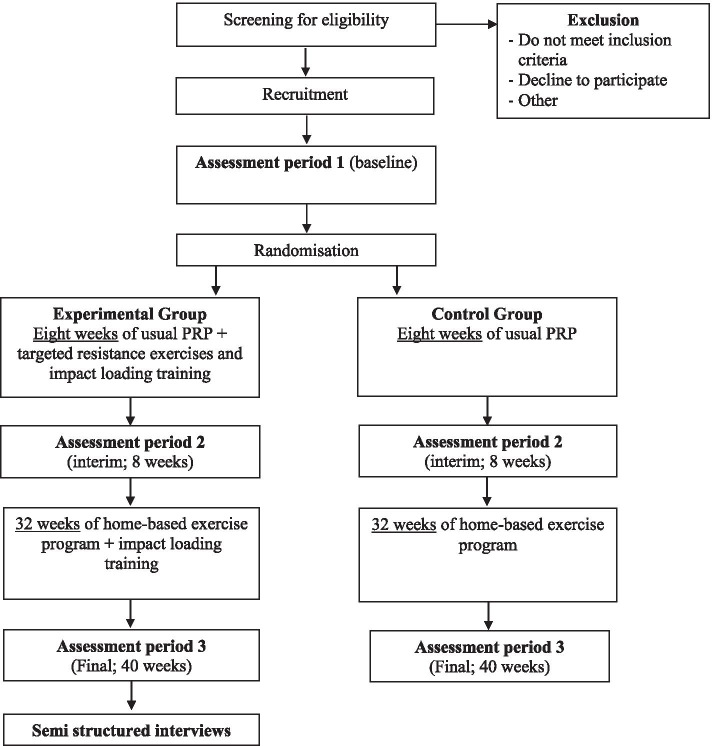
This is a protocol for a pilot feasibility and tolerance randomised controlled trial (RCT). Fifty-eight people with COPD will be randomly allocated, on a 1:1 ratio, to either the experimental or control group. Initially, participants in both groups will complete a standard 8-week (twice-weekly) PRP followed by a 32-week period of maintenance exercises. Over the initial 8-week period, participants allocated to the experimental group will also undertake targeted lower limb resistance exercises and commence a programme of impact loading exercises (e.g. bounding and drop jumps). On completion of the initial 8-week PRP, in addition to the standard maintenance exercises, participants in the experimental group will continue with home-based impact loading exercises, four times a week, for the extra 32 weeks. The primary outcome of this study is feasibility of and tolerance to impact loading exercises. Feasibility will be measured using data collected pertaining to recruitment, withdrawal and completion. Adherence to the exercises will be collected using exercise logs. Tolerance to the exercises will be determined using outcomes to assess pain, recording any adverse effects such as a fall and feedback from the participants in semi-structured interviews on completing of the trial. The effects of the 40-week experimental intervention on bone health, balance and falls risk will be reported.
This pilot RCT will test the feasibility and tolerance of an intervention that has never been trialed in people with COPD. It will also provide initial information regarding the size of the effect this intervention has on outcomes such as BMD, balance and falls risk. These data will be critical when designing a definitive RCT to advance this area of research.
Australian and New Zealand Clinical Trials Registry (ANZCTR): 12620001085965 (20/10/2020).
慢性阻塞性肺疾病(COPD)是一种与多种肺外表现(也称为可治疗特征)相关的疾病,包括低骨密度(BMD)。迄今为止,尚无针对该人群骨密度管理的具体指南。冲击负荷运动已被确定为一种可改善或维持其他人群骨密度的干预措施。然而,COPD患者对冲击负荷运动的可行性和耐受性尚未得到测试。拟议研究的目的是调查在COPD患者的标准肺康复计划(PRP)中增加冲击负荷运动的可行性和耐受性,并报告其对骨骼健康、平衡和跌倒风险的影响。
这是一项关于试点可行性和耐受性的随机对照试验(RCT)方案。58名COPD患者将按1:1的比例随机分配到实验组或对照组。最初,两组参与者都将完成为期8周(每周两次)的标准PRP,随后进行为期32周的维持运动。在最初的8周期间,分配到实验组的参与者还将进行有针对性的下肢阻力运动,并开始冲击负荷运动计划(如跳跃和跳下)。在完成最初8周的PRP后,除了标准的维持运动外,实验组的参与者将在额外的32周内继续每周进行4次的家庭冲击负荷运动。本研究的主要结果是冲击负荷运动的可行性和耐受性。可行性将通过收集与招募、退出和完成情况相关的数据来衡量。运动依从性将通过运动日志来收集。运动耐受性将通过评估疼痛的结果来确定,记录任何不良影响,如跌倒,以及参与者在试验结束时半结构化访谈中的反馈。将报告40周实验干预对骨骼健康、平衡和跌倒风险的影响。
这项试点RCT将测试一种从未在COPD患者中进行过试验的干预措施的可行性和耐受性。它还将提供有关该干预措施对骨密度、平衡和跌倒风险等结果影响大小的初步信息。在设计确定性RCT以推进该研究领域时,这些数据将至关重要。
澳大利亚和新西兰临床试验注册中心(ANZCTR):12620001085965(2020年10月20日)。