Emamat Hadi, Tangestani Hadith, Behrad Nasab Mojgan, Ghalandari Hamid, Hekmatdoost Azita
Student Research Committee, Department of Clinical Nutrition and Dietetics, Faculty of Nutrition Sciences and Food Technology, National Nutrition and Food Technology Research Institute, Shahid Beheshti University of Medical Sciences, Tehran, Iran.
Department of Nutrition, Faculty of Health and Nutrition, Bushehr University of Medical Sciences, Bushehr, Iran.
EXCLI J. 2021 Jun 14;20:1096-1105. doi: 10.17179/excli2021-3815. eCollection 2021.
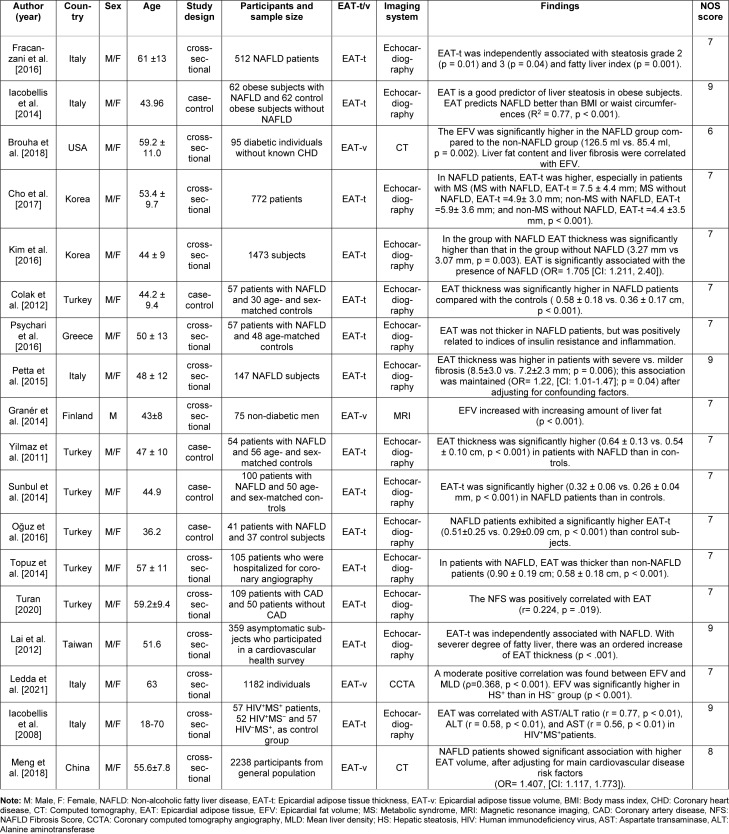
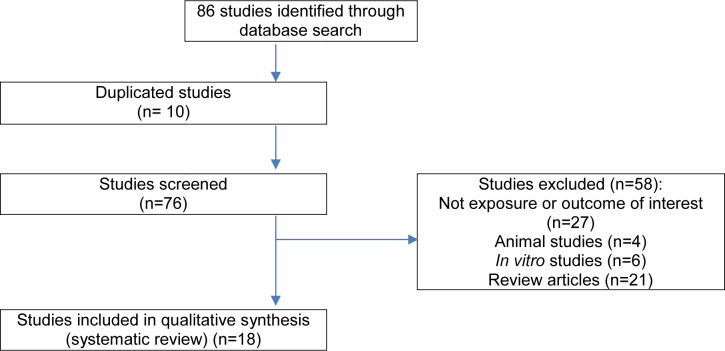
The prevalence of non-alcoholic fatty liver disease (NAFLD) has significantly risen all around the world. Although visceral fat mass has been identified as an independent risk factor for NAFLD, the association of other ectopic fat depots, such as Epicardial adipose tissue (EAT), with the disease has not been fully elucidated. The aim of the current study was to systematically review all available human studies conducted on the associations between EAT and NAFLD. All human studies published in English, which examined the association between the thickness or the volume of EAT and the incidence of NAFLD were systematically searched on PubMed, Scopus, and Google Scholar search engines, from inception up to April 2021. Eighteen studies that met inclusion criteria were included in the final review. A total of 86 studies were found through searching the databases. After excluding duplicates, seventy six remained studies were scanned by title and abstract, out of which, 58 were excluded. Finally, eighteen articles (thirteen cross-sectional studies and five case-control studies) published between 2008 and 2021, were included in the review. According to the results of the reviewed articles, EAT was associated with the presence and progression of NAFLD. Furthermore, NAFLD patients with thicker EAT may need a more intensive hepatic follow-up. However, we suggest further investigation to find out the underlying mechanisms describing the observed association.
非酒精性脂肪性肝病(NAFLD)在全球的患病率显著上升。尽管内脏脂肪量已被确定为NAFLD的独立危险因素,但其他异位脂肪沉积部位,如心外膜脂肪组织(EAT)与该疾病的关联尚未完全阐明。本研究的目的是系统评价所有关于EAT与NAFLD之间关联的现有人类研究。在PubMed、Scopus和谷歌学术搜索引擎上,系统检索了自数据库建立至2021年4月期间发表的所有英文人类研究,这些研究探讨了EAT厚度或体积与NAFLD发病率之间的关联。最终纳入综述的有18项符合纳入标准的研究。通过检索数据库共找到86项研究。排除重复项后,对76项剩余研究进行了标题和摘要筛选,其中58项被排除。最后,纳入了2008年至2021年期间发表的18篇文章(13项横断面研究和5项病例对照研究)进行综述。根据综述文章的结果,EAT与NAFLD的存在和进展相关。此外,EAT较厚的NAFLD患者可能需要更密切的肝脏随访。然而,我们建议进一步研究以找出描述所观察到关联的潜在机制。