Aithal Supritha, Karkou Vicky, Makris Stergios, Karaminis Themis, Powell Joanne
Research Centre for Arts and Wellbeing, School of Applied Health and Social Care, Edge Hill University, Ormskirk, United Kingdom.
Research Centre for Arts and Wellbeing, Department of Psychology, Edge Hill University, Ormskirk, United Kingdom.
Front Psychol. 2021 Jul 19;12:588418. doi: 10.3389/fpsyg.2021.588418. eCollection 2021.
Sustaining the wellbeing for children with an autism spectrum disorder (ASD) can be highly demanding. Dance Movement Psychotherapy (DMP), a form of psychotherapy with a non-verbal character, may present as a relevant intervention option for this group of children.
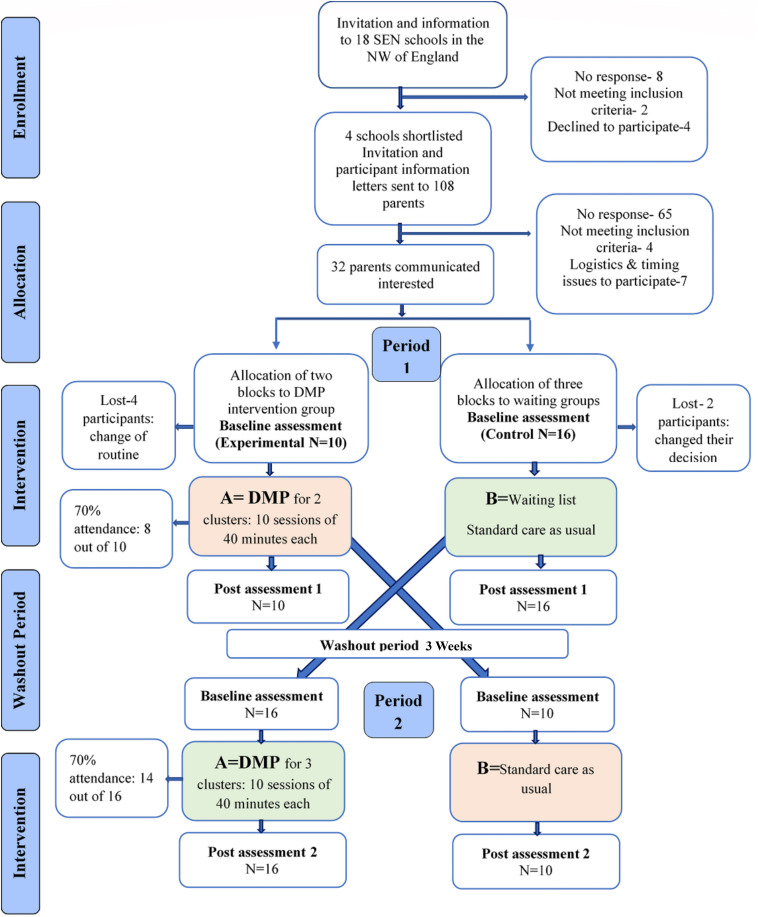
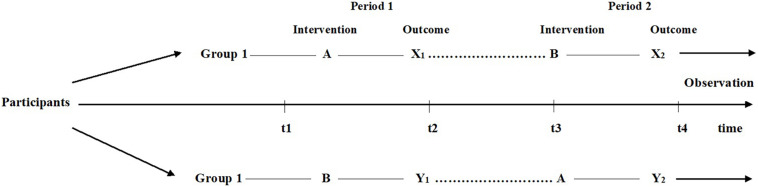
A protocol-based group DMP intervention was developed and implemented in two special educational needs schools in the North West of England. We aimed to investigate the effects of DMP on children with ASD using the Social Communication Questionnaire (SCQ) and Strengths and Difficulties Questionnaire (SDQ). Twenty-six children aged between 8 and 13 years (mean age = 10.65 years) with ASD were randomly allocated to DMP and a control group with standard care, following a crossover research design.
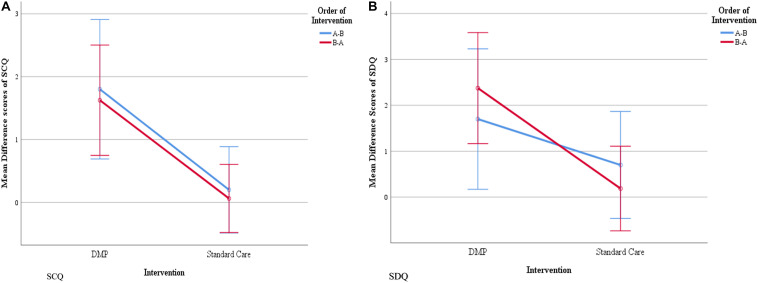
Results showed no significant carryover or period effects for either the SCQ or SDQ ( > 0.05). A significant intervention effect was found only for SCQ ( = 0.005) but not for SDQ ( > 0.05). ANCOVAs were performed on the data before the crossover to test for differences in SCQ and SDQ scores between the DMP intervention and control groups while controlling for pre-intervention scores. Those in the DMP intervention group presented significantly lower SCQ scores following the intervention period than those in the control group ( = 0.001). No significant differences in post-intervention SDQ scores were found between DMP intervention and control groups ( = 0.2). However, minimal clinically important differences (MCID) were reached for both SCQ and SDQ measures before crossover for those in the DMP intervention group. Moreover, repeated measures ANOVAs performed on SCQ and SDQ measures following crossover were significant, with the change in both SCQ ( = 0.001) and SDQ ( = 0.009) pre-and post-intervention being significantly greater for those in the DMP intervention than the control group.
The pilot DMP intervention has shown promising results on the social and emotional wellbeing of children with ASD irrespective of whether they preferred verbal or non-verbal mode of communication. Limitations and appropriateness of the research methods implemented in this study for their use in a large RCT are discussed in detail. Overall, our findings highlight the value of creative therapies for improving the lives of young vulnerable groups.
维持自闭症谱系障碍(ASD)儿童的幸福感可能极具挑战性。舞蹈动作心理治疗(DMP)是一种具有非语言性质的心理治疗形式,可能是这类儿童的一种相关干预选择。
在英格兰西北部的两所特殊教育需求学校开发并实施了基于方案的团体DMP干预。我们旨在使用社交沟通问卷(SCQ)和优势与困难问卷(SDQ)调查DMP对ASD儿童的影响。按照交叉研究设计,26名年龄在8至13岁(平均年龄 = 10.65岁)的ASD儿童被随机分配到DMP组和接受标准护理的对照组。
结果显示,SCQ或SDQ均无显著的遗留效应或阶段效应(P > 0.05)。仅在SCQ上发现了显著的干预效应(P = 0.005),而在SDQ上未发现(P > 0.05)。在交叉前对数据进行协方差分析,以检验在控制干预前分数的情况下,DMP干预组和对照组在SCQ和SDQ分数上的差异。DMP干预组在干预期后的SCQ分数显著低于对照组(P = 0.001)。DMP干预组和对照组在干预后SDQ分数上未发现显著差异(P = 0.2)。然而,DMP干预组的SCQ和SDQ测量在交叉前均达到了最小临床重要差异(MCID)。此外,交叉后对SCQ和SDQ测量进行的重复测量方差分析具有显著性,DMP干预组干预前后SCQ(P = 0.001)和SDQ(P = 0.009)的变化均显著大于对照组。
初步的DMP干预已在ASD儿童的社交和情感幸福感方面显示出有希望的结果,无论他们更喜欢语言还是非语言沟通方式。详细讨论了本研究中实施的研究方法在大型随机对照试验中的局限性和适用性。总体而言,我们的研究结果凸显了创造性疗法对改善年轻弱势群体生活的价值。