Wu Tian, Dai Wei, Ke Meilu, Huang Qing, Lu Li
Hubei Engineering Technology Research Center of Environmental Purification Materials, Hubei University of Education, Gaoxin Road 129, Wuhan, 430205, P. R. China.
Department of Mechanical Engineering, National University of Singapore, Singapore, 117575, Singapore.
Adv Sci (Weinh). 2021 Oct;8(19):e2100774. doi: 10.1002/advs.202100774. Epub 2021 Aug 5.
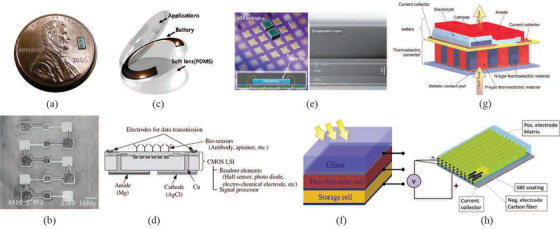
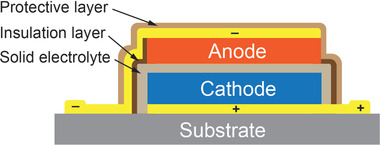
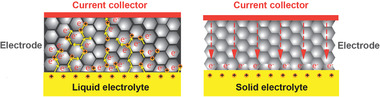
Continuous advances in microelectronics and micro/nanoelectromechanical systems enable the use of microsized energy storage devices, namely solid-state thin-film μ-batteries. Different from the current button batteries, the μ-battery can directly be integrated on microchips forming a very compact "system on chip" since no liquid electrolyte is used in the μ-battery. The all-solid-state battery (ASSB) that uses solid-state electrolyte has become a research trend because of its high safety and increased capacity. The solid-state thin-film μ-battery belongs to the family of ASSB but in a small format. However, a lot of scientific and technical issues and challenges are to be resolved before its real application, including the ionic conductivity of the solid-state electrolyte, the electrical conductivity of the electrode, integration technologies, electrochemical-induced strain, etc. To achieve this goal, understanding the processing of thin films and fundamentals of ion transfer in the solid-state electrolytes and hence in the μ-batteries becomes utmost important. This review therefore focuses on solid-state ionics and provides inside of ion transportation in the solid state and effects of chemistry on electrochemical behaviors and proposes key technology for processing of the μ-battery.
微电子学以及微/纳机电系统的不断进步使得微型储能设备即固态薄膜微电池得以应用。与目前的纽扣电池不同,微电池无需使用液体电解质,因此能够直接集成在微芯片上,形成非常紧凑的“片上系统”。使用固态电解质的全固态电池(ASSB)因其高安全性和更高的容量而成为研究趋势。固态薄膜微电池属于全固态电池家族,但尺寸较小。然而,在其实际应用之前,还有许多科学技术问题和挑战有待解决,包括固态电解质的离子电导率、电极的电导率、集成技术、电化学诱导应变等。为实现这一目标,了解薄膜的制备工艺以及固态电解质中离子转移的基本原理,进而了解微电池中的离子转移原理变得至关重要。因此,本综述聚焦于固态离子学,阐述了固态中的离子传输以及化学对电化学行为的影响,并提出了微电池制备的关键技术。