Department of Surgery, University Hospital of Regensburg, Regensburg, Germany.
Department of Medicine, Stanford University School of Medicine, Stanford, California.
Am J Kidney Dis. 2021 Dec;78(6):816-825. doi: 10.1053/j.ajkd.2020.11.032. Epub 2021 Aug 2.
RATIONALE & OBJECTIVE: Low muscle mass relative to fat mass (relative sarcopenia) has been associated with mortality and disability but has not been examined after kidney transplantation. We studied how measures of body composition change after receipt of a kidney allograft.
Prospective longitudinal cohort study.
SETTING & PARTICIPANTS: 60 kidney transplant recipients, aged 20-60 years, at the University of Pennsylvania.
Kidney transplantation.
Dual-energy x-ray absorptiometry measures of fat mass index (FMI) and appendicular lean mass index (ALMI, representing muscle mass), computed tomography measures of muscle density (low density represents increased intramuscular adipose tissue), dynamometer measures of leg muscle strength, and physical activity. ALMI relative to FMI (ALM) is an established index of relative sarcopenia.
Measures expressed as age, sex, and race-specific z scores for transplant recipients were compared with 327 healthy controls. Regression models were used to identify correlates of change in outcome z scores and compare transplant recipients with controls.
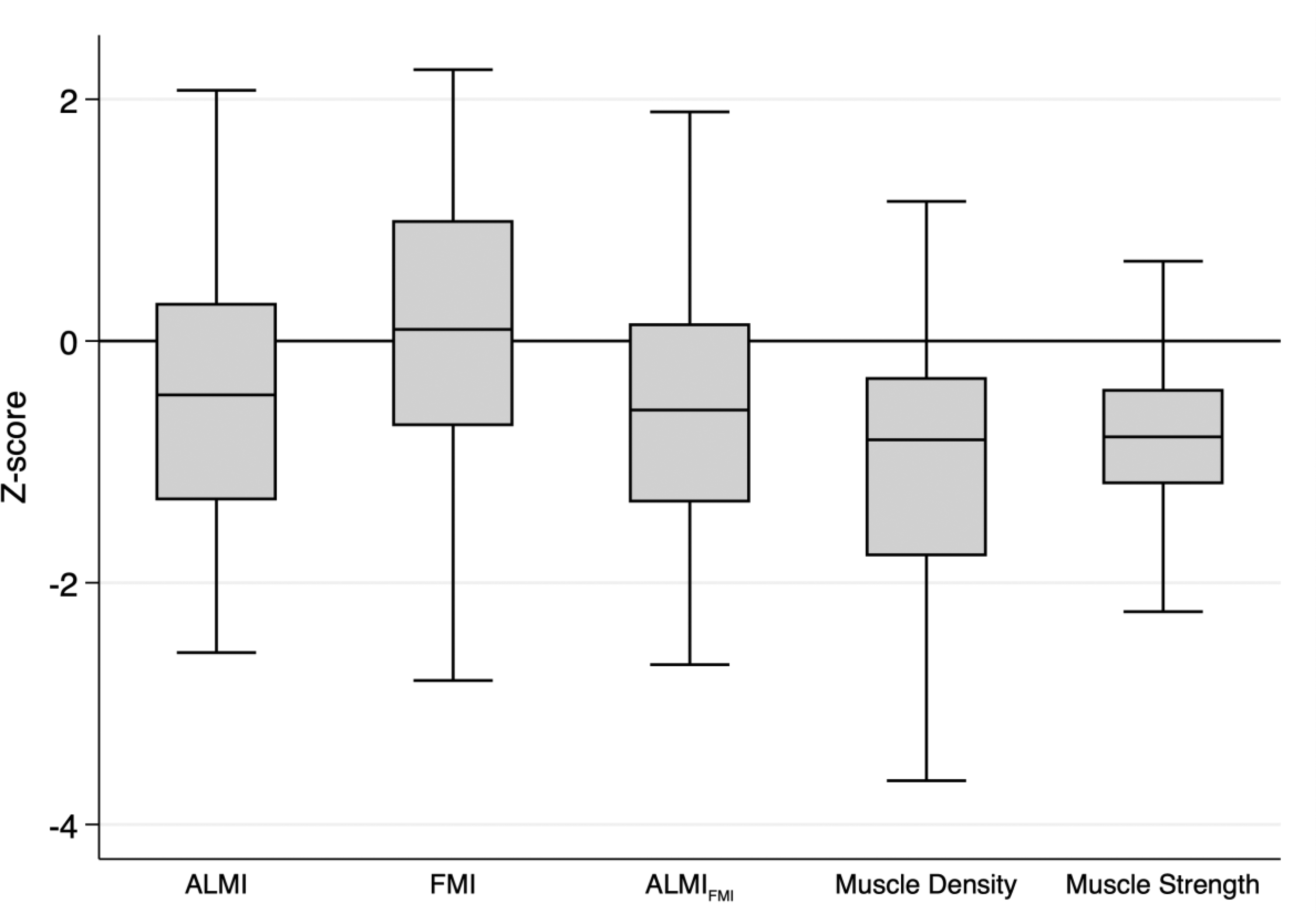
At transplantation, ALMI, ALMI, muscle strength, and muscle density z scores were lower versus controls (all P≤0.001). Transplant recipients received glucocorticoids throughout. The prevalence of obesity increased from 18% to 45%. Although ALMI increased after transplantation (P<0.001) and was comparable with the controls from 6 months onward, gains were outpaced by increases in FMI, resulting in persistent ALMI deficits (mean z score of-0.31 at 24 months; P=0.02 vs controls). Muscle density improved after transplantation despite gains in FMI (P=0.02). Muscle strength relative to ALMI also improved (P=0.04) but remained low compared with controls (P=0.01). Exercise increased in the early months after transplantation (P<0.05) but remained lower than controls (P = 0.02).
Lack of muscle biopsies precluded assessment of muscle histology and metabolism.
The 2-year interval after kidney transplantation was characterized by gains in muscle mass and strength that were outpaced by gains in fat mass, resulting in persistent relative sarcopenia.
相对于脂肪量而言的肌肉量较低(相对肌肉减少症)与死亡率和残疾有关,但在肾移植后尚未进行研究。我们研究了接受肾移植后身体成分的变化方式。
前瞻性纵向队列研究。
宾夕法尼亚大学的 60 名年龄在 20-60 岁的肾移植受者。
肾移植。
双能 X 射线吸收法测量的脂肪量指数(FMI)和四肢瘦质量指数(ALMI,代表肌肉量)、计算机断层扫描测量的肌肉密度(低密度表示肌肉内脂肪组织增加)、测力计测量的腿部肌肉力量和身体活动。ALMI 与 FMI(ALM)的比值是一种既定的相对肌肉减少症指数。
用与移植受者年龄、性别和种族特异性 z 评分相关的方式表示测量结果,并与 327 名健康对照者进行比较。采用回归模型确定结局 z 评分变化的相关因素,并比较移植受者与对照者。
在移植时,ALMI、ALMI、肌肉力量和肌肉密度 z 评分均低于对照组(均 P≤0.001)。移植受者全程接受糖皮质激素治疗。肥胖的患病率从 18%增加到 45%。尽管移植后 ALMI 增加(P<0.001),并且从 6 个月开始与对照组相当,但 FMI 的增加速度超过了 ALMI,导致持续的 ALMI 不足(24 个月时的平均 z 评分为-0.31;P=0.02 与对照组相比)。尽管 FMI 增加,但肌肉密度在移植后仍有所改善(P=0.02)。ALMI 相关的肌肉力量也有所改善(P=0.04),但仍低于对照组(P=0.01)。移植后早期运动量增加(P<0.05),但仍低于对照组(P=0.02)。
缺乏肌肉活检,无法评估肌肉组织学和代谢。
肾移植后 2 年的时间内,肌肉量和力量增加,但脂肪量增加速度更快,导致持续的相对肌肉减少症。