European School of Physiotherapy, Faculty of Health, Amsterdam University of Applied Sciences, Amsterdam, The Netherlands.
Faculty of Health, Center of Expertise Urban Vitality, Amsterdam University of Applied Sciences, Amsterdam, The Netherlands.
Crit Care. 2021 Aug 5;25(1):279. doi: 10.1186/s13054-021-03709-z.
Survivors of critical illness experience long-term functional challenges, which are complex, heterogeneous, and multifactorial in nature. Although the importance of rehabilitation interventions after intensive care unit (ICU) discharge is universally recognized, evidence on feasibility and effectiveness of home-based rehabilitation programs is scarce and ambiguous. This study investigates the feasibility of an interdisciplinary rehabilitation program designed for patients with Post-Intensive Care Syndrome (PICS) who are discharged home.
A mixed method, non-randomized, prospective pilot feasibility study was performed with a 6-month follow-up, comparing the intervention (REACH) with usual care. REACH was provided by trained professionals and included a patient-centered, interdisciplinary approach starting directly after hospital discharge. Primary outcomes were patient safety, satisfaction, adherence, referral need and health care usage. Secondary outcomes, measured at 3 timepoints, were functional exercise capacity, self-perceived health status, health-related quality of life (HRQoL), return to work and psychotrauma. Risk of undernutrition was assessed at baseline.
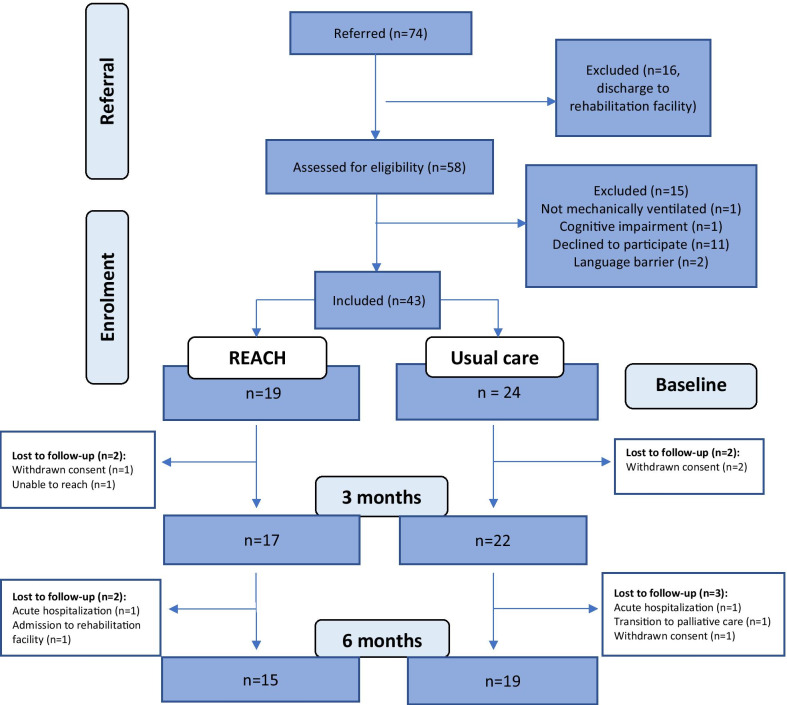
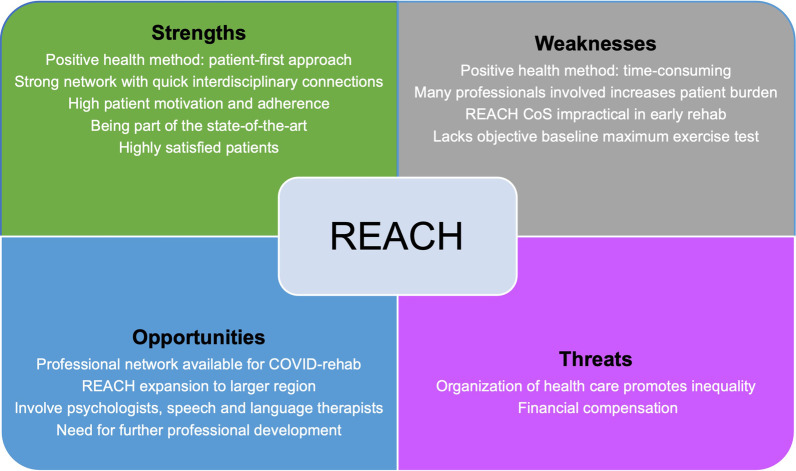
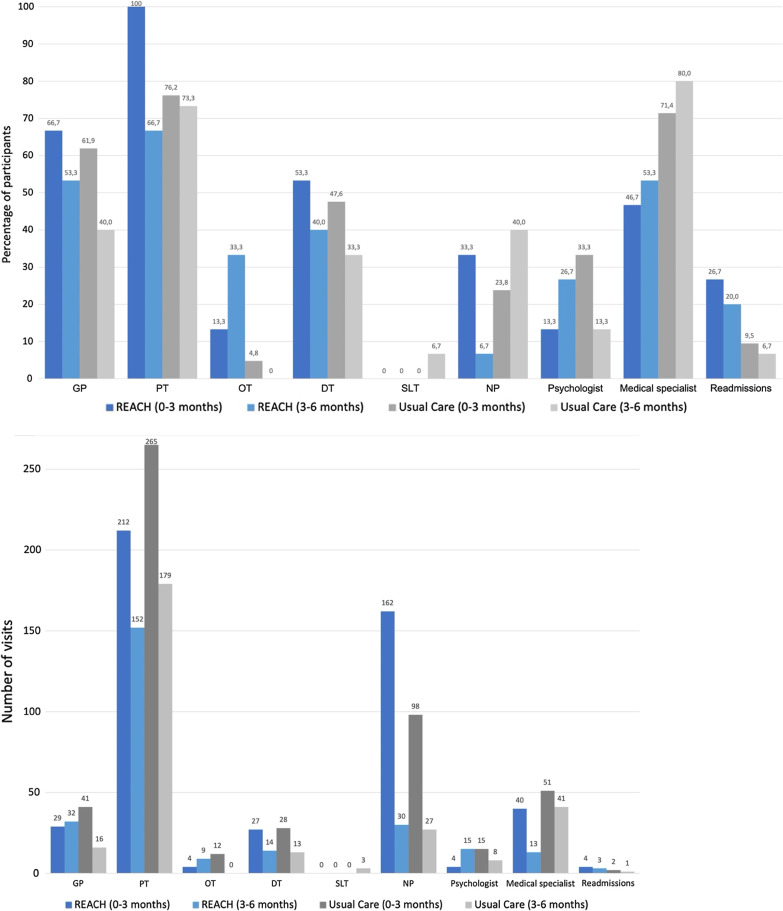
43 patients with a median mechanical ventilation duration of 8 (IQR:10) days, were included in the study and 79.1% completed 6-month follow-up. 19 patients received the intervention, 23 received usual care. Groups were similar for gender distribution and ICU length of stay. No adverse events occurred. REACH participants showed higher satisfaction with treatment and reported more allied health professional visits, while the usual care group reported more visits to medical specialists. Qualitative analysis identified positive experiences among REACH-professionals related to providing state-of-the-art interventions and sharing knowledge and expertise within an interprofessional network. Similar recovery was seen between groups on all secondary outcomes, but neither group reached reference values for HRQoL at 6 months. Larger return to work rates were seen in the REACH group. Prevalence of undernutrition at hospital discharge was high in both groups (> 80%), warranting the need for careful tuning of physical therapy and nutritional interventions.
This study shows that providing early, home-based rehabilitation interventions for patients with PICS-related symptoms is feasible and perceived positively by patients and professionals. When provided in an interdisciplinary collaborative network state of the art, person-centered interventions can be tailored to individual needs potentially increasing patient satisfaction, adherence, and efficacy. Registered in the Dutch Trial register: NL7792: https://www.trialregister.nl/trial/7792 , registered 7-06-2019.
危重病幸存者会经历长期的功能挑战,这些挑战具有复杂性、异质性和多因素的特点。尽管普遍认识到重症监护病房(ICU)出院后康复干预的重要性,但关于家庭为基础的康复方案的可行性和有效性的证据仍然稀缺和模糊。本研究旨在调查为患有 ICU 后综合征(PICS)并出院回家的患者设计的跨学科康复方案的可行性。
采用混合方法、非随机、前瞻性的初步可行性研究,进行了 6 个月的随访,将干预组(REACH)与常规护理进行比较。REACH 由经过培训的专业人员提供,包括以患者为中心的跨学科方法,从出院后直接开始。主要结局指标为患者安全性、满意度、依从性、转诊需求和医疗保健使用情况。次要结局指标在 3 个时间点进行测量,包括功能运动能力、自我感知健康状况、健康相关生活质量(HRQoL)、重返工作岗位和心理创伤。在基线时评估营养风险。
研究纳入了 43 名机械通气时间中位数为 8(IQR:10)天的患者,其中 79.1%完成了 6 个月的随访。19 名患者接受了干预,23 名患者接受了常规护理。两组在性别分布和 ICU 住院时间方面相似。未发生不良事件。REACH 组的患者对治疗的满意度更高,报告了更多的联合健康专业人员就诊,而常规护理组报告了更多的医疗专家就诊。定性分析表明,REACH 专业人员在提供最先进的干预措施以及在跨专业网络中分享知识和专业知识方面具有积极的经验。两组在所有次要结局上的恢复情况相似,但两组在 6 个月时均未达到 HRQoL 的参考值。REACH 组的重返工作岗位率较高。两组患者在出院时均存在较高的营养不良发生率(均超过 80%),需要仔细调整物理治疗和营养干预。
本研究表明,为患有 PICS 相关症状的患者提供早期的家庭为基础的康复干预是可行的,并且受到患者和专业人员的积极评价。当以跨学科协作网络的形式提供最先进的、以人为本的干预措施时,可以根据个体需求进行调整,从而潜在地提高患者满意度、依从性和疗效。在荷兰试验登记处注册:NL7792:https://www.trialregister.nl/trial/7792,注册日期为 2019 年 6 月 7 日。