Department of Biochemistry and Immunology, Instituto de Ciências Biológicas, Universidade Federal de Minas Gerais, Belo Horizonte, Brazil.
Department of Parasitology, Instituto de Ciências Biológicas, Universidade Federal de Minas Gerais, Belo Horizonte, Brazil.
Front Cell Infect Microbiol. 2021 Jul 20;11:706618. doi: 10.3389/fcimb.2021.706618. eCollection 2021.
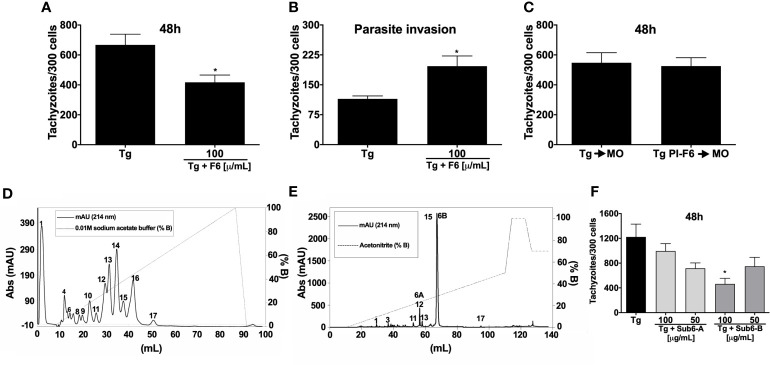
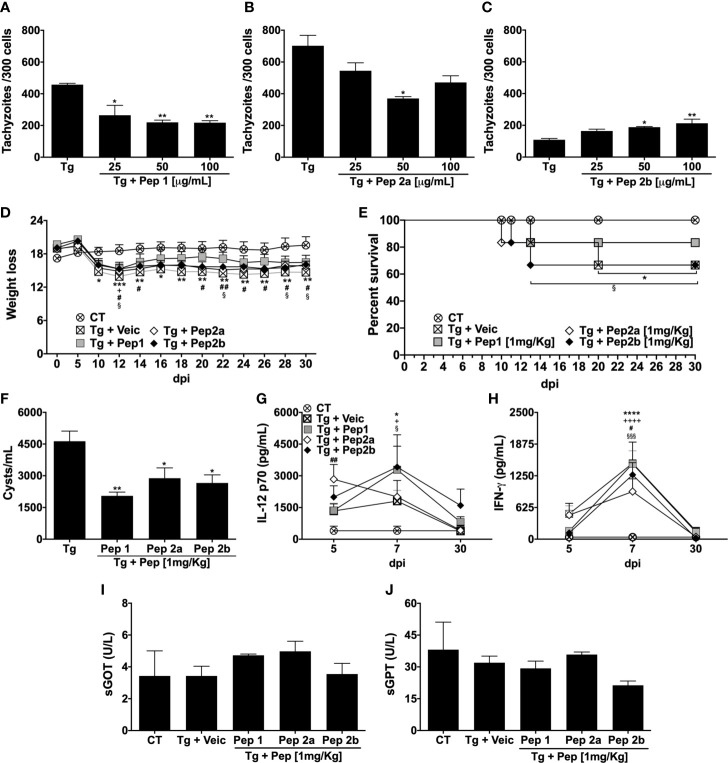
Toxoplasmosis, caused by , is a major public concern owing to its neurotropic nature and high morbidity and mortality rates in immunocompromised patients and newborns. Current treatment for this disease is inefficient and produces side effects. Inflammatory mediators produced during infection (e.g., cytokines and nitric oxide) are crucial in controlling parasite replication. In this context, venom (TsV) induces the production of inflammatory mediators by immune cells. Thus, this study aimed to isolate and identify the components of TsV with potential anti- activity. TsV was extracted from scorpions and lyophilized or loaded onto a column to obtain its fractions. TsV subfractions were obtained using chromatography, and its amino acid sequence was identified and applied to peptide design using bioinformatics tools. The C57BL/6 mice and their harvested macrophages were used to test the anti- activity of TsV components and peptides. TsV and its fraction F6 attenuated the replication of tachyzoites in macrophages and induced nitric oxide and cytokine (IL-12, TNF, and IL-6) production by infected cells, without host cell toxicity. Moreover, Su6-B toxin, a subfraction of F6, demonstrated anti- activity. The partially elucidated and characterized amino acid sequence of Sub6-B demonstrated 93% similarity with 2 toxin (Ts2). Ts2 mimetic peptides ("Pep1," "Pep2a," and "Pep2b") were designed and synthesized. Pep1 and Pep2a, but not Pep2b, reduced the replication of tachyzoites in macrophages. , treatment of -infected mice with Pep1, Pep2a, or Pep2b decreased the number of cerebral cysts and did not induce hepatotoxicity in the animals. Taken together, our data show promising immunomodulatory and antiparasitic activity of TsV that could be explored and applied in future therapies for treating infectious parasitic diseases such as toxoplasmosis.
刚地弓形虫感染所致弓形体病,因其嗜神经性和免疫抑制宿主及新生儿的高发病率和死亡率而引起广泛关注。目前对该病的治疗效果不佳,且具有副作用。在弓形虫感染过程中产生的炎症介质(如细胞因子和一氧化氮)对于控制寄生虫复制至关重要。在此背景下,蝎毒液(TsV)可诱导免疫细胞产生炎症介质。因此,本研究旨在分离和鉴定具有潜在抗弓形虫活性的 TsV 成分。从蝎子中提取 TsV 并冻干或加载到柱上以获得其馏分。使用色谱法获得 TsV 亚馏分,鉴定其氨基酸序列,并应用生物信息学工具进行肽设计。使用 C57BL/6 小鼠及其收获的巨噬细胞来测试 TsV 成分和肽的抗弓形虫活性。TsV 和其馏分 F6 可减弱巨噬细胞内速殖子的复制,并诱导感染细胞产生一氧化氮和细胞因子(IL-12、TNF 和 IL-6),而对宿主细胞没有毒性。此外,F6 的亚馏分 Su6-B 具有抗弓形虫活性。部分阐明和表征的 Su6-B 氨基酸序列与 2 毒素(Ts2)具有 93%的相似性。设计并合成了 Ts2 模拟肽(“Pep1”、“Pep2a”和“Pep2b”)。Pep1 和 Pep2a 但不是 Pep2b 可减少巨噬细胞内速殖子的复制。用 Pep1、Pep2a 或 Pep2b 治疗感染弓形虫的小鼠可减少脑囊数量,且不会引起动物肝毒性。综上所述,我们的数据显示 TsV 具有有希望的免疫调节和抗寄生虫活性,可在未来治疗弓形虫病等感染性寄生虫病的治疗中进行探索和应用。