Department of Anatomy, Southwest Medical University, Luzhou, People's Republic of China.
Department of Dermatology, Affiliated Hospital of Southwest Medical University, Luzhou, People's Republic of China.
Redox Rep. 2021 Dec;26(1):134-146. doi: 10.1080/13510002.2021.1962094.
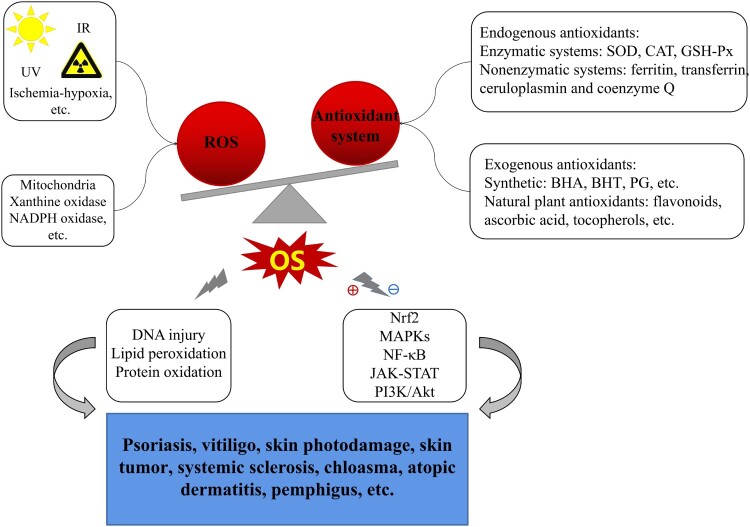
Skin, as a crucial external defense organ, is more vulnerable to oxidative stress (OS) insult, reactive oxygen species (ROS)-mediated OS in particular. OS results from a redox imbalance caused by various extrinsic stimuli and occurs once the oxidants production overwhelming the antioxidants capacity, through mediating in DNA damage, lipid peroxidation (LPO), protein oxidation and a serial of signaling pathways activation/inactivation, thereby offering favorable conditions for the occurrence and development of numerous diseases especially some dermatoses, e.g. psoriasis, vitiligo, skin photodamage, skin cancer, systemic sclerosis (SSc), chloasma, atopic dermatitis (AD), pemphigus, etc. Targeting OS molecular mechanism, a variety of anti-OS agents emerge, in which flavonoids, natural plant extracts, stand out.
To discuss the possible mechanisms of OS mediating in dermatoses and summarize the properties of flavonoids as well as their applications in OS-related skin disorders.
Published papers on flavonoids and OS-related skin diseases were collected and reviewed via database searching on PubMed, MEDLINE and Embase, etc.
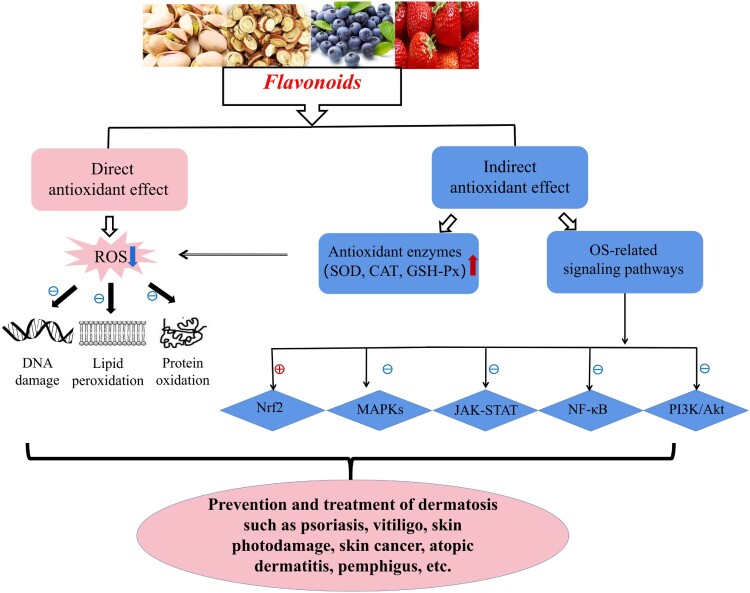
It has been confirmed that flavonoids, belonging to polyphenols, are a class of plant secondary metabolites widely distributed in various plants and possess diverse bioactivities especially their potent antioxidant capacity. Moreover, flavonoids benefit to suppress OS via eliminating free radicals and mediating the corresponding signals, further excellently working in the prevention and management of OS-related skin diseases.
Flavonoids have the potential therapeutic effects on oxidative stress-related dermatoses. However, more studies on specific mechanism as well as the dosage of flavonoids are needed in future.
皮肤作为重要的外部防御器官,更容易受到氧化应激(OS)的损伤,尤其是活性氧(ROS)介导的 OS。OS 是由各种外源性刺激引起的氧化还原失衡引起的,当氧化剂的产生超过抗氧化剂的能力时就会发生,通过介导 DNA 损伤、脂质过氧化(LPO)、蛋白质氧化和一系列信号通路的激活/失活,从而为许多疾病的发生和发展提供有利条件,特别是一些皮肤病,如银屑病、白癜风、皮肤光损伤、皮肤癌、系统性硬化症(SSc)、黄褐斑、特应性皮炎(AD)、天疱疮等。针对 OS 的分子机制,出现了各种抗氧化剂,其中黄酮类化合物、天然植物提取物尤为突出。
探讨 OS 介导皮肤病的可能机制,并总结黄酮类化合物的特性及其在 OS 相关皮肤疾病中的应用。
通过在 PubMed、MEDLINE 和 Embase 等数据库上搜索,收集并回顾了关于黄酮类化合物和 OS 相关皮肤疾病的已发表论文。
已经证实,黄酮类化合物属于多酚类,是一类广泛存在于各种植物中的植物次生代谢物,具有多种生物活性,特别是其强大的抗氧化能力。此外,黄酮类化合物通过清除自由基和介导相应信号来抑制 OS,从而有利于防治 OS 相关的皮肤疾病。
黄酮类化合物对氧化应激相关皮肤病具有潜在的治疗作用。然而,未来需要更多关于特定机制和黄酮类化合物剂量的研究。