College of Biotechnology, Guilin Medical University, Guilin, 541100, Guangxi, People's Republic of China.
BMC Pharmacol Toxicol. 2020 Jun 3;21(1):41. doi: 10.1186/s40360-020-00419-0.
Psoriasis is a chronic inflammatory skin disease affecting 2-3% of the population worldwide. Hyperproliferative keratinocytes were thought to be an amplifier of inflammatory response, thereby sustaining persistence of psoriasis lesions. Agents with the ability to inhibit keratinocyte proliferation or induce apoptosis are potentially useful for psoriasis treatment. 18β-Glycyrrhetinic acid (GA), an active metabolite of glycyrrhizin, exhibits diverse pharmacological activities, including anti-inflammatory, anti-bacteria and anti-proliferation. The current study aims to evaluate the effects of GA on the proliferation and apoptosis of human HaCaT keratinocytes in vitro and investigate the effects of GA on the skin lesions of imiquimod (IMQ)-induced psoriasis-like mouse model in vivo.
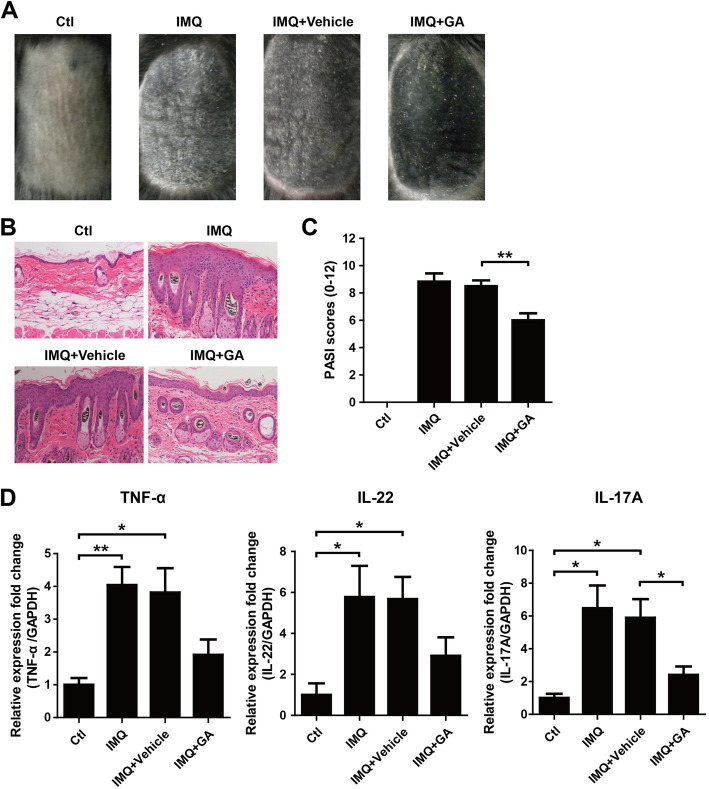
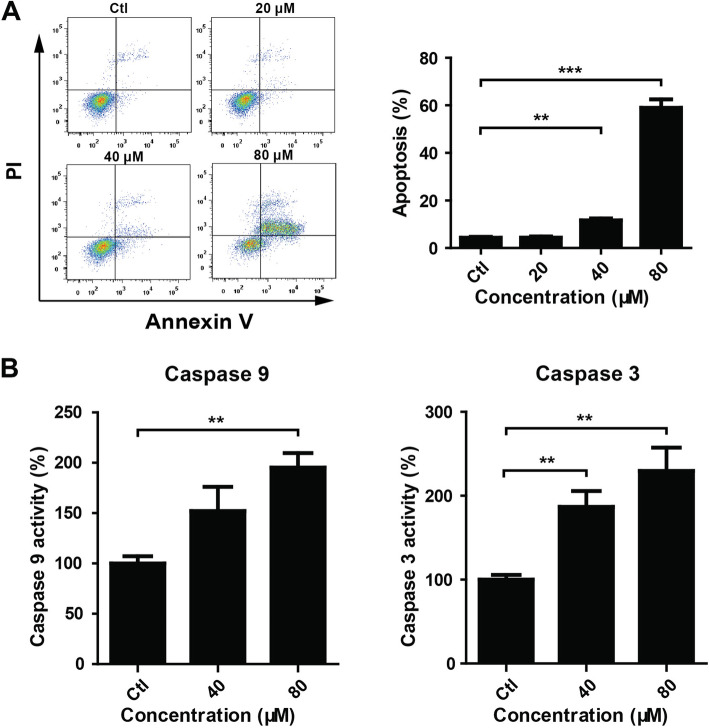
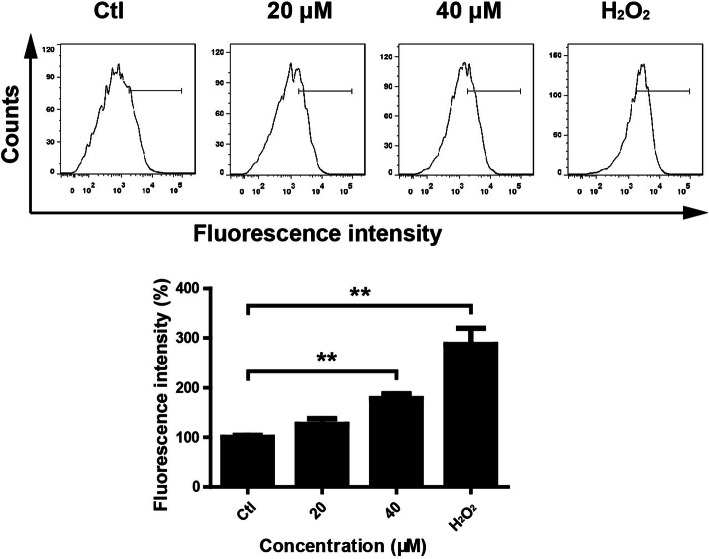
Cell viability was assayed by CCK-8. Flow cytometry was performed to measure apoptosis and reactive oxygen species (ROS), with Annexin V-FITC/PI detection kit and DCFH-DA probe respectively. Caspase 9/3 activities were measured using caspase activity assay kits. The protein levels of Akt and p-Akt were determined using Western blotting. IMQ was applied to induce psoriasis-like skin lesions in mice. The histological change in mouse skin lesions was detected using hematoxylin and eosin (H&E) staining. The severity of skin lesions was scored based on Psoriasis Area Severity Index (PASI). RT-PCR was employed to examine the relative expression of TNF-α, IL-22 and IL-17A in mouse skin lesions.
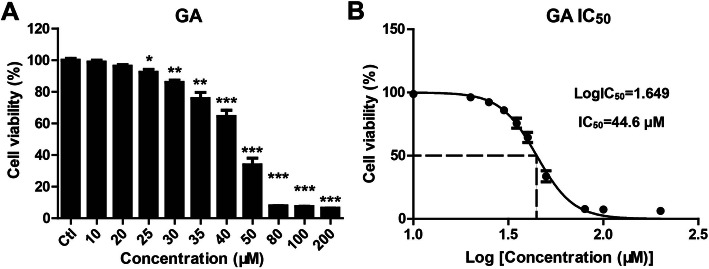
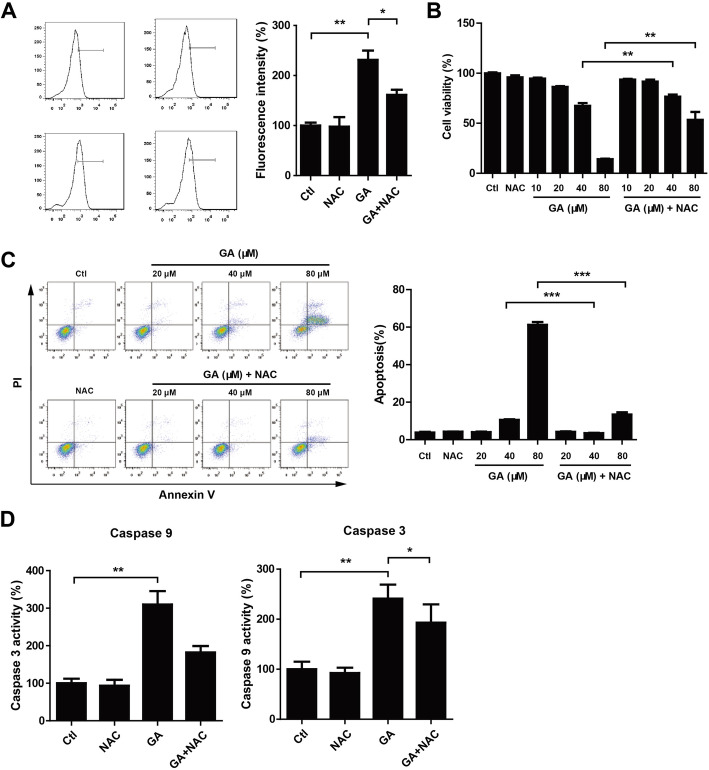
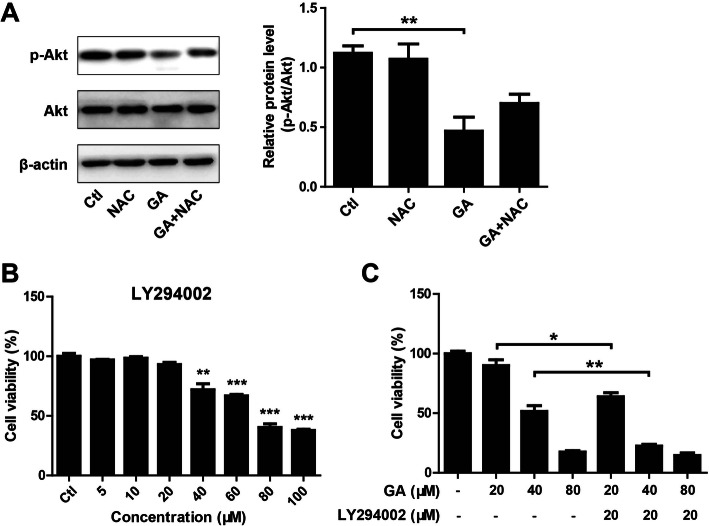
GA decreased HaCaT keratinocytes viability and induced cell apoptosis in a dose-dependent manner. In the presence of GA, intracellular ROS levels were significantly elevated. NAC, a ROS inhibitor, attenuated GA-mediated HaCaT keratinocytes growth inhibition and apoptosis. In addition, GA treatment remarkably decreased p-Akt protein level, which could be restored partially when cells were co-treated with GA and NAC. LY294002 (a PI3K inhibitor) treatment significantly enhanced GA-mediated cytotoxicity. Moreover, GA ameliorated IMQ-induced psoriasis-like skin lesions in mice.
GA inhibits proliferation and induces apoptosis in HaCaT keratinocytes through ROS-mediated inhibition of PI3K-Akt signaling pathway, and ameliorates IMQ-induced psoriasis-like skin lesions in mice.
银屑病是一种影响全球 2-3%人口的慢性炎症性皮肤病。过度增殖的角质形成细胞被认为是炎症反应的放大器,从而维持银屑病皮损的持续存在。具有抑制角质形成细胞增殖或诱导细胞凋亡能力的药物可能对银屑病的治疗有用。18β-甘草次酸(GA)是甘草酸的一种活性代谢物,具有多种药理活性,包括抗炎、抗菌和抗增殖作用。本研究旨在评估 GA 对体外人 HaCaT 角质形成细胞增殖和凋亡的影响,并研究 GA 对咪喹莫特(IMQ)诱导的银屑病样小鼠模型体内皮肤损伤的影响。
用 CCK-8 法测定细胞活力。用 Annexin V-FITC/PI 检测试剂盒和 DCFH-DA 探针分别通过流式细胞术检测细胞凋亡和活性氧(ROS)。用 caspase 活性测定试剂盒测定 caspase 9/3 的活性。用 Western blot 法测定 Akt 和 p-Akt 的蛋白水平。用 IMQ 诱导小鼠银屑病样皮肤损伤。用苏木精和伊红(H&E)染色检测小鼠皮肤损伤的组织学变化。根据银屑病面积严重程度指数(PASI)对皮肤损伤的严重程度进行评分。采用 RT-PCR 检测小鼠皮肤损伤中 TNF-α、IL-22 和 IL-17A 的相对表达。
GA 呈剂量依赖性降低 HaCaT 角质形成细胞活力并诱导细胞凋亡。在 GA 存在下,细胞内 ROS 水平显著升高。ROS 抑制剂 NAC 可减轻 GA 介导的 HaCaT 角质形成细胞生长抑制和凋亡。此外,GA 处理可显著降低 p-Akt 蛋白水平,当细胞与 GA 和 NAC 共同处理时,可部分恢复 p-Akt 蛋白水平。LY294002(PI3K 抑制剂)处理可显著增强 GA 介导的细胞毒性。此外,GA 可改善 IMQ 诱导的小鼠银屑病样皮肤损伤。
GA 通过 ROS 介导的 PI3K-Akt 信号通路抑制抑制 HaCaT 角质形成细胞增殖并诱导细胞凋亡,并改善 IMQ 诱导的小鼠银屑病样皮肤损伤。