Filev Anton D, Silachev Denis N, Ryzhkov Ivan A, Lapin Konstantin N, Babkina Anastasiya S, Grebenchikov Oleg A, Pisarev Vladimir M
Federal Research and Clinical Center of Intensive Care Medicine and Rehabilitology, V. A. Negovsky Research Institute of General Reanimatology, 107031 Moscow, Russia.
Research Centre for Medical Genetics (RCMG), 115478 Moscow, Russia.
Brain Sci. 2021 Jul 3;11(7):889. doi: 10.3390/brainsci11070889.
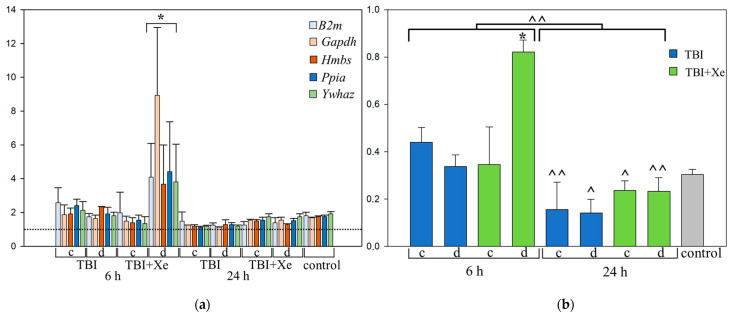
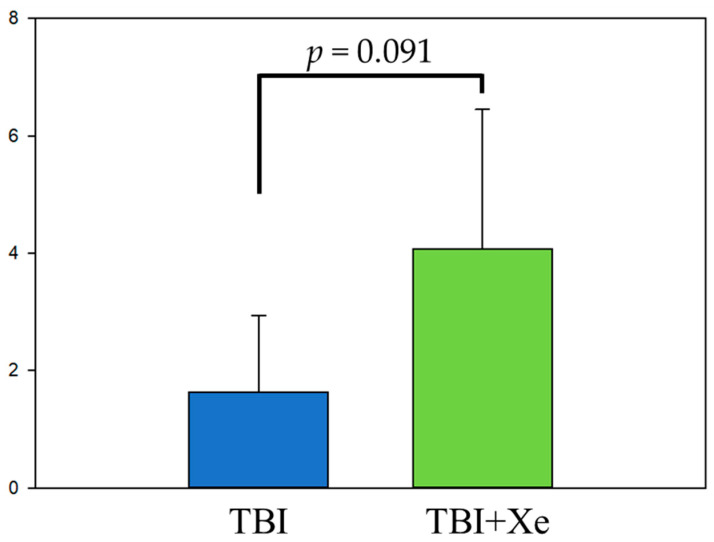
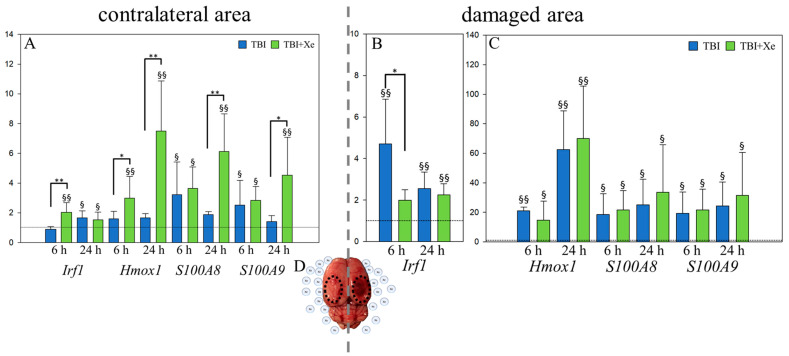
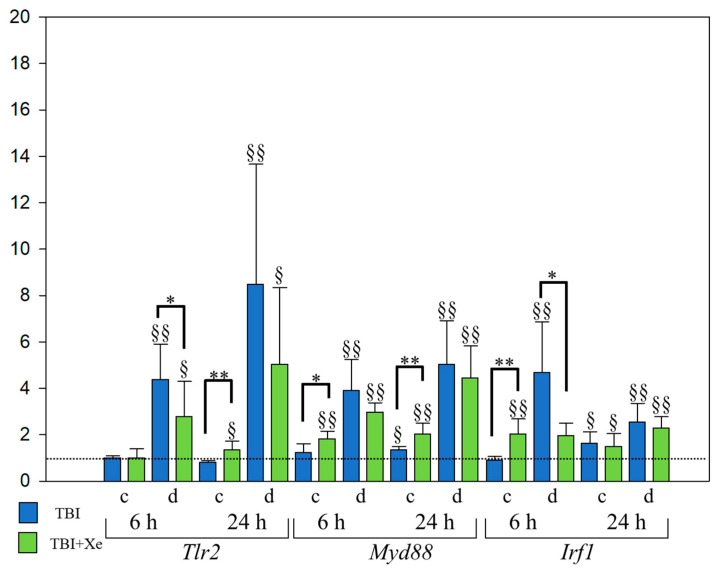
The overactivation of inflammatory pathways and/or a deficiency of neuroplasticity may result in the delayed recovery of neural function in traumatic brain injury (TBI). A promising approach to protecting the brain tissue in TBI is xenon (Xe) treatment. However, xenon's mechanisms of action remain poorly clarified. In this study, the early-onset expression of 91 target genes was investigated in the damaged and in the contralateral brain areas (sensorimotor cortex region) 6 and 24 h after injury in a TBI rat model. The expression of genes involved in inflammation, oxidation, antioxidation, neurogenesis and neuroplasticity, apoptosis, DNA repair, autophagy, and mitophagy was assessed. The animals inhaled a gas mixture containing xenon and oxygen (ϕXe = 70%; ϕO 25-30% 60 min) 15-30 min after TBI. The data showed that, in the contralateral area, xenon treatment induced the expression of stress genes (, , , and ). In the damaged area, a trend towards lower expression of the inflammatory gene was observed. Thus, our results suggest that xenon exerts a mild stressor effect in healthy brain tissue and has a tendency to decrease the inflammation following damage, which might contribute to reducing the damage and activating the early compensatory processes in the brain post-TBI.
炎症通路的过度激活和/或神经可塑性的缺乏可能导致创伤性脑损伤(TBI)后神经功能的延迟恢复。氙气(Xe)治疗是一种保护TBI脑组织的有前景的方法。然而,氙气的作用机制仍不清楚。在本研究中,在TBI大鼠模型损伤后6小时和24小时,研究了91个靶基因在受损脑区和对侧脑区(感觉运动皮层区域)的早期表达情况。评估了参与炎症、氧化、抗氧化、神经发生和神经可塑性、细胞凋亡、DNA修复、自噬和线粒体自噬的基因表达。动物在TBI后15 - 30分钟吸入含氙气和氧气的混合气体(ϕXe = 70%;ϕO₂ 25 - 30%,60分钟)。数据显示,在对侧区域,氙气治疗诱导了应激基因(、、和)的表达。在受损区域,观察到炎症基因表达有降低的趋势。因此,我们的结果表明,氙气在健康脑组织中发挥轻微的应激源作用,并且在损伤后有减轻炎症的趋势,这可能有助于减少损伤并激活TBI后脑的早期代偿过程。