Yu Qian, Cheval Boris, Becker Benjamin, Herold Fabian, Chan Chetwyn C H, Delevoye-Turrell Yvonne N, Guérin Ségolène M R, Loprinzi Paul, Mueller Notger, Zou Liye
Exercise Psychophysiology Laboratory, Institute of KEEP Collaborative Innovation, School of Psychology, Shenzhen University, Shenzhen 518060, China.
Swiss Center for Affective Sciences, University of Geneva, 1205 Geneva, Switzerland.
Brain Sci. 2021 Jul 19;11(7):951. doi: 10.3390/brainsci11070951.
Episodic memory (EM) is particularly sensitive to pathological conditions and aging. In a neurocognitive context, the paired-associate learning (PAL) paradigm, which requires participants to learn and recall associations between stimuli, has been used to measure EM. The present study aimed to explore whether functional near-infrared spectroscopy (NIRS) can be employed to determine cortical activity underlying encoding and retrieval. Moreover, we examined whether and how different aspects of task (i.e., novelty, difficulty) affects those cortical activities.
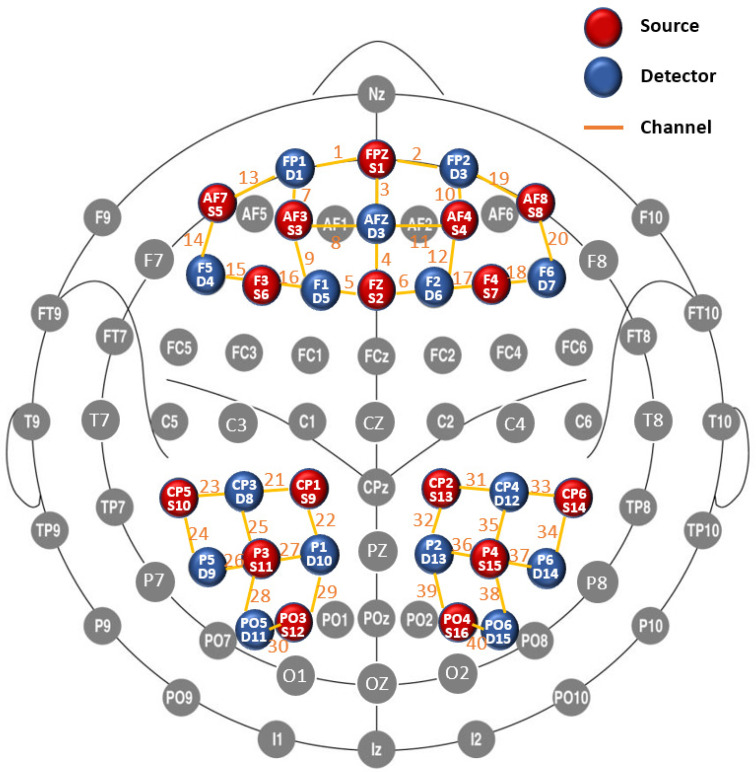
Twenty-two male college students (age: M = 20.55, SD = 1.62) underwent a face-name PAL paradigm under 40-channel NIRS covering fronto-parietal and middle occipital regions.
A decreased activity during encoding in a broad network encompassing the bilateral frontal cortex (Brodmann areas 9, 11, 45, and 46) was observed during the encoding, while an increased activity in the left orbitofrontal cortex (Brodmann area 11) was observed during the retrieval. Increased HbO concentration in the superior parietal cortices and decreased HbO concentration in the inferior parietal cortices were observed during encoding while dominant activation of left PFC was found during retrieval only. Higher task difficulty was associated with greater neural activity in the bilateral prefrontal cortex and higher task novelty was associated with greater activation in occipital regions.
Combining the PAL paradigm with NIRS provided the means to differentiate neural activity characterising encoding and retrieval. Therefore, the NIRS may have the potential to complete EM assessments in clinical settings.
情景记忆(EM)对病理状况和衰老尤为敏感。在神经认知背景下,配对联想学习(PAL)范式要求参与者学习并回忆刺激之间的关联,已被用于测量情景记忆。本研究旨在探讨功能近红外光谱(NIRS)是否可用于确定编码和检索过程中的皮层活动。此外,我们研究了任务的不同方面(即新颖性、难度)是否以及如何影响这些皮层活动。
22名男性大学生(年龄:M = 20.55,SD = 1.62)在覆盖额顶叶和枕叶中部区域的40通道近红外光谱仪下进行了面孔-名字配对联想学习范式实验。
在编码过程中,观察到包括双侧额叶皮层(布罗德曼区9、11、45和46)在内的广泛网络活动减少,而在检索过程中,观察到左侧眶额皮层(布罗德曼区11)活动增加。在编码过程中,观察到顶上叶皮层的血红蛋白氧(HbO)浓度增加,顶下叶皮层的HbO浓度降低,而仅在检索过程中发现左侧前额叶皮层的主要激活。更高的任务难度与双侧前额叶皮层更大的神经活动相关,更高的任务新颖性与枕叶区域更大的激活相关。
将PAL范式与NIRS相结合提供了区分编码和检索特征性神经活动的方法。因此,NIRS可能有潜力在临床环境中完成情景记忆评估。