Basit Farwa, Chen Min, Ahmed Temoor, Shahid Muhammad, Noman Muhammad, Liu Jiaxin, An Jianyu, Hashem Abeer, Fahad Al-Arjani Al-Bandari, Alqarawi Abdulaziz A, Alsayed Mashail Fahad S, Fathi Abd Allah Elsayed, Hu Jin, Guan Yajing
Institute of Crop Sciences, College of Agriculture and Biotechnology, Zhejiang University, Hangzhou 310058, China.
State Key Laboratory of Rice Biology, Institute of Biotechnology, Zhejiang University, Hangzhou 310058, China.
Antioxidants (Basel). 2021 Jul 7;10(7):1089. doi: 10.3390/antiox10071089.
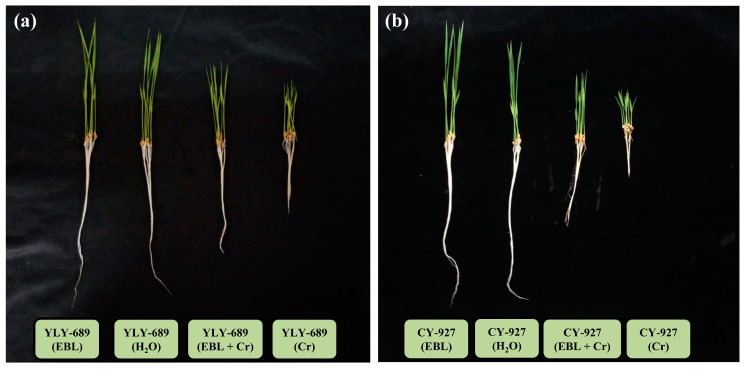
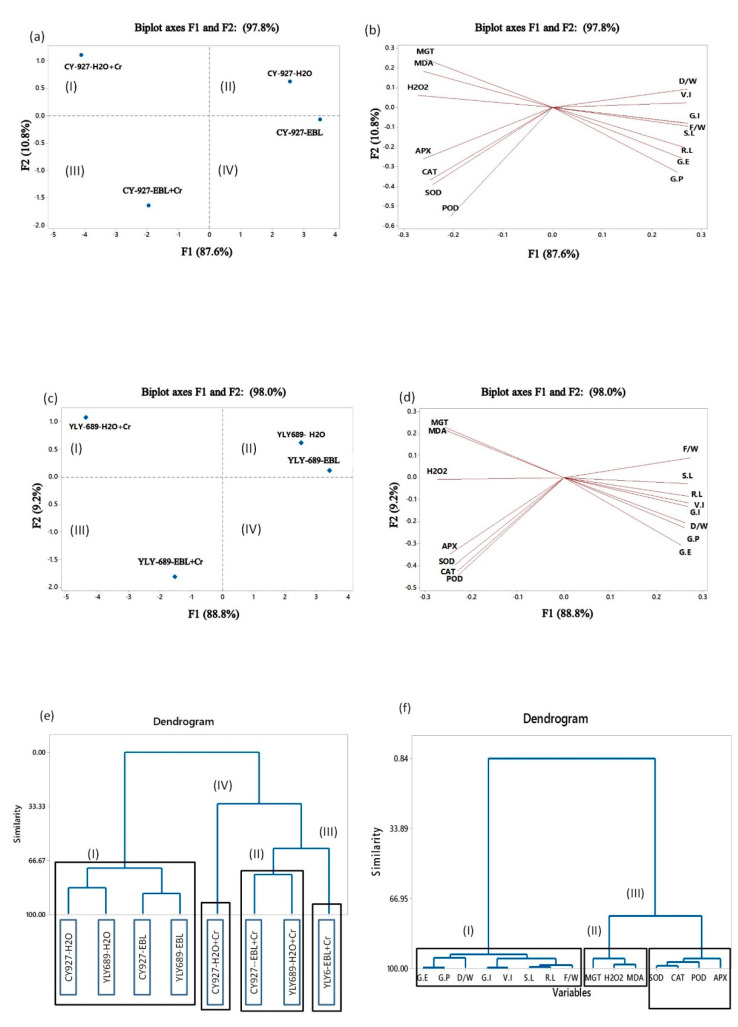
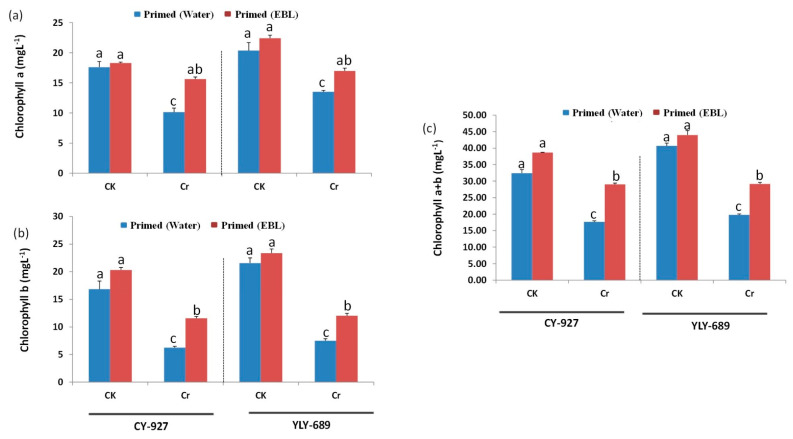
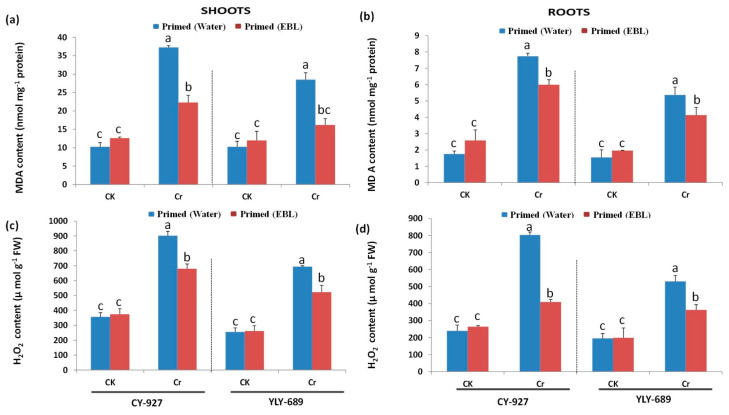
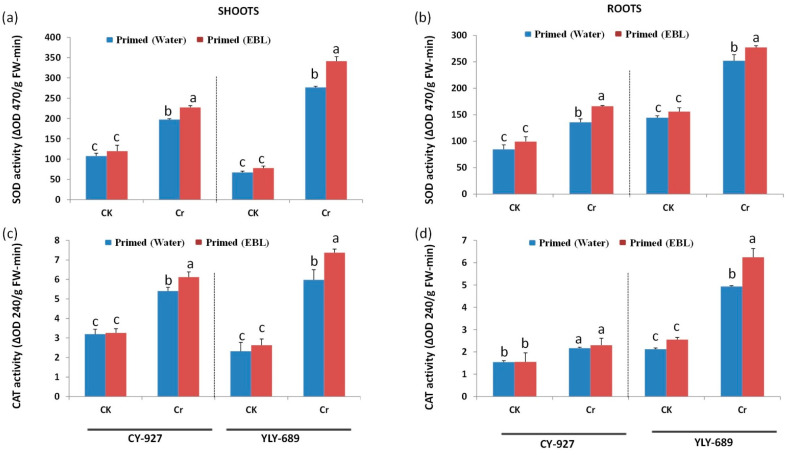
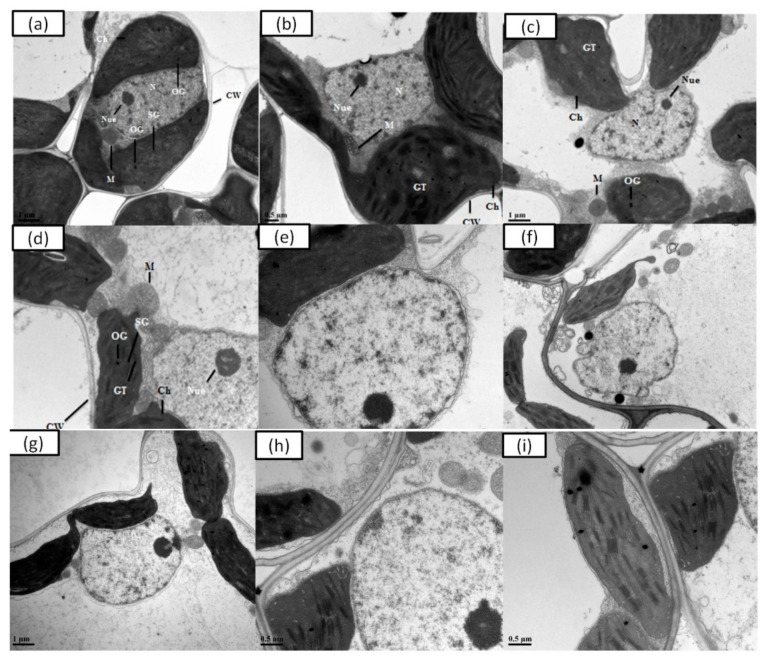
This research was performed to explore the vital role of seed priming with a 0.01 µM concentration of brassinosteroids (EBL) to alleviate the adverse effects of Cr (100 µM) in two different rice cultivars. Seed priming with EBL significantly enhanced the germination attributes (germination percentage, germination energy, germination index, and vigor index, etc.), photosynthetic rate as well as plant growth (shoot and root length including the fresh and dry weight) under Cr toxicity as compared to the plants primed with water. Cr toxicity induced antioxidant enzyme activities (SOD, POD, CAT, and APX) and ROS level (MDA and HO contents) in both rice cultivars; however, a larger increment was observed in YLY-689 (tolerant) than CY-927 (sensitive) cultivar. EBL application stimulatingly increased antioxidant enzyme activities to scavenge ROS production under Cr stress. The gene expression of SOD and POD in EBL-primed rice plants followed a similar increasing trend as observed in the case of enzymatic activities of SOD and POD compared to water-primed rice plants. Simultaneously, Cr uptake was observed to be significantly higher in the water-primed control compared to plants primed with EBL. Moreover, Cr uptake was significant in YLY-689 compared to CY-927. In ultra-structure studies, it was observed that EBL priming relieved the rice plants from sub-cellular damage. Conclusively, our research indicated that seed priming with EBL could be adopted as a promising strategy to enhance rice growth by copping the venomous effect of Cr.
本研究旨在探讨用0.01µM浓度的油菜素内酯(EBL)引发种子对缓解两种不同水稻品种中铬(100µM)的不利影响所起的重要作用。与用水引发种子的植株相比,用EBL引发种子显著提高了铬毒性条件下的发芽特性(发芽率、发芽势、发芽指数和活力指数等)、光合速率以及植株生长(地上部和根部长度,包括鲜重和干重)。铬毒性诱导了两个水稻品种的抗氧化酶活性(超氧化物歧化酶、过氧化物酶、过氧化氢酶和抗坏血酸过氧化物酶)和活性氧水平(丙二醛和过氧化氢含量);然而,在YLY - 689(耐性品种)中观察到的增幅大于CY - 927(敏感品种)。施用EBL刺激地增加了抗氧化酶活性以清除铬胁迫下的活性氧产生。与用水引发种子的水稻植株相比,EBL引发种子的水稻植株中超氧化物歧化酶和过氧化物酶的基因表达呈现出与超氧化物歧化酶和过氧化物酶酶活性类似的增加趋势。同时,观察到用水引发种子的对照植株中的铬吸收显著高于用EBL引发种子的植株。此外,YLY - 689中的铬吸收量高于CY - 927。在超微结构研究中,观察到EBL引发缓解了水稻植株的亚细胞损伤。总之,我们的研究表明,用EBL引发种子可作为一种有前景的策略,通过应对铬的毒害作用来促进水稻生长。